


The Upper Danube
Description
This section is from the book "The Upper Danube - John L. Stoddard's Lectures", by John L. Stoddard. Also available from Amazon: John L. Stoddard's Lectures 13 Volume Set.
The Upper Danube

The source of a great river, like the birthplace of a great man, is the threshold of a mystery. At each we ask ourselves the solemn questions: Whence and Whither? For what can we assert with confidence about the origin of either? And as for their conclusion, we know that sublimated water, lifted by the sun, falls on the hills again in rain, and once more flows from source to sea. But does the disembodied soul return in some new incarnation to its former habitat? How many anxious hearts await an answer to that question! Meanwhile we see that every life and river starts on its career in weakness. The helpless infant and the tiny stream are largely at the mercy of environment. A trifling obstacle determines their entire course. An inequality of station, physical or social, may decide their destiny. Brooks, that have almost mingled in their infancy, descend from the same watershed to oceans sundered by a continent; and lives, originating at a common hearthstone, may forever separate, - one reaching finally the heights of fame and happiness, the other sinking to the depths of ignominy and despair. In the magnificent section of Europe, known as the Black Forest, tall pines clothe leagues of mountain slopes with changeless green, and woo the winds to summon from their tree-tops, as from countless organ - pipes, majestic symphonies of sound. Within this shadowy realm is a small town called Donau- Eschingen. It is a station on the picturesque "Black Forest Railway," which travelers who are well informed choose for their route between the Rhine and Switzerland. Wonderfully interesting and attractive is a journey on that path of steel, which twists and turns in sweeping serpentines through Baden's leafy temples. But such is now the potency of Speed in influencing tourists that even those who travel here think more of reaching some great terminus than of inspecting anything along the way. A few, however, are wise enough to leave the train at Donau-Eschingen, in order to observe at leisure the cradle of the Danube. All rivers are well born, and take their rise upon the heights, but few have such an aristocratic birthplace as this stream which Germans call the Donau. Its source is in a palace garden, and is the property of the Prince of Fiirstenberg.

The Danube's early home in the black forest.

The Palace At Donau-Eschingen.
The sovereignty of this nobleman forms really an imperium in imperio, since his is one of those "mediatized" principalities of Germany, which still retain a nominal independence and a local government. Extraordinary also is the fact that, owing to the crowding of five different nationalities to gain a foothold on Lake Constance, the territory of this prince has been divided up among three separate Governments, - one part belonging to Baden, another to Wiirt-emberg, and a third to Prussia. Moreover, since he is a descendant of the Austrian branch of the family, and owns immense estates in Bohemia, this prince is, logically and actually, at the same time an hereditary member of four distinct parliaments, - those of Austria, Prussia, Wur-temberg, and Baden, and has a right to cast a vote in each of them. The future of this man will probably be a brilliant one. His progress will be well worth noting. A multi-millionaire, ardently patriotic, and a thorough sportsman, he is a very intimate friend of the German emperor, who, it is said, intends him for his future chancellor. Certain it is that he enjoys the confidence of William II. to a remarkable degree, and is well qualified to maintain the fine traditions of the Fur-stenbergs, who have for many generations been distinguished both as gallant soldiers and sagacious statesmen.

A Pond In The Palace Garden.
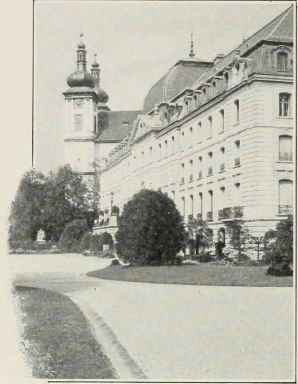
The path To The Danube's Source.
The cradle of the Danube, on the Furstenberg estate, is situated practically midway between church and palace - suggestive of the two great forces which have dominated Europe for so many centuries. There one beholds a handsome circular basin, eighty feet in circumference, partially filled with limpid water, bubbling up continually from the pavement of the curving reservoir. They err who think that Germans are devoid of sentiment. Beneath a Teuton's plain exterior lurks often genuine poetic feeling. A race so fond of music, natural scenery, and the fine arts could not be without it. Hence I was not surprised to find here an appropriate group of statuary, personifying charmingly the newborn stream. Still half supported by Germania, and seemingly reluctant to depart, the graceful Naiad of the river hesitates, despite her mother's gesture of farewell, and is unmindful that a tiny Triton at her feet blows merrily upon his horn, announcing that the time for starting has arrived. Holding with childish curiosity a shell, - fair emblem of the unknown ocean whither she must make her way, - she seems a perfect realization of the lines :
Continue to:


My Books

