


India II. Part 11
Description
This section is from the book "India - John L. Stoddard's Lectures", by John L. Stoddard. Also available from Amazon: John L. Stoddard's Lectures 13 Volume Set.
India II. Part 11

Old Moslem Tomb Near Delhi.
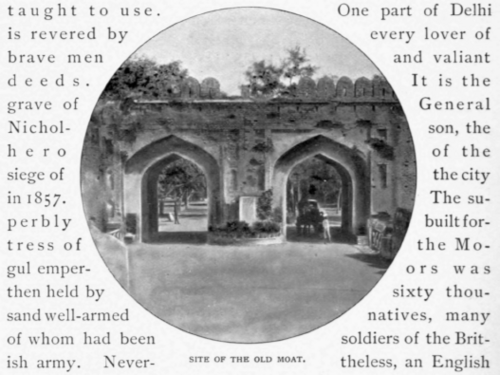

The Cashmere Gate, Delhi.

The Residency, Lucknow.

The Old Walls At Lucknow.
Passing beyond the Baillie gate, through which at last, after those awful months of siege, the rescuing army forced its way, we saw the room where the commander of that garrison, the lion-hearted Henry Lawrence, when mortally wounded by a shell, received the sacrament and breathed his last. He was almost the only man in India who had foreseen the coming storm in time to store up ammunition and prepare for war. As a rule, the mutiny took the British by surprise. So thoroughly had they relied upon their native regiments, that many British troops had been called home for the Crimean War. Only about twenty thousand English soldiers had been left in India, and these were scattered over an enormous territory, with scarcely any railroads to facilitate their concentration. One can but marvel, therefore, that any foreigners were left to tell the tale. But English steadfastness and valor proved too much for even those appalling odds, and India was saved to England by just such heroes as Sir Henry Lawrence, who, as his life blood ebbed away, whispered the words inscribed upon his tomb: "I have tried to do my duty. May the Lord have mercy on my soul."

Snake-Charmers.

The Baillie Gate, Lucknow.
When the remains of this noble patriot and Christian were laid to rest, the fighting was so severe that none of his officers dared to leave his post. But, one by one, the soldiers who bore him to the grave, ere they lowered him into the earth, lifted the sheet which covered the face of their beloved commander, and reverently kissed his brow.
Still bearing in mind those fearful days of '57, we journeyed from Lucknow to the town of Cawnpore. Tranquil enough it seems to-day, yet, forty years ago, there was enacted here one of the most awful tragedies ever recorded on the page of history. There was no fort in Cawnpore, and, accordingly, when the mutiny broke out, the old commander, Sir Hugh Wheeler, assembled all the European residents in an open field, and raised around them a low wall of earth. To defend this position he could only muster about four hundred English soldiers, more than seventy of whom were invalids. Opposed to them were three thousand Sepoys, armed with muskets and cannon. Moreover, into this unsheltered area the dreadful sun of India poured all day long its burning rays, almost as deadly in their effect as shot and shell. Making our way across this ground - mute witness of that physical and mental anguish, - we stood beside the solitary well upon which these poor refugees depended for their water. To get this precious liquid men had to go at night; for in the day, exposed to a sharp fire from the natives, to venture here meant certain death. The sight of it reminds one that two hundred English ladies, who had never known hardship or discomfort, together with many young and delicate children, were forced to lie, half mad with thirst, behind low earthworks, or else in holes dug in the ground, partially shaded from the deadly sun by garments stretched on the points of bayonets.

Room Where Sir Henry Lawrence Died.
After twenty-one days, when Sir Hugh Wheeler had himself fallen ill, and when the wretched garrison was desperate from sickness and starvation, they received a proposition from the native leader, Nana.
He solemnly swore by the sacred Ganges that if they would surrender and lay down their arms, he would conduct them safely to the river, half a mile away, and send them all in comfortable boats down to the British colony at Allahabad. It was decided to accept the offer.
Continue to:


My Books

