


India II. Part 6
Description
This section is from the book "India - John L. Stoddard's Lectures", by John L. Stoddard. Also available from Amazon: John L. Stoddard's Lectures 13 Volume Set.
India II. Part 6
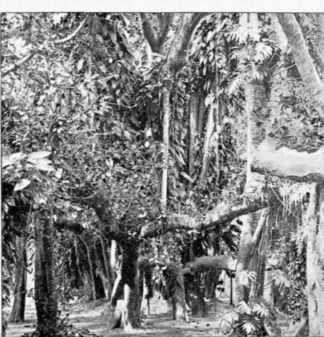
Under The Banyan Tree.
Three coolies, whose oily skin glistened in the sun, at length brought in a body on a bamboo litter. This they let fall upon the ground with the same care that an American "baggage-smasher" shows in handling a trunk. By walking ten feet farther, they could, at least, have laid it in the shade: instead of that they left it in the broiling sun. The superintendent asked some questions, and then informed us that the corpse was that of a man who had died half an hour before of rheumatism.
We did not have to wait long for the cremation. Without delay the coolies brought in ten or a dozen logs of wood about four feet in length, and threw them down close to the body. So roughly was this done that some of the sticks bounded six inches from the ground, and I fully expected to see them strike the corpse. Wood is the most expensive factor in this system of cremation. A funeral with the amount of kindling here described costs a dollar; children half-price. Yet even this is not the cheapest method. Sometimes less wood is used. In such cases the body is not entirely consumed, and the remnants must be buried. Formerly they were thrown into the river among the bathers, but this is now prohibited. The funeral-pyre, when constructed, formed a pile of logs, arranged in cross-tiers. On this the body was laid, its only covering being a bit of cotton. I could see plainly that the limbs were not yet rigid, nor had the eyes been closed. To make up for the shortness of the pyre the legs were bent back at the knees. Another layer of sticks was then placed upon the body to keep it in position. All was now ready for the burning. It is the Hindu custom for the nearest male relative to light the fire, and in this instance a son of the deceased, about sixteen years of age, took up some wisps of straw, and aided by his little brother six years old, walked around the pile of wood, lighting the kindling on every side. This was not done, however, with solemnity or the least emotion. The other relatives looked on as listlessly as if they were assisting at a bonfire, and called out to the son to light it better here or there. A priest was meanwhile mumbling over something like a prayer, but no one paid him the least attention, and two of the body-bearers laughed and talked so boisterously as to drown his voice. "Are the bodies of wealthy Hindus burned in this filthy area?" I inquired.

In The Burning Ghat.
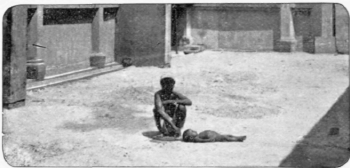
Waiting For Wood.
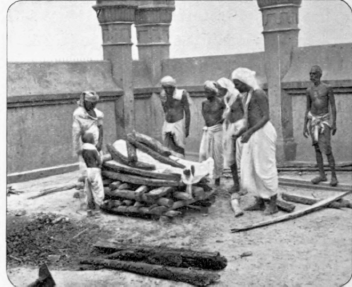
Ready To Light The Pyre.
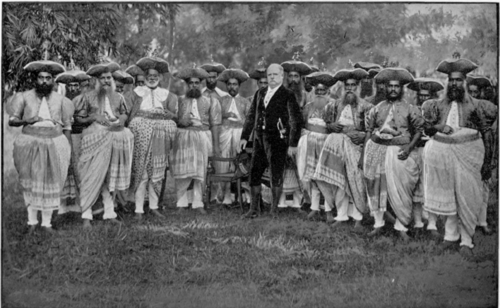
England And India.
Yes, was the reply: " but their pyres usually contain more or less san-dal-wood and spices, and large fees are then demanded by the assistants."
I have dwelt thus on the Hin-du system of cremation, not only because it made upon me a profound impression, but also from the fact that it is typical of what is going on all over India. Thousands are burned somewhere in these densely populated provinces every day, and nothing is more strikingly illustrative of Hindu customs. But, as performed here, cremation lacks all delicacy and solemnity, and the last crematory act that I beheld was as revolting as the first.
One of the most remarkable and interesting cities of India is Delhi. In point of age it challenges comparison with Benares. It antedates by many-centuries the Rome of Romulus. It is poetically called the "Rome of Asia." It has been seven times ruined and rebuilt. The desolate plain surrounding it resembles the Campagna. Throughout an area of twenty-four square miles are strewn the fragments of the city's former grandeur. Much of its past is too indefinite to appeal to us; but there is one magnificent epoch in its history, only three hundred years ago, which gives to it a fascination rarely equaled even in the Orient. For Delhi was the capital of India's Mohammedan conquerors, -the favorite home of those incomparably rich and lavish sovereigns, the Great Moguls.
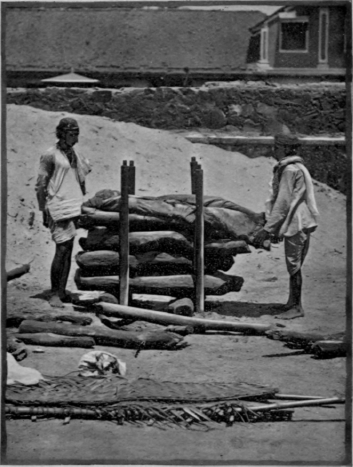
Arranging The Body.
Continue to:


My Books

