


India. Part 2
Description
This section is from the book "India - John L. Stoddard's Lectures", by John L. Stoddard. Also available from Amazon: John L. Stoddard's Lectures 13 Volume Set.
India. Part 2

" Only Man Is Vile."
Some hours later our steamer reached Colombo, the capital of Ceylon, and anchored in the bay. We were asleep. A sudden flash from the lighthouse on the granite breakwater, coming through the stateroom window, fell directly on my face. I started up as if it were a conflagration.
"What is it?" I cried out to my companion.
"Don't be alarmed," he answered; "it is the Light of Asia!"
As every traveler knows, when one arrives in port at night, sleep is no longer possible. Accordingly, at sunrise the next morning I was already on deck, eager to disembark.
Although anxious to explore Ceylon, I was sorry to leave, the steamer. The voyage from China hither had been the pleasantest I had ever known. During that time, as we subsequently learned, terrific storms had raged upon the North Atlantic, but the Indian Ocean had been as smooth as glass. Day after day, and evening after evening, we sat beneath awnings on the spacious deck reading and writing, or walking and conversing, or watching for new constellations in the southern sky. Though lightly clad we felt no chill.
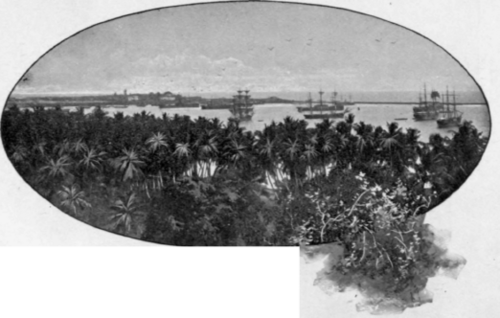
The Harbor Of Colombo.
The mercury never fell below 790. The soft caress of the breeze was perfectly delightful. It was one of those rare experiences in a life of travel which have almost made me love the sea.
Even before daybreak our steamer was surrounded by a multitude of little boats, tenanted by naked boys who sought to show their skill in diving. From time to time we threw into the water small silver coins, and laughed to see the urchins dive in hot pursuit, twenty or thirty vanishing together in one tremendous splash. It seemed impossible that so small an object could be found in such a crowd, but not one silver piece was ever lost or even reached the bottom of the sea. The lucky boy would hold it up in triumph as he climbed into his canoe.
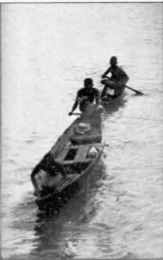
Divers.

On The Indian Ocean.
But presently other boats arrived to take us to the land. They were the strangest looking craft I ever saw; for though about twenty feet in length and narrow as a wherry, they rose at least two feet above the water. The bottom of each was merely the hollowed trunk of a tree, to which long planks were fastened to form the sides. They would capsize upon the slightest provocation, were it not for an outrigger of bamboo poles arching out to a log about eight feet away, which even in the roughest water will keep the slender boats from upsetting. In this respect they certainly are most ingenious, but the confusion and collisions occasioned by these outrig-gers in a crowd can easily be imagined.
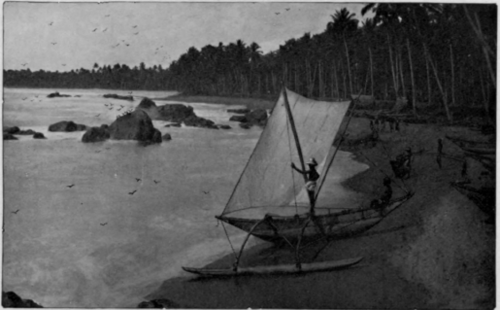
Ceylon Boats.
In one such boat, however, we risked our lives, and ten minutes later stepped upon the soil of Colombo. A few feet from the landing-pier stands the Grand Oriental Hotel. I recollect this now as an enormous gridiron, upon which I was broiled for several days. I have, however, no fault to find with it. The trouble was - not with the gridiron, but with the sun. A brief exposure to the solar rays, even when protected by a white umbrella, produced a curious feeling in my head and spine. This was the warmest place we found in all our travels, though residents assured us that the really hot weather had not yet set in. But even in December, in the dining - room, gigantic wooden fans, covered with muslin and hanging from the ceiling, were in constant motion. These fans, which are essential to the comfort of Europeans in India, are called punkahs, and the relays of perspiring coolies who pull them back and forth, day and night, bear the euphonious name of punkah wallahs, the pay of each of them being sixpence a day. Every one in Colombo seemed to be dressed in white, except the natives. They wore extremely little except black - in suits that never could be changed.
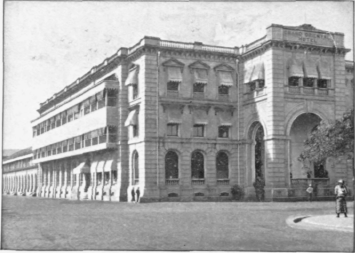
The Grand Oriental Hotel.
Dressed in our lightest clothes we presently started out to see Colombo. A singular means of transportation stood at the hotel steps. It was a springless, two - wheeled cart, drawn by a bullock. Yet this was a regularly licensed vehicle of the town, with lamps which must be lighted when the sun goes down, like those of our city cabs. The driver was a Hindu, whose only dress consisted of a handkerchief about his waist and a table-cloth around his head. I shall never forget that ride, for the bullock-cart was so extremely short that, when once in it, I found myself only two feet away from the bullock and six-and-a-half inches from the man. Accordingly, I had an admirable opportunity to study the persuasive powers of the driver, whose only modes of making the poor beast advance were those of uttering incessant cries resembling the creaking of a rusty hinge, and of continually twisting its tail, long since grown hairless under his manipulations. I soon discovered also that, after the fashion of the country, the Hindu had besmeared himself from head to foot with cocoa-nut-oil to make his skin insensible to draughts. Hence, as one of the breezes of Ceylon was blowing at the time, that was the "spiciest" drive I ever took.
Continue to:


My Books

