


Ireland. Part 11
Description
This section is from the book "Ireland - John L. Stoddard's Lectures", by John L. Stoddard. Also available from Amazon: John L. Stoddard's Lectures 13 Volume Set.
Ireland. Part 11
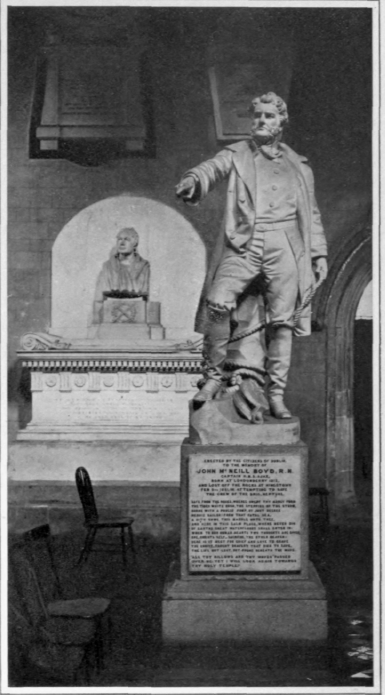
Curran's Bust And The Boyd Monument.
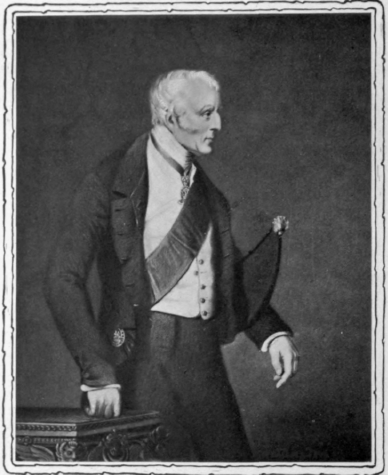
The Duke Of Wellington.
Curran, the brilliant wit; Robert Emmet, the "Irish Darling"; Richard Brinsley Sheridan, the author of the "Rivals" and the " School for Scandal"; Dion Boucicault, actor and playwright; Michael Balfe, the composer of the "Bohemian Girl"; Lady Blessington, whose salon was a memorable centre of literary and artistic life; Mrs. Jameson, the art-critic; and Mrs. Hemans, the author (among many other beautiful productions) of the poem dear to every American heart, beginning with the lines:
"The breaking waves dashed high On a stern and rock-bound coast."
Wherever the buildings associated with these distinguished personages were still in existence, I gladly went to see them; yet in some cases I almost regretted having done so. Moore's birthplace, for example, is at present a saloon of doubtful respectability, where I was greatly annoyed by a drunken brawler. O'Connell's residence is still a fine, aristocratic mansion, and the house of Sheridan's nativity is a neat, though humble, dwelling; but the birthplace of Wellington is exceedingly shabby, the house where Mrs. Hemans died is dilapidated, and the former home of Mrs. Jameson is positively disreputable. After all, the birthplace of a celebrated person, though always interesting, never appeals to me so forcibly as some locality associated with his active life, or even with his death. We often find the spot of his nativity greatly changed; transformed, perhaps, into a huge commercial edifice, or possibly deteriorated into a wretched tenement. We may, indeed, discover equally striking contrasts, on visiting scenes connected with his later life; but here at least it is no longer of the undeveloped child that we are reminded, but of the man, whose genius has distinguished him from millions of his fellows in noble deeds, wise statesmanship, or contributions to the literature of his race. In a man's birthplace we think chiefly of his family; but in his study, or beside his grave, we think of him alone. Thus, I would rather look upon the "Way-side " or the "Old Manse" at Concord, where Hawthorne wove his subtle fancies into faultless prose, than on the modest house in Salem where he first saw the light; and Dickens' home at Gad's Hill and his grave in Westminster Abbey touch my heart more than could ever do the room where he was born. It is the difference between seeing, on the Clyde, the empty cradle of a war-ship, and looking on the spot where, after desperate fighting to defend the country from invasion, that same war vessel sent her powerful antagonist to an ocean sepulchre, wrapt in a winding-sheet of flame.

Birthplace Of Thomas Moore.

Sir Walter Raleigh's Irish Home, Youghal.

Statue Of Lord Adilaun.
One of the most attractive features of Dublin is St. Stephen's Green - a charming public garden, which the philanthropist, Sir Arthur Guinness, better known in Dublin as Lord Adilaun, presented to the city at a cost of one hundred thousand dollars, having first tastefully embellished it with shade-trees, flower-beds, miniature lakes and fountains. Some of the houses fronting on this square are rich in literary memories. In number nine, for example, lived Sir Walter Scott, during his visit in Dublin, when, as Lockhart tells us, " If he entered a street, the watchword was passed down both sides like lightning, and the shopkeepers and their wives stood bowing and courtesying all the way down; while the mob and boys huzzaed, as at the chariot-wheels of a conqueror." Num- ber sixteen was the residence of Archbishop Whately; and, at one time, the poetess, Mrs. Hemans, lived in number thirty-six, to which she had removed, as she explains, "for the sake of having back rooms, as I suffered greatly from the noise where I lived before." It was her memory that I especially recalled, whenever I sat or walked in the pretty enclosure of St. Stephen's Green, for her poetry is the first of which I have any recollection. One of the earliest reminiscences of my childhood is that of my mother singing or repeating to me, over and over again (for I never tired of hearing it), a poem by this gifted Irish lady, descriptive of a crusader who had been captured by the enemy and imprisoned in a solitary castle. One day the prisoner sees his former comrades on the plain below, passing his tower on their homeward march from Palestine. They are ignorant of the fact that he is a captive there, and by a cruel irony of Fate the strains of their triumphant music drown his cries for help. I am not sure how young I was when this was sung to me, but the mental picture that I formed of it is just as vivid to me now as that of any scene I ever looked upon; and many a time, when I have gazed upon some ruined castle, especially in the Tyrol or along the Danube, I have recalled with deep emotion the stirring lines:
Continue to:


My Books

