


Ireland. Part 28
Description
This section is from the book "Ireland - John L. Stoddard's Lectures", by John L. Stoddard. Also available from Amazon: John L. Stoddard's Lectures 13 Volume Set.
Ireland. Part 28
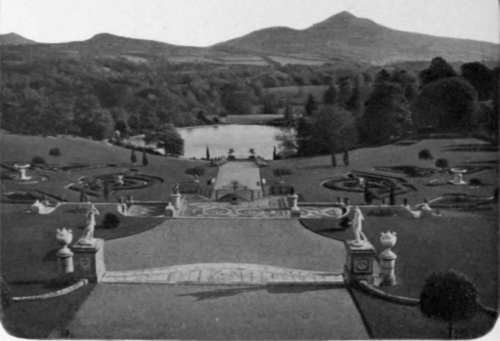
View From The Powerscourt Gardens.
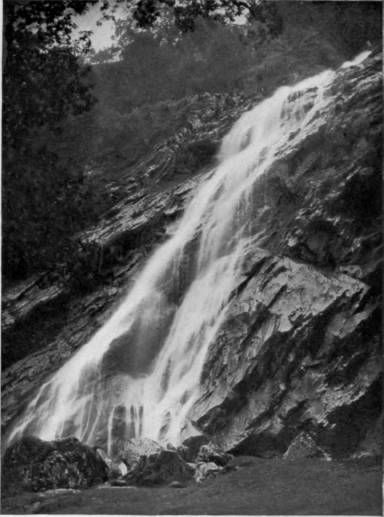
The Powerscourt Waterfall.
"The devil seems to own a good deal of property around here."
"Yes, sor," replied the guide; "but he's an absentee landlord, and lives in England." The wit of the Irish is thoroughly delightful, especially when it takes the form of repartee, in which they are unrivaled.
" Where are you going, Pat?" asked a priest, who saw one of his parishioners stepping into a train. " To the races, yer riverince," was the reply. "You are going to hell then," said the priest. "Faith, it's no matter," rejoined Pat; "I've a return ticket."
And who can forget poor Sheridan's response to the doctor when the latter told him that he seemed to be coughing with greater difficulty?
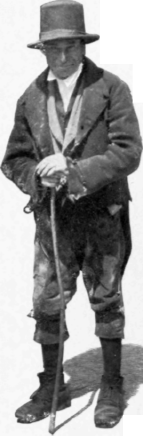
Wit In Rags.
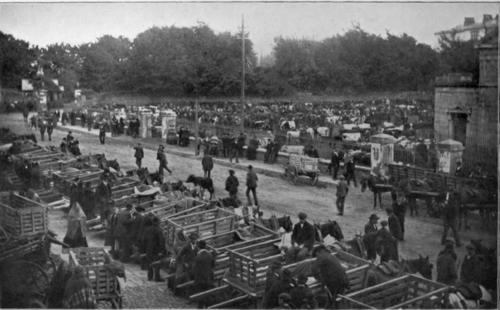
An Irish Cattle Market.
"That's odd," whispered the dying man, "for I've been practicing all night."
Late in the afternoon of a day spent on the hills and in the vales of County Wicklow, I came upon the pretty village of Glendalough, where I proposed to pass the night. As I drew near to it, I thought of all that its musical name had stood for in the history of Ireland. As early as the sixth century it was well known as a place of Christian culture, where the Irish monk, Saint Kevin, had founded the first of the seven churches which subsequently flourished here. Those churches now are only a collection of gray ruins; but one of the finest of the famous Round Towers of Ireland still dominates the peaceful valley, and is almost as perfect at the present time as when constructed a thousand years ago. I had not thus far seen an Irish Round Tower, and had been slightly apprehensive, as I drove along, lest my anticipations of these structures should not be fulfilled. But even from a distance, when I first discerned its slender, tapering form, I knew that all the praise these buildings had received was fully justified. What interesting relics of the past they are! For years they have furnished an attractive theme for speculation and romance. Some have attributed their origin to adventurous Vikings; others have seriously tried to prove that they were built by wanderers from the Orient; while others still have regarded them as penitential residences of ascetic monks. At present, however, antiquarians practically agree in thinking that these singular edifices, which are always found in close proximity to churches, were designed as places of refuge for ecclesiastics, whenever the surrounding territory was exposed to the ravages of invading Norsemen. Up to the year 800, Irish monasteries and churches needed almost no defense, so easy and effectual had been the conversion of the pagan Celts.
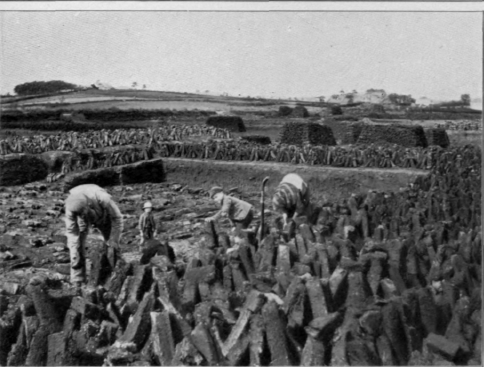
Cutt1ng Peat.
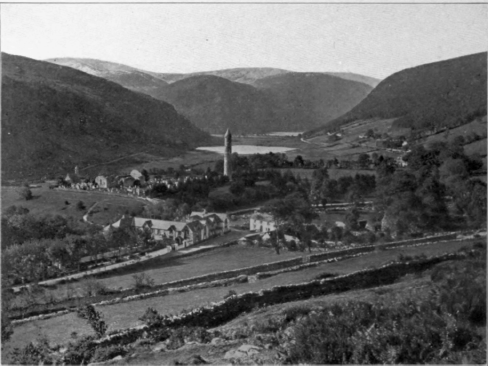
Glendalough.
But with the dawn of the ninth century began those terrible invasions of the Danes, which rendered absolutely necessary some places of retreat and shelter both for the monks and for the treasures they possessed in sacred vestments, altar-ornaments, and manuscripts. To this necessity the Round Towers owed their origin. They certainly were well adapted for defense. The tower at Glendalough, for example, is one hundred and ten feet high and fifty-two feet in circumference, with walls about four feet in thickness. Built of massive stones, hammer-dressed to the curve, the attacks of nature and of man have slipped off from its rounded sides, and failed to make the least impression on its sturdy strength. In fact, so well has it resisted all the ravages of time and the still worse assaults of bigoted iconoclasts, that nothing but a portion of its conical roof has had to be repaired. The interior staircase, it is true, is gone; but that was only recently removed by the town authorities, after the recklessness of visitors had occasioned several accidents. Everything shows the care employed to insure the safety of the contents of these towers. Their entrances are usually twelve or fourteen feet above the ground, and must have been reached by ladders, which were drawn up after the last refugee had clambered in. The windows of the different stories, too, were so constructed as to give the slightest possible chance of ingress to the missiles of assailants. That these old towers were in that age almost indestructible, is proved by their remarkable preservation; for among eighty which have outlived nearly a millennium of history, twenty are substantially intact. That they were also campaniles for the neighboring churches is considered certain; and no doubt from these detached belfries the alarm was often sounded, when from the upper windows, which commanded distant views on sea and land, the dreaded Danes were seen approaching. To one who has traveled in Moslem lands there is in these, tall towers a suggestion of the minaret; and although close inspection renders the differences between the styles of architecture more apparent, I found great pleasure in comparing them. Thus, from the gallery of the minaret it is the human voice that summons worshipers to prayer; but from the Irish tower the appeal was made in the soft tones of a melodious bell. The Moslem shaft is graceful, and often richly ornamented with stone-carving. The Christian monument is usually devoid of decoration, save where the clinging ivy thrusts its tiny fingers into crevices, and climbs aloft to mantle it with green. The minaret (frequently made of snow-white marble) looks like a beautiful wax taper rising from an altar. The heavier Celtic column suggests a taper turned to stone.
Continue to:


My Books

