


Around Lake Garda. Part 2
Description
This section is from the book "Lake Garda - John L. Stoddard's Lectures", by John L. Stoddard. Also available from Amazon: John L. Stoddard's Lectures 13 Volume Set.
Around Lake Garda. Part 2

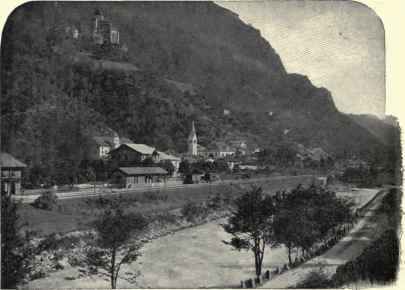
Old Convent Near Klausen, On The Brenner.
Wa1dbruck, On The Brenner.
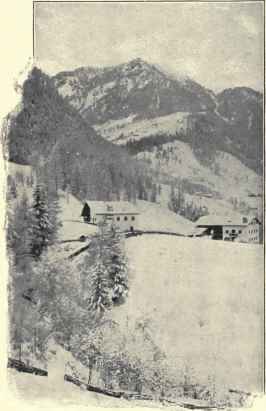
" Silver Powdered Forests And Pyramids Of Prisms".
But even if the tourist cannot drive leisurely along this famous route, should he elect to make the trip in sections, leaving the train occasionally, to resume his journey at a later hour or on the following day, he will discover scores of interesting objects to reward his efforts; while almost every station is a starting-point for an excursion up a lateral valley. I, have in my library a German book of nearly two hundred and fifty pages, in fine print, exclusively devoted to a critical study of "Art along the Brenner"; so rich in architecture, painting, woodcarving, and historic value are many of the monasteries, castles, churches, cemeteries, old inns, houses, gates, and towers existing in the towns between the Tyrolese capital and Botzen! The latter city itself might well detain one for some time, if he would study its old streets and buildings, and appreciate their history. For Botzen (the Pons Drusi of the Romans) has played a prominent part in the development of southern Europe. Bordering the shortest highway between Germany and Italy, it has seen millions of the human family enter and leave its gates; from fierce barbarians, swooping vulture-like on Italy, to emperors, kings, popes, bishops, princes, soldiers, and crusaders, coming and going, in wars, embassies, and pilgrimages without number.
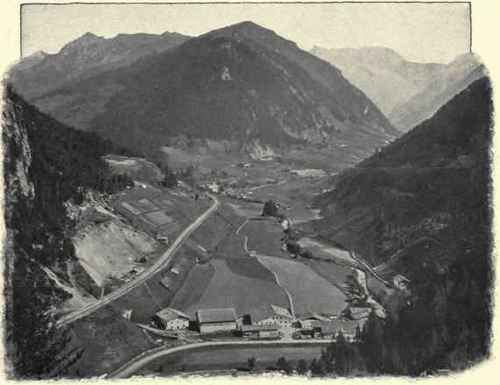
Ra1lway And Carriage Road Along The Brenner.
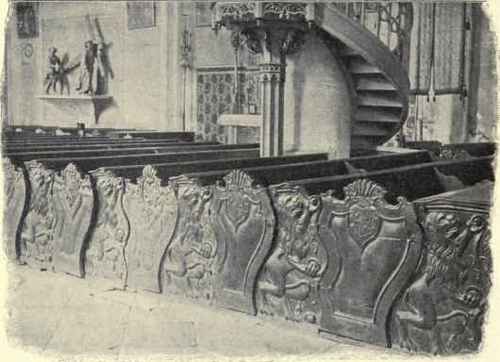
Woodcarv1ng In The Church At Sterzing, On The Brenner.
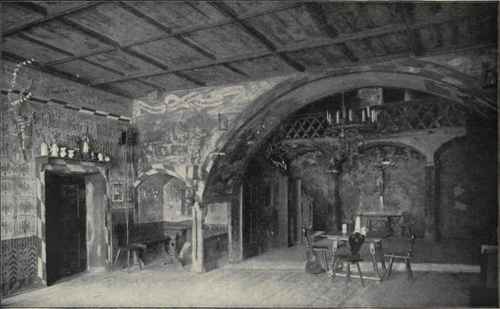
A Fifteenth-Century Dining Hall At Klausen, Brenner.
Geographically, Botzen may be called the heart of the Tyrol. At all events, on arriving there the tourist finds himself at a remarkably central starting-point for driving to many of the most important scenic and historic features of the land. And, parenthetically, let me add, that while deciding in what order these attractive places should be visited, one can be lodged in this small Tyrolese city in a new hotel, which, in its sumptuously appointed restaurant and reading room, its rich mahogany woodwork, its bedroom furniture of the same costly material, its beautiful, artistic, stained glass - a product of Tyrolean industry - together with the handsome tiling extending through the corridors, staircases, and bathrooms, is not surpassed in any city in America. In fact, for tastefulness and elegance, I have rarely seen its equal in any portion of the world.
It is at Botzen that the route begins which leads one to such points of interest as Meran, the Vintschgau valley, the home of Andreas Hofer in Passeier Thal, and the highest carriage road in Europe - the majestic Stelvio. Moreover, in the opposite direction, rises that marvelous portion of the Alpine world known as the Dolomites, some of whose colored summits are distinctly visible from Botzen's streets, and to the very centre of whose splendor one can drive thence in five hours. A little to the southwest, also, is the celebrated Mendel Pass, which can be quickly reached, either by a newly opened electric road or a superbly constructed driveway, leading to the lovely region of Madonna di Campiglio bordering Italy. Furthermore, many interesting castles are within easy access of this city, and not far distant, toward the south, lies exquisite Lake Garda, in whose sapphire depths the Tyrolese mountains sink to rest. Amid so much to choose from, it is difficult to decide here whither to travel first; but we may well select Lake Garda as offering variety between the Ortler mountains, which we have already visited, and the fantastic Dolomites, which we are yet to see. Our route to it lies down the natural prolongation of the Brenner Pass - a broad and fruitful valley, which, after leaving Botzen, rapidly descends between two parallel mountain ranges to the Lombard plain. The river Eisack still accompanies us, but it no longer has an individual existence, having at Botzen given up its name. For there the united Etsch and Passer, rolling swiftly down from their respective valleys, which meet each other at Meran, join forces with the wild child of the Brenner, their triune volume being thenceforth known as the Adige.
Continue to:


My Books

