


Japan. Part 16
Description
This section is from the book "Japan - John L. Stoddard's Lectures", by John L. Stoddard. Also available from Amazon: John L. Stoddard's Lectures 13 Volume Set.
Japan. Part 16
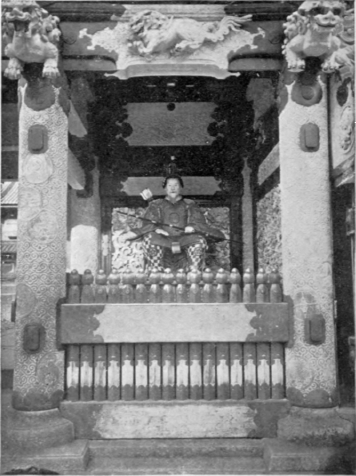
A Guardian Of The Gate.
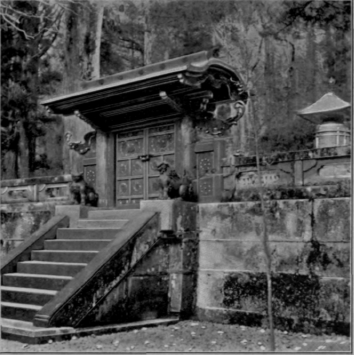
The Bronze Portal.
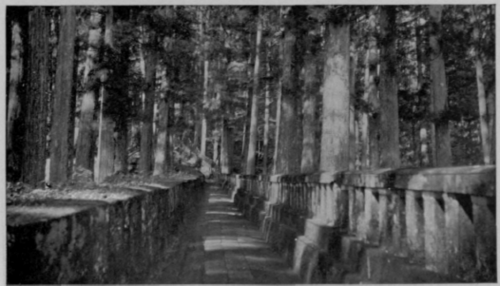
The Path To The Shogun's Grave.
Leaving at length the shrines of Nikko, we climbed still hundred years, had always had two sovereigns at the same time: one the ideal and secluded monarch, - the Mikado; the other, the actual regent, known as the Shogun. Bearing this fact in mind we reached the summit of the staircase. Before us was a portal of black bronze, inscribed with Sanskrit characters in gold. Behind it was a small enclosure, surrounded by a massive wall. Only two dragon-headed dogs were stationed here as guardians; but no one dares set foot within the sacred area, - none save a priest may pass beneath the low-browed arch. But, standing on the steps, we obtained at least a glimpse of what is here enshrined. It is the tomb of Ieyasu, the most powerful military ruler of Japan. It is a simple cylinder of bronze, six feet in height, the roof of which curves upward like a miniature pagoda. In front, upon a pedestal of stone, are the Japanese emblems of immortality. Here, then, the mightiest of the Shoguns rests, in death exalted, as in life, above his subjects. It is an awe-inspiring burial-place. Above him wave, like funeral plumes, majestic cryptomerias; beneath him are the temples where his spirit is adored; while, close beside him, in a deep ravine, the mountain torrent moans an endless requiem.
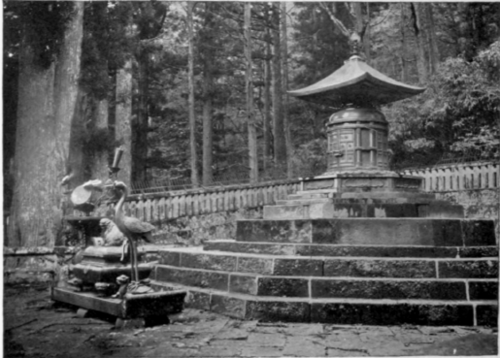
The Shogun's Tomb.
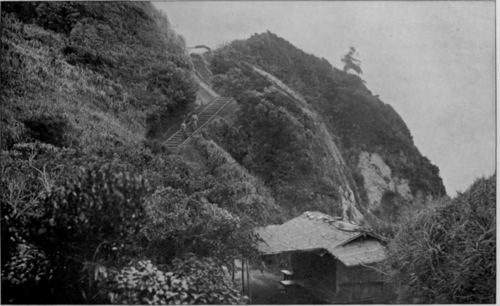
Near Enoshima.
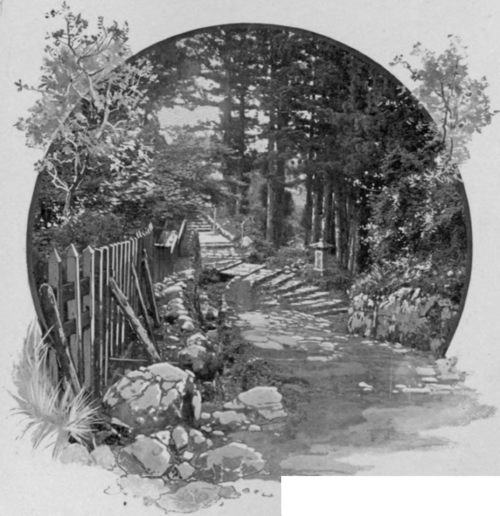
Neglected Shrines.
Yet it was when we left the Shogun's grave, and came down through the forest by that foaming stream, that we best appreciated the grandeur and sublimity of Nikko. Nowhere in the world, not even on the Alhambra hill, have I been so profoundly moved and thoroughly enchanted by a walk as by the one which winds about the sacred mountain of Japan. For miles above and around us stretched a cryptomerian cathedral, whose columns were the colossal trees, whose stained glass was the autumnal foliage, whose altar-covering was the green velvet of the forest, whose surpliced choristers were the white-robed and sweet-voiced rivers and cascades. One may well liken it to a cathedral, for its shadowy expanse is tenanted by countless rustic monuments and altars. Most of them looked abandoned both by gods and men; yet, here and there, we saw that worshipers had not forgotten them entirely, since fragrant flowers lay upon the thresholds of the few.
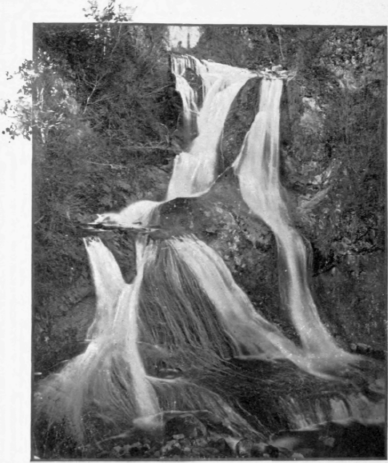
A Mountain Torrent.

A Cryptomerian Cathedral.
Lingering among these moss-grown emblems of an ancient faith, and treading pathways deepened by the feet of millions long since turned to dust, I shall never forget the impression made upon me. I felt that I was assisting at the last hours of a great religion. "Young Japan" has no more use for these ancestral shrines. It guards them merely as historic souvenirs: its faith in them is gone. In one sense, I was glad of this; but in another, I experienced here a feeling of regret. It seemed to me that this was earth's last stronghold of romantic paganism, and that its life was ebbing fast.
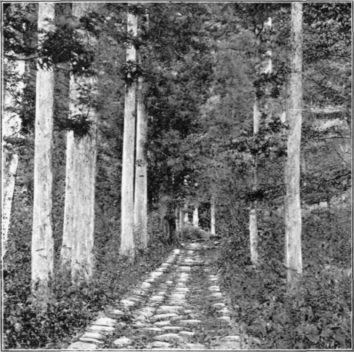
The Sacred Grove.

The Last Stronghold Of Romantic Paganism.
Its sylvan gods, its nymphs and dryads of the hills, had left these immemorial shrines; and I could easily fancy that the drops of rain which fell that day from these old trees were in reality Nature's tears of grief that Pan was dying. Another generation, and he will be dead.
Continue to:


My Books

