


Japan. Part 18
Description
This section is from the book "Japan - John L. Stoddard's Lectures", by John L. Stoddard. Also available from Amazon: John L. Stoddard's Lectures 13 Volume Set.
Japan. Part 18
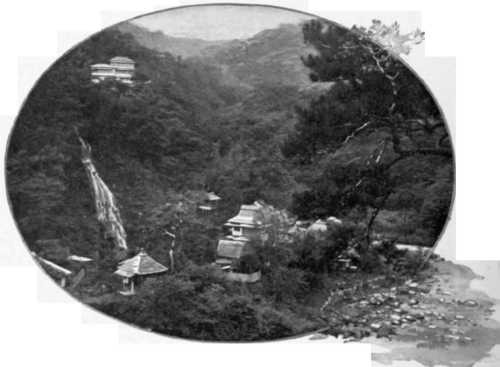
Approaching Miyanoshita.
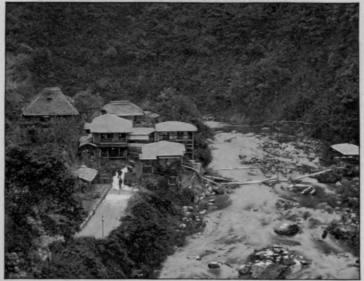
A Japanese Village Near Miyanoshita.
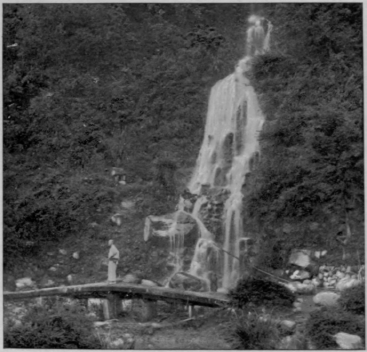
A Bit Of Japan.
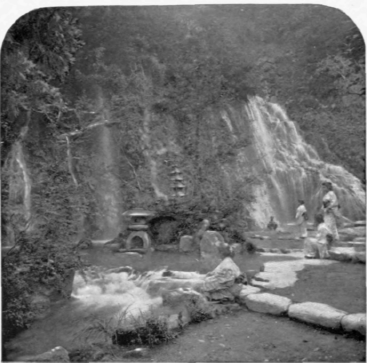
Rural Scenery In Japan.
Yet this is what one sees continually in Japan. What would in other lands seem artificial, is here only natural. Accordingly, the charm of Japanese scenery is enhanced by the surroundings given it by man. Picturesque figures, clad in robes as multicolored as the trees themselves; bridges, temples, and pagodas, often as brilliant as the autumnal leaves around them - these make the landscapes irresistibly attractive, as if both man and Nature had agreed to wear at the same time their holiday attire. One feels that he is traveling through a land where Nature is adored, where animals are kindly treated, and where such pleasing and poetic myths as we associate only with ancient Greece and Rome are still believed by many faithful souls, and make each forest the abode of rural deities and every mountain rivulet a place of prayer.
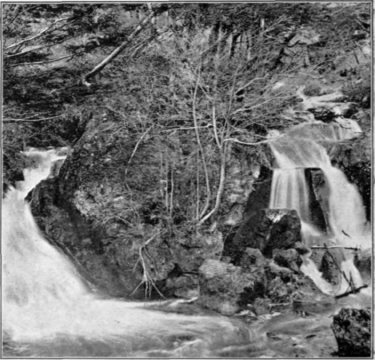
A Mountain Stream.
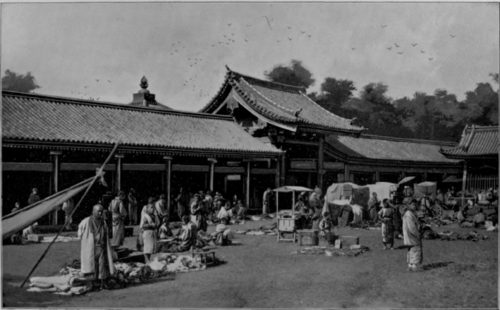
A Japanese Fair.
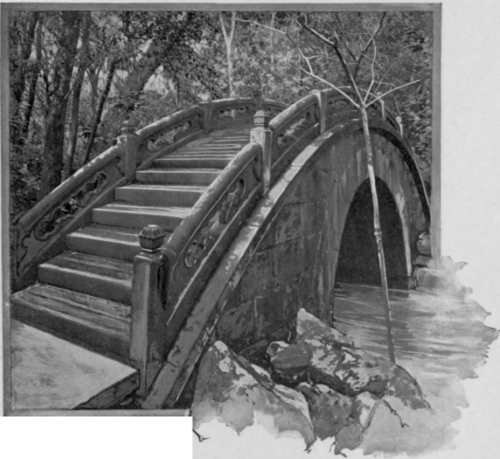
A Japanese Bridge.

A Farmer In His Working Suit.
As we moved farther up the valley, we found at every turn some new source of enjoyment; first, in the vivid foliage, which made the mountains seem like huge bouquets of ferns; then, in the silvery stream whose voice would shout a welcome to us as it hurried on; and lastly, in the little Japanese inns, along whose carved-wood balconies were hung red paper lanterns, that glowed at night like monster rubies, and gave to the whole scene that charmingly unreal, or theatrical effect, so characteristic of Japan.
Seeing some buildings on the opposite bank, we asked:
"How do you cross here from shore to shore?
Boats surely are not possible; nor are there any bridges, unless - but certainly those tiny structures yonder, stretched like a spider's web across the flood, cannot be bridges! "Yet closer scrutiny revealed the fact that they are really used as a means of transportation. Long poles of bamboo, bound about with reeds, and supported in the centre by a rough-hewn tripod, - such are the structures often spanning mountain-torrents in Japan! If swept away,they can easily be replaced; and, while they last, the peasants cross them fearlessly.
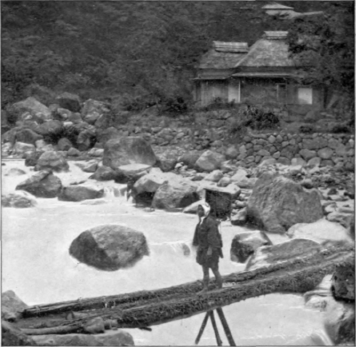
A Rustic Bridge.
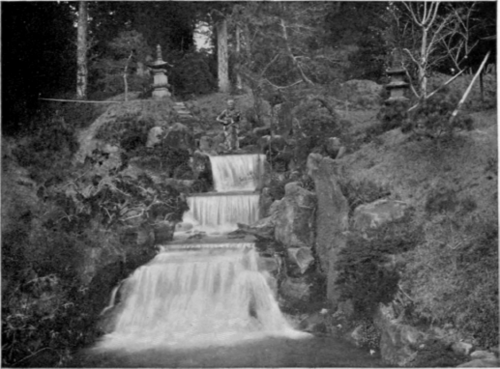
A Characteristic View.
"But how about wagons, carriages, and horses?" we inquired, only to be again reminded, with a laugh, that no provision need be made for them, for carriage-roads do not yet exist in these mountain regions, and horses are almost as rare as centaurs. In fact, one of the first things to impress us in these rural districts was the absence of animals. We saw no oxen, sheep, or donkeys, and only in rare instances a pony. Japanese farmers hardly know what meat, milk, and butter are, and when one recollects that they have never eaten bread, and have no word for it in their language, one naturally asks, "On what do they live?" Through our interpreter, we questioned a young laborer who was returning homeward from the fields in his everyday working-suit of clothes. He was well-formed and looked well-nourished, like most of his fellows, yet he assured us that only fish, rice, and vegetables formed his diet. When, therefore, one considers how much hard work the Japanese perform, and thinks of all the thousands here, who, in lieu of horses, haul heavy loads of wood and stone, it cannot be denied that they derive from their food quite as much strength as we do from ours. It is true, doctors declare that Japanese food, while good for peasants working in the open air, is bad for those who lead a sedentary life. But is anything good for those who lead a sedentary life?
Continue to:


My Books

