


Japan. Part 24
Description
This section is from the book "Japan - John L. Stoddard's Lectures", by John L. Stoddard. Also available from Amazon: John L. Stoddard's Lectures 13 Volume Set.
Japan. Part 24
This, it is true, is more than he himself can do, since he is blind; but our pity is soon diverted from him to the person he is treating, not so much because of the pinching to which he subjects his victim as on account of the pillow on which the patient's head reclines. It makes one think of Anne Boleyn or Mary Stuart, with their necks upon the fatal block; for a Japanese pillow is a wedge-shaped piece of wood, about a foot in length, on top of which is tied a wad of cloth, about the size of a Bologna sausage. To try to sleep with the neck supported in this fashion would seem to most Americans as hopeless as to woo slumber with a fence-rail for a pillow. One shudders to consider the discomfort, under these conditions, of turning over in bed, and trying to locate the neck on such a diminutive support. Yet, after all, we are creatures of habit, and forty million people in Japan use just such pillows every night, without suffering from insomnia. It is even claimed that Japanese women delight in them, since they do not disarrange the hair. Nor does this appear strange, when one scrutinizes their methods of coiffure. They are something marvelous. The American ladies who have tried the Japanese dress say - that the tying of the obi is extremely difficult. But here, as in the art of hair-dressing, a lady's maid is almost indispensable. The bow, although arranged in different styles, is always worn behind, thus spoiling, in some measure, the outline of the form. When a Japanese lady becomes a widow, she makes no change in the position of the obi, unless she wishes publicly to announce that she will never marry again. In that case, it is said, she ties the bow in front. Whether this wards off all proposals may be doubted; but gossip relates that, once in a while, the widow comes to look at life a little differently, and then the bow works gradually round again to its original position. Japanese ladies make a serious mistake when they exchange their national style of dress for that of foreigners, for, as a rule, their charm and beauty leave them when they appear in European garments. On two occasions we saw some thus arrayed, and the effect was painful. I f most of them had put on each other's dresses by mistake, they would have looked about as well; and in the absence of corsets their little figures seemed as much out of place as children in their mother's wrappers.
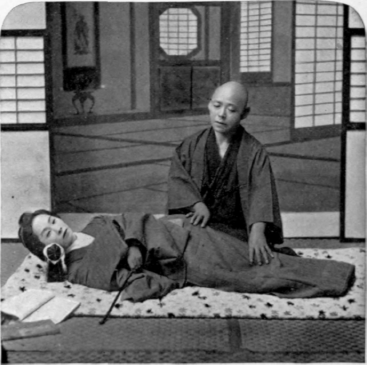
Massage.
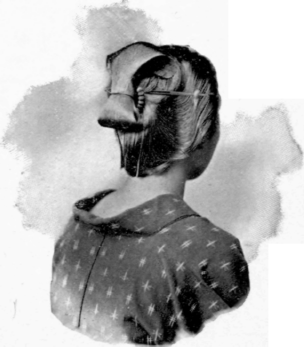
Japanese Coiffure.

A Japanese Pillow.

In The Boudoir.
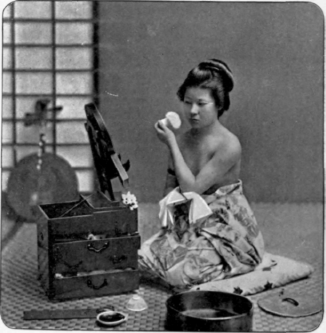
The Last Touches.

The Obi.

A Japanese Beauty.

Tying The Obi.
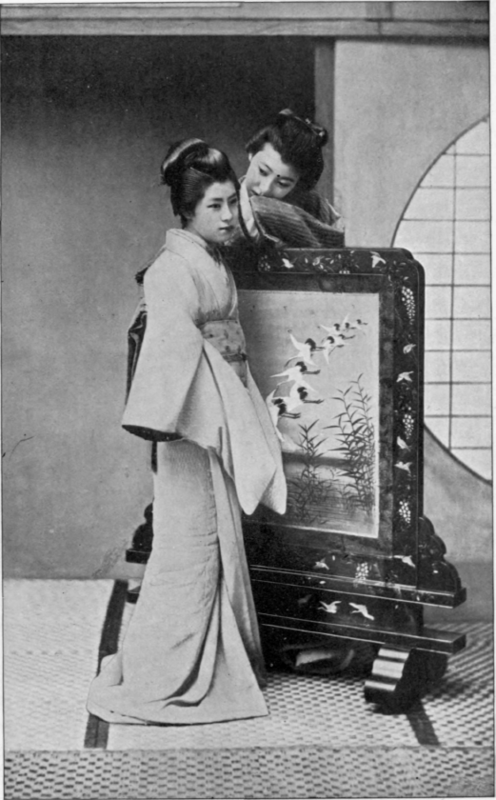
Friends In Council.
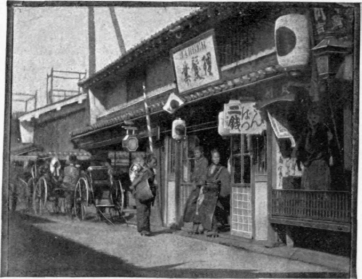
A Japanese Shop.
Some years ago a letter signed by Mrs. Cleveland and many other prominent women of America was addressed to their sisters in Japan, urging them not to risk their health and comfort by adopting European dress. It was of little avail. The die was cast. In 1885 the Japanese Empress and her suite appeared for the last time in public in the tasteful costumes of the past. Since then, the order has gone forth that all ladies who present themselves at court must do so in European dress; and it is to be feared that, ere a score of years have passed, the lovely and appropriate robes of old Japan will have disappeared forever. Until quite recently, the universal rule for Japanese women, when they married, was to shave their eyebrows, pull out their eyelashes, and stain their teeth jet-black. Even the present empress did these things at her marriage. The idea seems to have been to make themselves look hideous, so as to have no more admirers, despite the fact that the average husband, as we all know, appreciates his wife better if he perceives that other men are aware of her attractions. But under the new regime this sad disfigurement is rapidly disappearing, and at present the younger ladies of Japan, at least, show rows of pearly teeth when laughter parts their lips.
Continue to:


My Books

