


Japan. Part 32
Description
This section is from the book "Japan - John L. Stoddard's Lectures", by John L. Stoddard. Also available from Amazon: John L. Stoddard's Lectures 13 Volume Set.
Japan. Part 32

Ropes Of Women's Hair.

A Religious Festival.
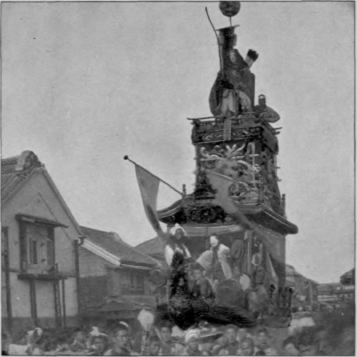
A Matsuri.
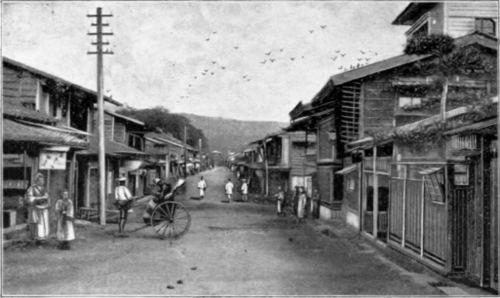
A Characteristic Street.
The streets in Kioto, like those of most Japanese cities, are usually much alike. No heavy teams disturb their rounded surfaces. Few vehicles, save light jinrikishas, pass over them. Almost no animals are ever seen in them. They are as clean as sidewalks are with us. In most of them we can perceive some groups or individuals, arrayed in varied colors, moving about like brilliant fragments in a long kaleidoscope. On either side extends a line of little houses, which, in point of architectural effect, appear monotonous, but since their lower stories are all open to the street, and from the fact that most of them are shops with all their goods on exhibition two feet from the thoroughfare, they really offer infinite variety.
Approaching one of these shops, one first encounters a wooden platform, two feet from the ground. On this the Japanese purchaser usually seats himself, as he prepares to bargain. Most foreigners, however, being unable to fold comfortably their limbs beneath them for a cushion, assume a different attitude, and allow their feet to hang over the side. If they ascend the platform and really enter the shop, they are supposed to leave their shoes below, and walk in stocking feet; for the shops of the Japanese are, like their houses, paved with polished wood or covered with spotless matting. The goods displayed by no means constitute the merchant's entire stock. The choicest articles are often in a fire-proof store-house, close at hand, and can be sent for at a moment's notice. As for the contents of these street bazaars, they comprise every article of clothing, ornament, and furniture conceivable by the Japanese mind.

Styles Of Japanese Sandals.
The shoe shops in particular were, at first, a source of great surprise to us. "These surely are not shoes," we said, as we beheld their great variety of foot-coverings. And yet the Japanese are shod, though sandals is a better name than shoes, for what they wear. A Japanese gentleman, who has not yet adopted European dress, wears in the house a cotton sock, which has a separate compartment for the great toe, like the thumb of a mitten. When he walks out, he plants his foot on a straw sandal, or, if the streets be muddy, on a wooden clog that rises three inches from the ground. In doing so, he thrusts the apex of a V-shaped cord between his great toe and the smaller ones, and, holding on his sandals thus, he marches off. But not all the merchants of Kioto are content to stay in shops; and, in this respect, human nature is much the same the world over. The gorgeous vehicles of American country peddlers, which we admired in our childhood days, are reproduced here on a smaller scale, though without wheels; and as the Japanese are sure to be artistic in everything, we were not surprised to find their brooms and dusters grouped in clusters like a huge bouquet. The peddlers themselves are pictures of human placidity. It is true, their eyes will open somewhat at the sight of foreigners, but most of the beardless faces that one sees beneath their mushroom hats of straw might easily serve an artist as models for a Japanese grandmother.
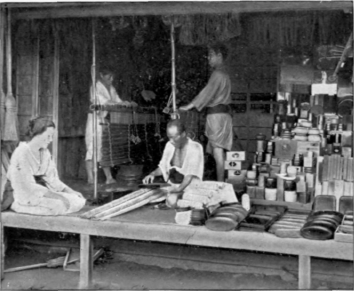
Shopping Made Easy.

Flower Merchant.
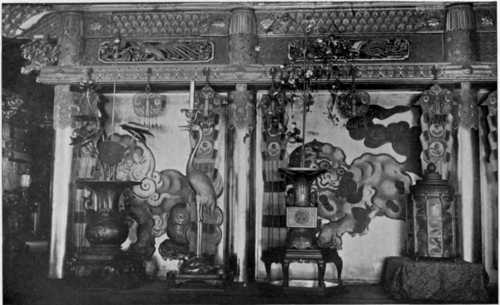
Japanese Handiwork.
In strolling through the streets, we often paused to watch the natives at their work. If, for example, it chanced to be a cobbler making wooden clogs, we saw, to our astonishment, that his great toe could hold a block of wood as firmly as a thumb, and we began to ask ourselves if western workmen had gained much by covering up the feet and losing a third hand. The methods of Japanese laborers seem to us, at first, a little clumsy, because they are unlike our own. But one soon comes to marvel at their skill. No nation is superior to them in dexterity, fineness of touch, and delicacy of finish. In great things, as in small, one finds the same perfection. Japanese carpenters, for example, will use few nails in building a house, but they will make mortises so exact that water cannot penetrate between the joints; and they will decorate a fan or paint a photographic slide with touches so delicate that they will bear inspection with a magnifying-glass. To watch them is like watching our own motions in a mirror, for everything appears reversed. Our carpenters push the plane from them; the Japanese pull it toward them. The threads of our screws turn to the right; theirs turn to the left. Our keys turn outward; theirs turn inward. Nor is this difference true of handicraft alone. Their way of doing hundreds of familiar things is so directly opposite to ours, that one is almost tempted to believe the cause to be their relative position on the other side of the globe, and that they are really living upside down. The only question is: "Which side is up, and which is down?' The Japanese think our ways just as strange as we do theirs. We, for example, carry our babies in our arms; in Japan, however, they are strapped on the backs of children not much larger than themselves, their little heads being left to flop about like flowers half-broken from the stem. Nor is this custom the exception. It is the universal rule, alike in city streets and country lanes. Whole pages could be filled in mentioning points of difference between Japanese and European customs. Thus, we stand erect before distinguished men, in token of respect; the Japanese, on the contrary, sit down We take off our hats when we enter a house, while they remove their shoes. Our books begin at the left; theirs at the right; and if they have any "foot-notes," they are placed at the top of the page. We write across a sheet of paper horizontally; they write vertically down the page, like we make a column of figures. Our color for mourning is black; theirs is white. The best rooms in our houses are in front; theirs are in the rear. We mount our horses from the left; they from the right. We put a horse head foremost into a stall; they back him in and fasten him in the front. On seeing this, we laughingly recalled the showman's trick of getting people to "come and see a horse's head where his tail should be."
Continue to:


My Books

