


Moscow. Part 3
Description
This section is from the book "St. Petersburg and Moscow - John L. Stoddard's Lectures", by John L. Stoddard. Also available from Amazon: John L. Stoddard's Lectures 13 Volume Set.
Moscow. Part 3

The Foundling Hospital.

Church Of The Monastery.
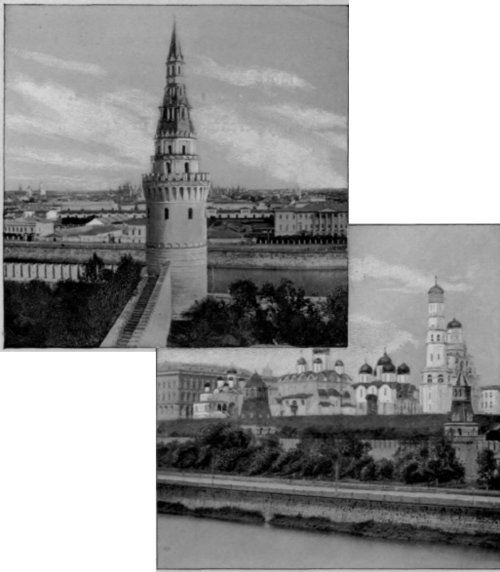
One Of The Kremlin Towers.
The Moskwa And The Kremlin.

The Kremlin Walls.
A prominent feature in the Muscovite capital is the river Moskwa, which gives the name " Moscow' to the city through which it flows. If the tourist should stand on one of the Kremlin towers, one hundred feet above this stream, he would perceive that Moscow lies in the form of two great circles, - one within the other, like the rings of a tree. Both represent successive periods of Moscow's growth. Both are enclosed by walls of fortification ; and the inner circle, or core, of the Tsar's capital is its far-famed Kremlin. Before I visited Russia I did not fully understand what this Kremlin was. In reality it is the Acropolis of Moscow - a kind of fortress similar to those built by the Mogul conquerors of India at Agra and at Delhi.
Within its walls are situated the Imperial Palace, the Treasury, the Arsenal, and the most sacred temples in the empire; and these, with their gilded domes and variously colored roofs and walls, display above the Kremlin battlements a veritable galaxy of splendor.
Before examining these treasures, I carefully observed the casket that contains them. Originally, the Kremlin was surrounded by stout walls of oak. More than five hundred years ago, however, the wooden walls gave place to those of stone, in order that the Tartars might be more successfully resisted. Again and again, under successive shocks of war, these battlements have been injured and rebuilt; but in their form they have remained substantially the same.
Outlying Moscow was, as all know, burned by the Russians to resist Napoleon, yet most of the Kremlin fortunately remained unharmed, for the devouring element did little save to lick the historic towers with its tongues of flame. I had imagined this great Muscovite citadel blackened by time, or at least clothed in the sombre tints that seem the fitting garb of venerable monuments. Here, however, I was pleasantly disappointed. The Russians, like the people of almost every new nation, love brilliant, striking coloring, and, therefore, they repaint the walls of the Kremlin as often as their colors fade under the keen breath of the frosty North.

A Corner Of The Kremlin.
Eager to enter the enclosure of the Kremlin, we made our way toward its principal entrance. To reach this we were obliged to cross the famous " Red Square," which flanks the Kremlin's deeply tinted walls. Its history proves it to have been well named; for, if its pavement could bear witness to the dreadful deeds enacted here, it would be red with blood. Two hundred years ago, this was the place of public punishment, and in those days of horrible brutality the victims of despotic cruelty were (as the judges decided) hanged, broken on the wheel, impaled, beaten to death, buried alive, or burned in iron cages. Counterfeiters were stretched on the ground, and molten lead was poured down their throats, while those who had been guilty of sacrilege were torn to pieces by iron hooks.
At one extremity of the Red Square stands the world-renowned Church of St. Basil. The man for whom this extraordinary edifice was named was a popular prophet and miracle-worker more than three centuries ago. This was not all, however. He claimed, as his distinctive glory, that he was " idiotic for Christ's sake," whatever that may mean. Ivan the Terrible caused this church to be erected over the grave of " Basil the Imbecile "; and in it were also placed the relics of another weak-headed saint, called " John the Idiot." In plain English, therefore, this celebrated sanctuary was reared by the Russian Nero over the graves of two idiots. It should be said, however, that idiocy is a form of religious mendicancy very common in Russia, and that imbeciles are treated there with great consideration. Beggars in Moscow, therefore, sometimes feign idiocy, and go about barefooted in winter; but very few of these are either saints, or followers of Father Kneipp.
Continue to:


My Books

