


Moscow. Part 5
Description
This section is from the book "St. Petersburg and Moscow - John L. Stoddard's Lectures", by John L. Stoddard. Also available from Amazon: John L. Stoddard's Lectures 13 Volume Set.
Moscow. Part 5
But if the bells within this gold-capped tower amazed us, what could we say when we beheld the monster lying at its base ? This is, indeed, the "King of Bells." It looked to me, as I approached it, like a huge bronze tent. Through the aperture in its side, a man can enter without lowering his head, and in the interior there is room for forty people at one time. It has been used as a chapel. It is needless to say that this bell was intended to adorn the belfry of the Ivan Tower, from which, however, it has been forever excluded; for, owing to an imperfection in its casting, a piece weighing eleven tons was broken out of its side, and the bell was ruined. Hence, throughout all the joys and sorrows of the city's history, this " King of Bells " has remained silent since its birth. It must be said, however, that it has filled the world with its renown. As for the broken piece of metal, the peasants claim that a good bell could be made from that alone, as Eve was made out of a rib of Adam.
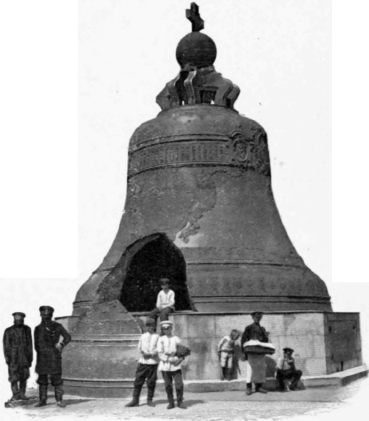
The King Of Bells.

Iberian Chapel And Resurrection Gate.

The Church Of The Annunciation.
While standing in the belfry of the Ivan Tower, I watched with interest the immense flocks of pigeons which sometimes came in clouds about the buildings. In fact, pigeons are more numerous in Moscow than in Venice, for to a Russian the dove is a sacred bird, - a living emblem of the Holy Spirit.
From this aerial bell-tower one looks directly down upon the most sacred edifice in Russia - the Cathedral of the Assumption. It is severely plain in appearance, and its whitewashed walls give no hint of the treasures contained beneath its gilded domes. But in reality gigantic gilded columns support its roof, and sacred pictures line its walls from floor to ceiling like a tapestry of gold.
It is in this cathedral that, amid the most imposing ceremonies, all the Tsars, from Ivan the Terrible to the present sovereign, have been crowned. To speak more exactly, however, they have crowned themselves; for no one is deemed worthy, at that solemn hour, to place upon the Emperor's brow the emblem of sovereignty, save the Tsar himself. We beheld the very platform on which they have all, in succession, stood.
Leaving the cathedral, a few steps brought us to the famous Palace of the Kremlin, which contains some of the richest and most elegant apartments I have ever seen. In the Hall of St. George, for example, columns of alabaster support a gilded roof, from which descend magnificent chandeliers; while on the walls gilded letters spell the names of all the heroes who have been decorated with St. George's cross, - the highest military order in the empire. This room, however, honors the illustrious living as well as the distinguished dead; for it is here that, on State occasions, the Emperor receives foreign ambassadors and royal guests.

The Palace And The Moskwa.
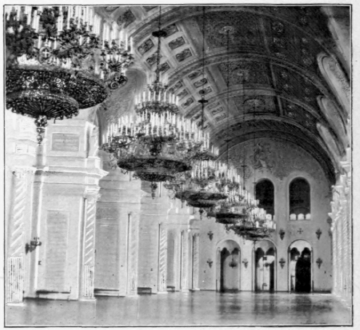
St. George,S Hall.

Holy Gate Of Kremlin.
At right angles to the Hall of St. George, is another magnificent apartment, known as the Hall of St. Andrew. Here twisted pillars, enriched with flowers of gold, rise on every side, while fourteen lofty mirrors reflect as many windows, opening upon the balconies of the Kremlin. The inlaid floor is wonderfully designed, every kind of wood being used to produce intricate and elaborate patterns of scrolls and flowers; its gorgeous ceiling, sparkling with gilding and heraldic devices, glitters sixty-eight feet above the pavement; and the walls, which are hung in light pink silk and gold, form beautiful expanses of marble, golden ornamentation, and paintings. At one extremity of the room are two black velvet stands, on which are placed rare gold and silver ornaments of the imperial family when the Emperor is residing here.

St. Andrew's Hall.
Continue to:


My Books

