


St. Petersburg. Part 6
Description
This section is from the book "St. Petersburg and Moscow - John L. Stoddard's Lectures", by John L. Stoddard. Also available from Amazon: John L. Stoddard's Lectures 13 Volume Set.
St. Petersburg. Part 6

Summer In The Winter Palace.

The Ball-Room.
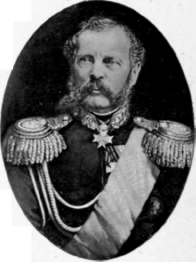
Alexander II.

The Winter Palace.
If possible, more solemn still must have been the sight of the silent thousands who lined the shores of the Neva, until the river seemed to flow between two banks of pale and saddened faces. Bareheaded and mute they stood there for hours, many of them praying for the soul of the dead Tsar; while hundreds of priests, clad in their ecclesiastical robes, and bearing tapers in their hands, were chanting on the air a solemn requiem.

The Neva And Winter Palace.

A Villa On The Neva.
If the Tsar stands at any window, in the portion of his palace fronting the river, he can perceive on the opposite bank the Bastille of Russia,-the Fortress of Petropaulovski.
Probably no prison now standing in the world has witnessed more cruelty and suffering than this. Walls, it is said, have ears; but, had they tongues, what horrible deeds could be disclosed by these dark, icy dungeons, situated below the level of the Neva - the walls and floors slimy with dampness! Here Alexis, the rebellious son of Peter the Great, died, after protracted torture; and here a number of political prisoners were drowned during an overflow of the Neva.
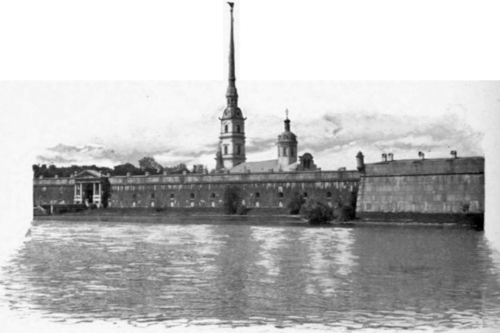
The Fortress Of Ss. Peter And Paul.
A curious ceremony takes place in front of the Winter Palace, in the spring, when the ice breaks up in the Neva. Naturally, this is a period of great rejoicing, and the first boat that crosses the liberated stream conveys the governor of the fortress to the palace, where he presents a glass of Neva water to the Tsar. The Emperor drinks it, and returns the goblet to the governor, filled to the brim with gold coin. Such, at least, was the custom till Alexander III. noticed that every year the glass increased in size, requiring more gold pieces to fill it. Accordingly, he named a certain sum that should be placed in the goblet, irrespective of its capacity, and which he deemed sufficient to reward, if not to satisfy, the Ganymede of the Neva.
Standing on the bank of a canal, and connected with the Winter Palace by a bridge, - the form of which reminds us of the Venetian Bridge of Sighs, - is another prominent building, the Hermitage. Catharine II. caused this to be built, much as Frederick the Great erected, near Berlin, his pretty villa, Sans Souci, as a refuge from the cares of State; and here she passed many of her evenings, surrounded by French philosophers, musicians, and artists, all of whom were obliged, according to the laws of the Hermitage, to leave behind them, at the threshold, every consideration of precedence, rank, and birth, and to meet on terms of absolute equality. Thus, on the walls of this palace was a notice forbidding guests to rise when the Empress came into the room, to speak unkindly to any one present, or of any one absent, or even to look ill-tempered! They were also reminded to leave their quarrels at the door, with their swords and hats. Small fines were inflicted for the violation of these rules, and the money was given to the poor. So thoroughly unconventional was life in the Hermitage that the Empress, when playing games, paid her forfeits like the other guests. On one occasion, for example, she was told to sit down on the floor, and she obeyed at once.
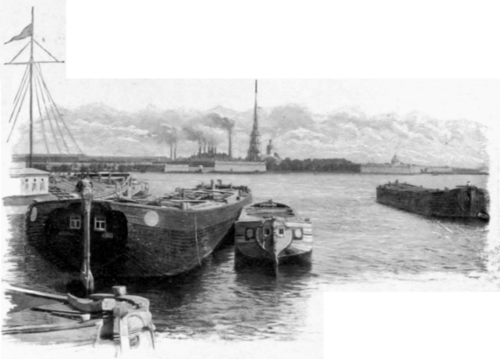
Lumber Boats On The Neva.

The Hermitage.

Portico Of The Hermitage.

The Admiralty Quay.
Catharine II. was certainly an extraordinary woman; intellectually great enough, to be called by the French philosopher, Diderot, "The candlestick bearing the light of the age"; sufficiently voluptuous, to be still passionately in love at sixty-seven, and to be styled " the Semiramis of the North " ; yet brave enough, to risk her life and beauty by being almost the first in her empire to be inoculated for smallpox ; every inch an empress, yet treating others with a simplicity which put them immediately at their ease, and able to rule her empire well, though lovable and popular with all. "To tell the truth," she said, " I have never fancied myself extremely beautiful; but I have the art of pleasing which, I think, is my greatest gift."
Continue to:


My Books

