


Scotland. Part 18
Description
This section is from the book "Scotland - John L. Stoddard's Lectures", by John L. Stoddard. Also available from Amazon: John L. Stoddard's Lectures 13 Volume Set.
Scotland. Part 18

Runic Cross, Iona.

A Highland Hamlet.
But, if Iona is interesting, Staffa is sublime. It is a child of Nature merely, wholly uninhabited by man, but its extraordinary natural phenomena bring travelers hither from all portions of the world. Twice have I seen it: once in storm, and once in sunshine. On both occasions it was wonderfully impressive; for, with a rounded form about two miles in circuit, it rises perpendicularly from the sea to the height of one hundred and forty feet; and its broad, level summit resembles an enormous table, upheld by thousands of basaltic columns, which stand in stately colonnades, pressed closely one against another, and in some places even curved slightly outward, as if to offer more resistance to the tremendous surges of the sea. This island, which is probably the crest of an extinct volcano, appeared to me the appropriate cradle of Scandinavian mythology. It is around just such a lonely, uninhabited rock, beaten for ages by the billows of the ocean, that the grand Sagas of the North would naturally cluster; for the old Norse myths are strong and heroic. They have a savage grandeur that is lacking in the legends of other races. While not possessing the subtile beauty of Greek and Roman mythology, they are, nevertheless, immeasurably more virile, dominant and fateful. There is only one "Twilight of the Gods," and it belongs to the land of Thor. The grandest feature of the island of Staffa, and, indeed, one of the most extraordinary objects in the world, is the awe-inspiring cavern, known as "Fingal's Cave," after the legendary Gaelic hero, Fingal. As our boat halted on its solemn threshold, the sound of voices ceased. The entire company seemed breathless. Before us, massive as the eternal hills, rose a gigantic arch, sixty-five feet above the waves. Beneath this, leading on mysteriously toward the island's heart, lay a dark, undulating avenue whose terminus we could not see. To right and left, in serried ranks, stood hundreds of black, glistening columns of volcanic rock, worn smooth and lustrous by the waves which, for unnumbered ages, have been slowly eating out the softer stone of the interior, leaving the lofty arch and groined roof supported by basaltic pillars, tempered in lava fire when the earth was young. Slowly we drew on toward the sombre portal, and as we halted in its awful shadow, and gazed on into the long gallery, the sides of which were black (save where the spectral fingers of the spray traced mystic characters upon the walls in lines of foam), I felt that nervous chill, that quick involuntary catching of the breath, which mark a recognition of sublimity. It seemed, indeed, a temple fashioned by Almighty God to give to man a model for his noblest shrines.
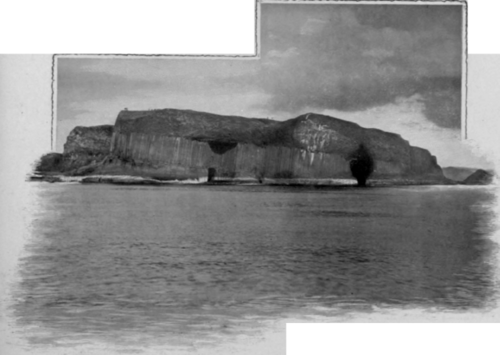
The Cliffs At Staffa.

Staffa.
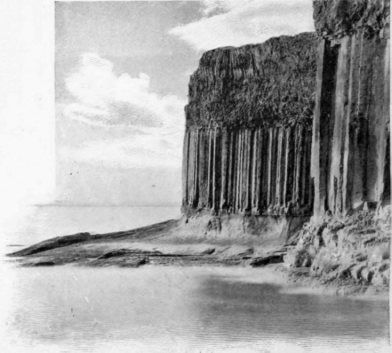
Basaltic Columns, Staffa.

The Approach To Fingal's Cave.
But oh! above all else that I remember here was the grand voice of the Atlantic in this cavern. After each wave, ere its successor could approach, there came an awful pause, in which the ocean seemed to hold its breath. Then, as the sea surged inward once more from the mighty deep, and swept its liquid touch along the stately colonnades, as if they were the strings of an AEolian harp, we heard the most unearthly and soul-stirring harmony: first, low and tender; then, swelling into a magnificent crescendo; and, finally, filling the whole cavern with an overpowering diapason that rolled like peals of thunder through the gloomy vault.
Continue to:


My Books

