


Spain. Part 17
Description
This section is from the book "Spain - John L. Stoddard's Lectures", by John L. Stoddard. Also available from Amazon: John L. Stoddard's Lectures 13 Volume Set.
Spain. Part 17

In The Mosque Of Cordova.
A fragment of the old Moorish ceiling was recently discovered here. The wood is arbor vitae, which is considered practically incorruptible - at all events, this portion is as sound to-day as when placed here eleven hundred years ago. Yet how feebly do these relics represent the former splendor of this structure!
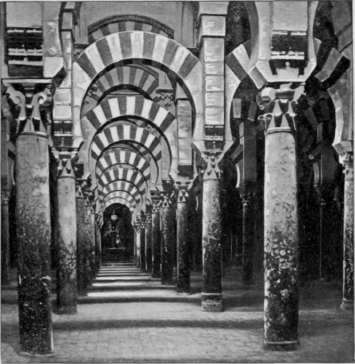
A Sculptured Forest.
Then, suspended from the ceiling, carved to represent overhanging tropical foliage, four thousand seven hundred gilded lamps lit up with rainbow colors twelve hundred of these columns, and made the rich mosaics in the walls seem like a sacred tapestry of gold. The floors, too, were covered with Oriental rugs, and in the shadow of these polished shafts knelt hundreds of adoring worshipers. But acting through misguided bigotry, the Spaniards whitewashed and destroyed the sculptured ceiling of cedar-wood, so beautiful as to be worthy of the Alhambra. All the outside aisles were filled with tawdry chapels, thus walling in more than one hundred splendid monoliths; and sixty more columns were leveled in the centre of the mosque to make room for an ugly chapel two hundred feet in length, which, in this maze of slender columns, looks like a hideous tumor, obstructs the view, and exasperates the beholder.
When Charles V, who was himself something of a vandal, beheld this act of barbarism, he was indignant with the monks who had effected it, exclaiming, "You have built here what might have been built anywhere, but you have destroyed what was unique in the world." It was then, however, too late for repentance: the irreparable evil had been done.

A Section Of The Ceiling In The Mosque Of Cordova.
Some years ago, the Emperor of Morocco visited Cordova; and as he knelt and prayed within this sanctuary of his ancestors, while the Spanish priests were chanting vespers in the chapel, he bowed his head and wept, feeling himself an outcast and stranger in this magnificent memorial of that Moorish genius, which, alas! has passed away forever!
From Cordova, a railroad journey of five hours brought us to Seville. "Sevilla!" shouted an enthusiastic Spaniard, as our train drew near it, and leaning out of the car window, gazed long and lovingly upon this city which he called his home. No wonder he was proud of it, for clasping it in beauty, like a silver girdle, was the stately river whose Moorish name, even when pronounced in English, - the Guadalquivir, - sounds like a strain of music; while in the distance rose above all other objects that graceful Moorish tower known as the Gi-ralda.

Seville.
As we drew nearer to the city, this tower grew still more distinct and prominent, rising beside the vast cathedral which was once a Moorish mosque. The Giralda was then the minaret of the Moslem sanctuary, and from its sculptured galleries came the muezzin's call to prayer, just as it does from all the minarets of the East to-day. All famous cities have some magnet of attraction, which stands distinctively associated with their names; and, as Rome possesses her St. Peter's, Naples her lava-crowned Vesuvius, Athens her Acropolis, and Pisa her leaning tower, - so Seville boasts of her Giralda! Under the Moors this must have been wonderfully beautiful. It rises to the height of three hundred and fifty feet, and its square walls were originally decorated with elegant designs on a background of rose-color, fragments of which still remain.
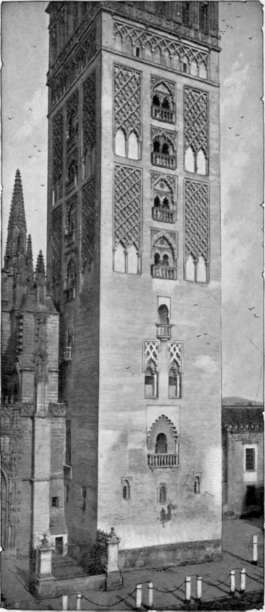
Section Of The Giralda.
At that time its summit was surmounted with four enormous golden balls, whose lustre was discernible at a distance of twenty-five miles, and whose value was no less than two hundred and fifty thousand dollars. But these costly ornaments were destroyed by an earthquake in 1395, and now the Giralda is crowned by a colossal female figure in bronze, which, although fourteen feet in height, and weighing more than a ton, is nevertheless so nicely balanced, that it turns with the slightest breeze. Oddly enough, this statue represents Faith. Truly, a strange subject for a weather-vane, never steadfast, but blown about by every wind. I suspect the architect was a practical joker.
Continue to:


My Books

