


Switzerland. Part 4
Description
This section is from the book "Switzerland - John L. Stoddard's Lectures", by John L. Stoddard. Also available from Amazon: John L. Stoddard's Lectures 13 Volume Set.
Switzerland. Part 4
A moment or two later we entered the well-known cavern in this glacier - a strange and chilling passageway, two hundred feet in length, cut in the solid ice, whose gleaming walls and roof seemed to be made of polished silver.
As I was picking my way safely, though shiveringly, through this huge refrigerator, I asked my guide to tell me about one of the clerical misfortunes which had made him suspicious of gentlemen of the cloth. He turned and looked at me curiously. "You know, of course, the fate of our pastor, M. Mouron?" he exclaimed. I confessed my ignorance.

A Glacier.

A Chilling Passageway.
"Then come with me," he said. Accordingly, emerging from the cavern, we climbed for nearly an hour over great blocks of ice, until we came to a profound abyss. Suspended from the frozen parapet a mass of icicles pointed mysteriously down like ghostly fingers. Then all was dark. "It was by falling down this," said the guide, "that the pastor of Grindelwald lost his life. Me was seeking one day to ascertain its depth by casting stones into its cavernous maw and counting till he heard the sound of their arrival at the bottom of the abyss. Once, in his eagerness, he placed his staff against the opposite edge, leaned over and listened. Suddenly the ice gave way, and he fell headlong into the crevasse. His guide ran breathless to the village and informed the people of their loss. But, to his horror, he found that he himself was looked upon with suspicion. In fact, some went so far as to say that he must have murdered their pastor, and robbed him of his watch and purse.

Ghostly Fingers.
"The guides of Grindelwald, however, who felt themselves insulted at this accusation, united and agreed that one of their number (chosen by lot) should, at the peril of his life, descend into this crevasse to establish the innocence of the accused. The lot was drawn by one of the bravest of them all, a man named Bergenen. The whole village assembled on the flood of ice to witness the result of the search. After partaking of the sacrament, Bergenen fastened a rope around his waist and a lantern to his neck. In one hand he took a bell. In the other he grasped his iron-pointed staff to keep himself from the sharp edges. Four men then carefully lowered him down. Twice, on the point of suffocation, he rang the bell and was drawn up. Finally a heavier weight was felt upon the rope, and Bergenen re appeared, bring ing the body of the pastor from a depth of seven hundred and fifty feet. A mighty shout went up from the guides and populace as well. The man was innocent. Both watch and purse were found upon the corpse!"

Lausanne.
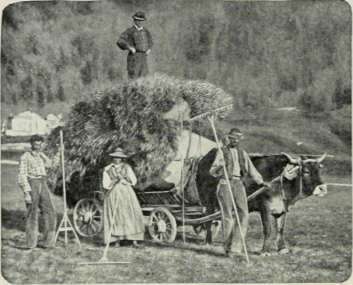
Hay-Ma King.
As we returned from Grindelwald to Interlaken, we often paused to note the peasants toiling in the fields. So far as their appearance was concerned, we might have supposed them laborers on a Vermont farm; but their low carts were quite unlike our country hayracks; and the appearance of a single ox, harnessed with ropes around his horns, presented an amusing contrast to the sturdy beasts which, bound together by the yoke, drag to our barns their loads of fragrant hay. Women, of course, were working with the men; but female laborers in Switzerland are not in the majority. In many instances the ratio is but one to three.

Upon The Heights.
These peasants look up curiously as we drive along, and no doubt think that we are favored beings, to whom our luxuries give perfect happiness. And yet the very tourists whom they thus envy may, in a single hour, endure more misery and heartache than they in their simplicity and moderate poverty will ever know. Among these people are not found the framers of those hopeless questions: "Is life worth living?' and "Does death end all?' The real destroyers of life's happiness are not a lowly home and manual labor. They are the constant worri-ments and cares of artificial life, - satiety of pleasures, the overwork of mental powers, and the disenchantment of satisfied desires.
Continue to:


My Books

