


Switzerland. Part 6
Description
This section is from the book "Switzerland - John L. Stoddard's Lectures", by John L. Stoddard. Also available from Amazon: John L. Stoddard's Lectures 13 Volume Set.
Switzerland. Part 6
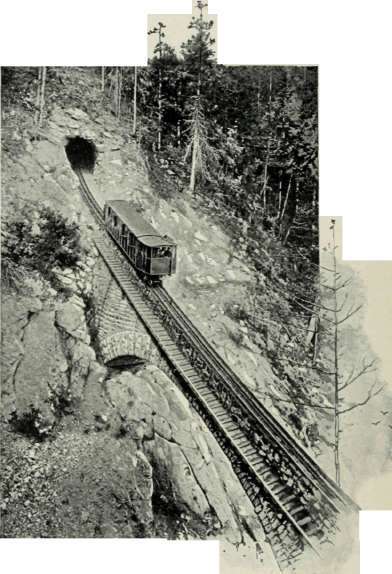
The Alpine Elevator On Mount Pilate.
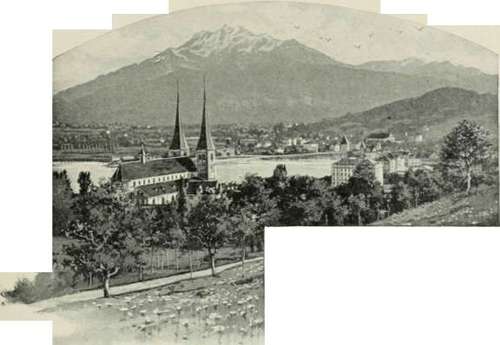
One of the greatest pleasures of the tourist in Lucerne is to sail out, as he may do at almost any hour of the day, upon its lovely lake. This, in respect to scenery, surpasses all its Alpine rivals. Twenty-three miles in length, it has the form of a gigantic cross, each arm of which (when looked upon in the glow of sunset from a neighboring height) seems like a plain of gold and lapis-lazuli set in a frame-work of majestic mountains. No tour in Switzerland is complete without a sail upon this fair expanse of water. Hence more than half a million travelers cross it every year during the summer months alone, and tiny steamers are continually visible, cutting their furrows on its smooth, transparent surface, as sharply as a diamond marks a pane of glass.

The Lion Of Lucerne.

Brunnen, On Lake Lucerne.
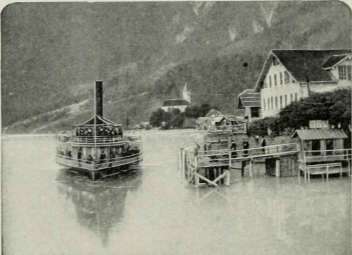
Making A Landing.
Moreover, when the boat glides inward toward the shore, one sees that other elements of beauty are not wanting here. Pretty chalets with overhanging roofs; rich pastures, orchards, and gardens, - all these, with numerous villages, succeed each other here for miles, between the lake and the bold cliffs that rise toward Heaven. Nor is this all. The villages possess a history, since these romantic shores were formerly the stage on which Swiss patriots performed those thrilling scenes immortalized by Schiller in his drama of "William Tell".

Tell's chapel.

Montreux.
In fact, at one point half concealed among the trees is the well-known structure, called Tell's Chapel. It stands upon the spot where, it is said, the hero, springing from the tyrant's boat, escaped the clutches of the Austrian governor. As is well known, doubts have been cast on even the existence of this national chieftain; and yet it is beyond per-adventure that a chapel was erected here to his memory as early as the fifteenth century, and only eleven years ago this structure was restored at government expense. Moreover, once a year at least, the people of the neighboring cantons gather here in great numbers to celebrate a festival which has been held by their ancestors for centuries.
The little building is certainly well calculated to awaken patriotism. Appropriate frescoes, representing exploits ascribed to William Tell, adorn the walls; while opposite the doorway is an altar at which religious services are held. How solemn and impressive must the ceremony be, when religious rites are performed in such a historic and picturesque locality in the presence of a reverent multitude! At such a time this tiny shrine may be considered part of the sublime cathedral of the mountains, whose columns are majestic trees, whose stained glass is autumnal foliage, whose anthems are the songs of birds, whose requiems are the moaning of the pines, and whose grand roof is the stupendous arch of the unmeasured sky, beneath which the snow-clad mountains rise like jeweled altars, lighted at night, as if with lofty tapers, by the glittering stars.

Altar In Tell's Chapel.

Lake Lucerne By Night.
But to appreciate the beauty of this sheet of water, one should behold it when its surface is unruffled by a breeze. Enamoured of their own beauty, the mountains then look down into the lake as into an incomparable mirror. It is an inverted world. The water is as transparent as the sky. The very breezes hold their breath, lest they should mar the exquisite reflection. The neighboring peaks display their rugged features in this limpid flood, as if unconscious of the wrinkles which betray their age. The pine trees stand so motionless upon the shore that they appear like slender ferns. Instinctively we call to mind those graceful lines, supposed to be addressed by such a lake to an adjoining mountain:
Continue to:


My Books

