


Southern California. Part 13
Description
This section is from the book "Southern California - John L. Stoddard's Lectures", by John L. Stoddard. Also available from Amazon: John L. Stoddard's Lectures 13 Volume Set.
Southern California. Part 13

Not Afraid Of The Sun.
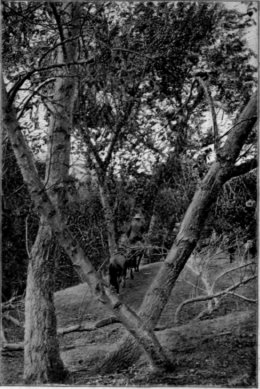
In Cottonwood Cañon, Santa Catalina.

Liliputian And Giant.
That the winter climate of Southern California, not only on the coast, but in the interior, is delightful, is beyond question. What was healthful a hundred years ago to the Spanish monks who settled here, proved equally so to those adventurous "Forty-niners" who entered California seeking gold, and is still more beneficial to those who now come to enjoy its luxuries and comforts. Flowers and fruit are found here throughout the entire year. The rainy days are few, and frosts are as ephemeral as the dew; and to the aged, the invalids, the fugitives from frost, and the "fallen soldiers of civilization," who are no longer able to make a courageous fight with eastern storms and northern cold, San Diego is a climatic paradise. Accordingly, from early October until April the overland trains roll westward from a land of snow and frost to one of sun and flowers, bearing an annually increasing multitude of invalids and pleasure-seekers, some of whom have expensive permanent homes and costly ranches here - like that of Mr. Andrew Mc-Nally, at Al-tadena - while others find abundant comfort in the fine hotels.
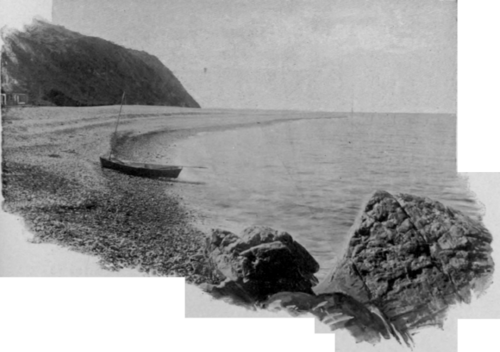
On The Beach At Santa Catalina.

An Old Californian Trading Post.
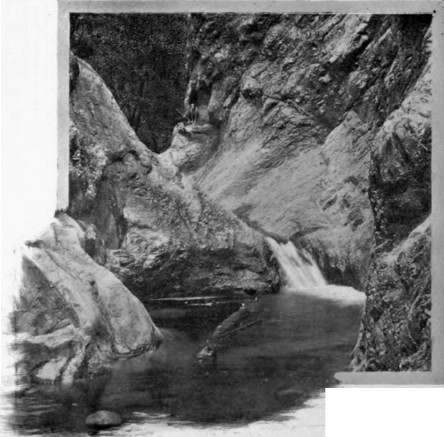
A Bit Of Nature.
On The Coast.
Perhaps the principal secret of the charm of the winter climate of Southern California, as well as that of its wonderful health-restoring properties, lies in the fact that its dry, pure air and even temperature make it possible for one to live continu-ously out of doors. Yet, though not cold, it is a temperature cool enough to be free from summer languor.
Especially attractive to the visitors from the North are the palms of Southern California. Many of these resemble monstrous pineapples terminating in gigantic ferns. What infinite variety the palm tree has, now dwarfed in height, yet sending out on every side a mass of thick green leaves; now rising straight as an obelisk from the desert sand, and etching its fine feathery tufts against the sky; now bearing luscious fruit of different kinds; now furnishing material for clothing, fishing-nets, and matting; or putting forth those slender fronds, frequently twenty feet in length, which are sent North by florists to decorate dwellings and churches for festivals and weddings! The palm is typical of the South, as the pine is of the North. One hints to us of brilliant skies, a tropic sun, and an easy, indolent existence; the other suggests bleak mountains and the forests of northern hills, and symbolizes the conflict there between man and nature, in which both fortitude and daring have been needful to make man the conqueror. One finds a fascination in contrasting these two children of old Mother Earth, and thinks of Heine's lines:

Cal1fornian Palms.
" A pine tree standeth lonely
On a northern mountain's height; It sleeps, while around it is folded A mantle of snowy white.
It is dreaming of a palm tree
In a far-off Orient land, Which lonely and silent waiteth
In the desert's burning sand".
On my last day at San Diego, I walked in the morning sunshine on Coronado Beach. The beauty of the sea and shore was almost indescribable : on one side rose Point Loma, grim and gloomy as a fortress wall; before me stretched away to the horizon the ocean with its miles of breakers curling into foam; between the surf and the city, wrapped in its dark blue mantle, lay the sleeping bay; eastward, the mingled yellow, red, and white of San Diego's buildings glistened in the sunlight like a bed of coleus; beyond the city heaved the rolling plains, rich in their garb of golden brown, from which rose distant mountains, tier on tier, wearing the purple veil which Nature here loves oftenest to weave for them; while, in the foreground, like a jewel in a brilliant setting, stood the Coronado.
Continue to:


My Books

