


Southern California. Part 15
Description
This section is from the book "Southern California - John L. Stoddard's Lectures", by John L. Stoddard. Also available from Amazon: John L. Stoddard's Lectures 13 Volume Set.
Southern California. Part 15

A Lonely Ocean.
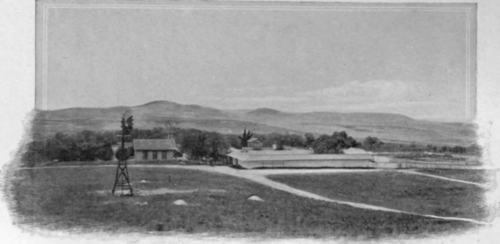
Ramona's Home.

The Chapel, Ramona's Home.

Palms Near San Fernando Mission.
Presently the Mexicans made their appearance here; but, though they held and managed enormous ranches, the situation was comparatively unchanged; for they maintained harmonious relations with the Missions, and had no serious difficulties with the Indians. Thus life went on for nearly half a century, and seemed to the good Fathers likely to go on forever; for who, they thought, would ever cross the awful eastern plains to interfere with their Arcadian existence, or what invading force would ever approach them over the lonely sea? But history repeats itself. The Missions soon became too rich not to excite cupidity; and those who coveted their lands and herds declared, as an excuse for violence, that the poor Indians were held in a state of slavery, and should be made to depend upon themselves. At length, in 1833, the Mexican Government by a decree of secularization ruined the Missions; but the Indians, although not so prosperous and well treated as under the Fathers, still kept, through Mexican protection, most of their privileges and the lands they owned. Finally came the Anglo-Saxon, and, under the imperious civilization that poured into California from 1840 to 1860, the pastoral age soon disappeared. The Missions, which had already lost much of their property and power under the Mexican Government, quickly shrank after this new invasion into decrepitude. The practical Anglo-Saxon introduced railroads, electricity, commerce, mammoth hotels, and scientific irrigation, all of which the Fathers, Mexicans, and Indians never would have cared for. Nevertheless, with his arrival, the curtain fell upon as peaceful a life-drama as the world had seen.

Corridor, San Fernando Mission.
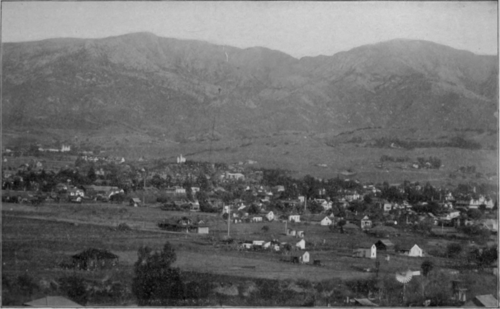
Santa Barbara.

San Juan Cap1strano.
To the reader, thinker, and poet the memories and associations of these Missions form, next to the gifts of Nature, the greatest charm of Southern California; and, happily, although that semi-patriarchal life has passed away, its influence still lingers; for, scattered along the coast - some struggling in poverty, some lying in neglect - are the adobe churches, cloisters, and fertile Mission-fields of San Juan Cap-istrano, San Fernando Rey, Santa Monica, Santa Barbara, and Santa Cruz, all of which still preserve the soft and gracious names, so generously given in those early days, and fill us with a genuine reverence for the sandaled monks, who by incessant toil transformed this barren region into a garden, covered these boundless plains with flocks and herds, and dealt so wisely with the Indians that even their poor descendants, to-day, reverence their memory.

Group Of Franciscan Friars.

Chief Of A Tribe Of Mission Indians.
The Saxon has done vastly more, it is true ; but, in some ways, he has done much less. The very names which he bequeathed to places not previously christened by the Spaniards, such as Gold Gulch, Hell's Bottom, and Copperopolis, tell a more forcible, though not as beautiful a tale, as the melodious titles, San Buenaventura, San Francisco Dolores, Santa Clara, San Gabriel, and La Purissima.
It is not, therefore, the busy streets and handsome dwellings of Los Angeles and Pasadena, but the adobe ruins, the battered statues, the cracked and voiceless bells, the poor remnants of the Indian tribes, and even the old Spanish names, behind which lies a century of sanctity and romance, which give to Southern California an atmosphere of the Old World and harmonize most perfectly with its history Most of the Mission buildings are in a sad condition. Earthquakes have shattered some; neglect and malice have disfigured others; but a society, composed alike of Catholics and Protestants, is now, in the interest of the past, endeavoring to rescue them from utter ruin. It is a worthy task. What subjects for a painter most of them present! How picturesque are their old cloisters, looming up dark, grand, and desolate against the sky! How worn and battered are they by the storms of years! How tremblingly stands the Cross upon their ancient towers, as if its sacred form had become feeble like the fraternity that once flourished here! What witnesses they are of an irrevocable past! Their crumbling walls, if they could speak, might grow sublimely eloquent, and thrill us with inspiring tales of heroism, patience, tact, and fortitude exhibited when these Missions bloomed like flowery oases on the arid areas of the South and West, and taught a faith of which their melancholy cloisters are the sad memorials.
Continue to:


My Books

