


Southern California. Part 3
Description
This section is from the book "Southern California - John L. Stoddard's Lectures", by John L. Stoddard. Also available from Amazon: John L. Stoddard's Lectures 13 Volume Set.
Southern California. Part 3

Wrested From The Sand.
Pass, for example, through the suburbs of Los Angeles, and you will find that, while one yard is dry and bare, the next may be embellished with a palm tree twenty feet in height, with roses clambering over the portico of the house, and lilies blooming in the garden. Of the three things essential to vegetation-soil, sun, and water-man must contribute (and it is all he can contribute) water.
Once let the tourist here appreciate the fact that almost all the verdure which delights his eyes is the gift of water at the hand of man, and any disappointment he may have at first experienced will be changed to admiration. Moreover, with the least encouragement this country bursts forth into verdure, crowns its responsive soil with fertility, and smiles with bloom. Even the slightest tract of herbage, however brown it may be in the dry season, will in the springtime clothe itself with green, and decorate its emerald robe with spangled flowers. In fact, the wonderful profusion of wild flowers, which, when the winter rains have saturated the ground, transform these hillsides into floral terraces, can never be too highly praised. Happy is he who visits either Palestine or Southern California when they are bright with blossoms and redolent of fragrance. The climax of this renaissance of Nature is, usually, reached about the middle of April, but in proportion as the rain comes earlier or later, the season varies slightly. At a time when many cities of the North and East are held in the tenacious grip of winter, their gray skies thick with soot, their pavements deep in slush, and their inhabitants clad in furs, the cities of Southern California celebrate their floral carnival, which is a time of great rejoicing, attended with an almost fabulous display of flowers. Los Angeles, for example, has expended as much as twenty-five thousand dollars on the details of one such festival. The entire city is then gay with flags and banners, and in the long procession horses, carriages, and riders are so profusely decked with flowers, that they resemble a slowly moving throng of animated bouquets. Ten thousand choice roses have been at such times fastened to the wheels, body, pole, and harness of a single equipage. Sometimes the individual exhibitions in these floral pageants take the form of floats, which represent all sorts of myths and allegories, portrayed elaborately by means of statues, as well as living beings, lavishly adorned with ornamental grasses, and wild and cultivated flowers.
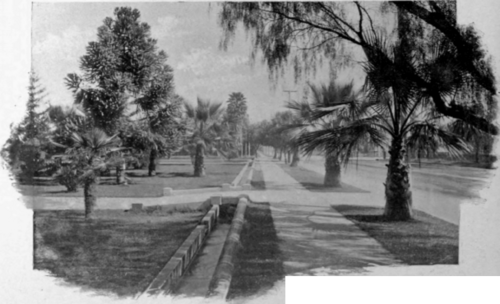
A Palm-Girt Avenue, Los Angeles.
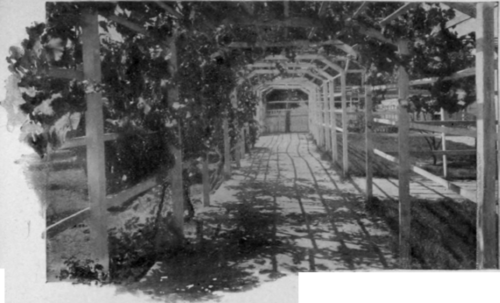
An Arbor In Winter.
Southern California is not only a locality, it is a type. It cannot be defined by merely mentioning parallels of latitude. We think of it and love it as the dreamland of the Spanish Missions, and as a region rescued from aridity, and made a home for the invalid and the winter tourist. Los Angeles is really its metropolis, but San Diego, Pasadena, and Santa Barbara are prosperous and progressive cities whose population increases only less rapidly than their ambition.
One of the first things for an eastern visitor to do, on arriving at Los Angeles, is to take the soft sound of g out of the city's name, and to remember that the Spaniards and Mexicans pronounce e like the English a in fate. This is not absolutely necessary for entrance into good society, but the pronunciation "Angeelees" is tabooed. The first Anglo-Saxon to arrive here was brought by the Mexicans, in 1822, as a prisoner. Soon after, however, Americans appeared in constantly increasing numbers, and, on August 13, 1846, Major Fremont raised at Los Angeles the Stars and Stripes, and the house that he occupied may still be seen. Nevertheless, the importance of Los Angeles is of recent date. In 1885 it was an adobe village, dedicated to the Queen of the Angels; to-day, a city of brick and stone, with more than fifty thousand inhabitants, it calls itself the Queen of the State. Its streets are broad, many of its buildings are massive and imposing, and its fine residences beautiful. It is the capital of Southern California, and the head -quarters of its fruit-culture. The plains and valleys surrounding it are one mass of vineyards, orange groves and orchards, and, in 1891, the value of oranges alone exported from this city amounted to one and a quarter millions of dollars. It must be said, however, that there is less verdure here than in well-cared-for eastern towns of corresponding size, and that Los Angeles, and even Pasadena, notwithstanding their many palm trees, have on the whole a bare appearance, compared with a city like New Haven, with its majestic elms and robe of vivid green, which even in autumn seems to dream of summer bloom. Nevertheless, Los Angeles is clean, and poverty and squalor rarely show themselves; while, in the suburbs of the city, even the humblest dwellings are frequently surrounded by palm trees, and made beautiful by flowers.
Continue to:


My Books

