


Yellowstone National Park. Part 6
Description
This section is from the book "Yellowstone National Park - John L. Stoddard's Lectures", by John L. Stoddard. Also available from Amazon: John L. Stoddard's Lectures 13 Volume Set.
Yellowstone National Park. Part 6
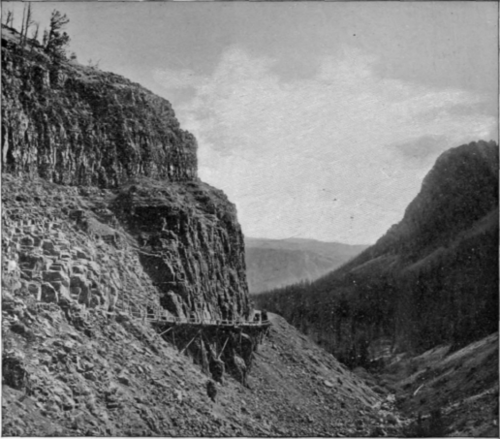
The Golden Gate.
A few miles after leaving the Hot Springs, we reached the entrance to a picturesque ravine, the tawny color of whose rocks has given it the name of Golden Gate. This is, alike, the entrance to, and exit from, the inner sanctuary of this land of marvels. Accordingly a solitary boulder, detached from its companions on the cliff, seems to be stationed at this portal like a sentinel to watch all tourists who come and go. At all events it echoes to the voices of those who enter almost as eager as seekers after gold; and, a week later, sees them return, browned by the sun, invigorated by the air, and joyful in the acquisition of incomparable memories.
Emerging from this Golden Gate, I looked about me with surprise, as the narrow walls of the ravine gave place to a plateau surrounded everywhere by snow-capped mountains, from which the Indians believed one could obtain a view of Paradise. Across this area, like a railroad traversing a prairie, stretched the driveway for our carriages.
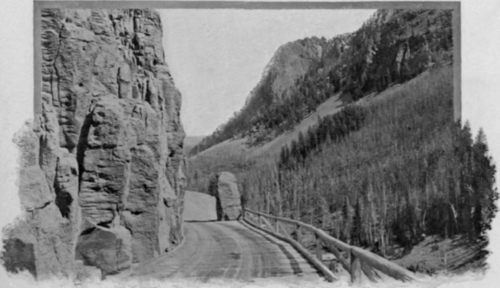
The Golden Gate, Looking Outward.
"Do tourists usually seem delighted with the park?" I asked our driver.
"Invariably," he replied. "Of course I cannot understand the words of the foreigners, but their excited exclamations show their great enthusiasm. I like the tourists," he continued, "they are so grateful for any little favor! One of them said to me the other day, 'Is the water here good to drink ?' 'Not always,' I replied, 'you must be careful.' At once he pressed my hand, pulled out a flask, and said, 'I thank you!' "
While crossing the plateau we enjoyed an admirable view of the loftiest of the mountains which form, around the Park, a rampart of protection. Its sharply pointed summit pierces the transparent air more than eleven thousand feet above the sea, and it is well named Electric Peak, since it appears to be a storage battery for all of the Rocky Mountains. Such are the mineral deposits on its sides, that the best instruments of engineers are thrown into confusion, and rendered useless, while the lightning on this favorite home of electricity is said to be unparalleled.
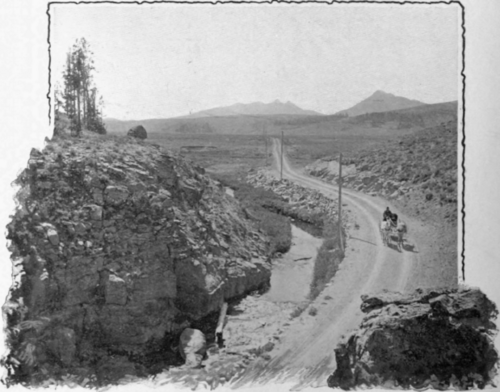
The Plateau.
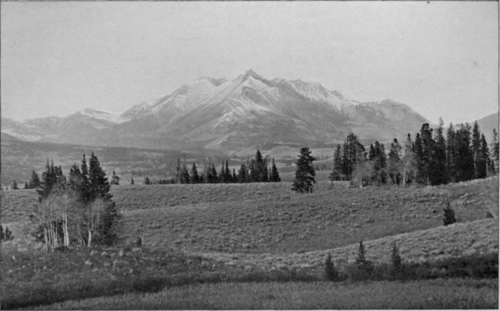
Electric Peak.
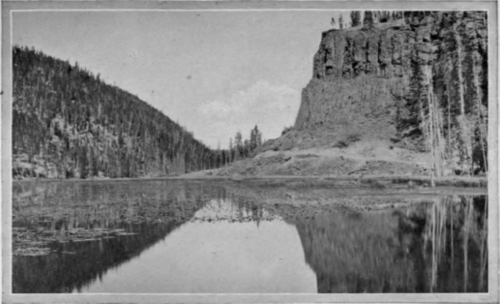
The Glass Mountain.
Presently a turn in the road revealed to us a dark-hued mountain rising almost perpendicularly from a lake. Marvelous to relate, the material of which this mountain is composed is jet-black glass, produced by volcanic fires. The very road on which we drove between this and the lake also consists of glass too hard to break beneath the wheels. The first explorers found this obsidian cliff almost impassable; but when they ascertained of what it was composed, they piled up timber at its base, and set it on fire. When the glass was hot, they dashed upon the heated mass cold water, which broke it into fragments. Then with huge levers, picks, and shovels, they pushed and pried the shining pieces down into the lake, and opened thus a wagon-road a thousand feet in length.
The region of the Yellowstone was to most Indian tribes a place of horror. They trembled at the awful sights they here beheld. But the obsidian cliff was precious to them all. Its substance was as hard as flint, and hence well suited for their arrow-heads. This mountain of volcanic glass was, therefore, the great Indian armory; and as such it was neutral ground. Hither all hostile tribes might come for implements of war and then depart unharmed. While they were here a sacred, intertribal oath protected them. An hour later, those very warriors might meet in deadly combat, and turn against each other's breasts the weapons taken from that laboratory of an unknown power.
Can we wonder that, in former times, when all this region was still unexplored, and its majestic streams rolled nameless through a trackless wilderness, the statements of the few brave men who ventured into this enclosure were disbelieved by all who heard them ? One old trapper became so angry when his stories of the place were doubted, that he deliberately revenged himself by inventing tales of which Munchhau-sen would have been proud. Thus, he declared, that one day when he was hunting here he saw a bear. He fired at it, but without result. The animal did not even notice him. He fired again, yet the big bear kept on grazing. The hunter in astonishment then ran forward, but suddenly dashed against a solid mountain made of glass. Through that, he said, he had been looking at the animal. Unspeakably-amazed, he finally walked around the mountain, and was just taking aim again, when he discovered that the glass had acted like a telescope, and that the bear was twenty-five miles away! Not far from the volcanic cliff which gave the trapper inspiration for his story, we reached one of the most famous basins of the Park. In briefest terms, these basins are the spots in the arena where the crust is thinnest. They are the trap-doors in a volcanic stage through which the fiery actors in the tragedy of Nature, which is here enacted, come upon the scene. Literally, they are the vents through which the steam and boiling water can escape. In doing so, however, the water, as at the Mammoth Springs, leaves a sediment of pure white lime or silica. Hence, from a distance, these basins look like desolate expanses of white sand. Beside them always flows a river which carries off the boiling water to the outer world.
Continue to:


My Books

