


Beekeeping Is Pleasurable And Profitable. Continued
Description
This section is from the book "Beekeeping for Beginners", by G. H. Cale, Jr.. Also available from Amazon: Beekeeping for Beginners.
Beekeeping Is Pleasurable And Profitable. Continued
Beekeeping Is Universal
Wherever flowers bloom, bees may be kept, the success of their efforts, of course, depending upon the rigors and length of the season and on the amount of bloom available. While the vigorous extremes may preclude profitable bee culture in the Arctic or the desert, yet some bees are kept in Alaska, and nomadic tribes carry their rude colonies with them in the Near East as they wander across the sands with the seasons.
Fifty years ago the Dakotas and the western Canadian provinces imported honey. Bees apparently were thought unable to flourish there. Yet, today these very sections represent some of the best commercial honey producing regions of the American continent.
Nor has civilization and city congestion limited the possibility for keeping bees. For wherever there are flowers, honey bees may be kept.
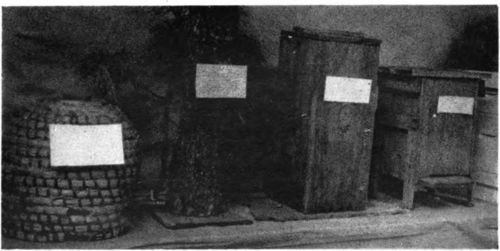

The evolution of the modern beehive. Top-straw skep, log hive, wooden box hive. Left -Langstroth hive and Modified Dadant hive. Notice the difference in size between the Langstroth and the Modified Dadant.
Beekeeping Made Easy
The beekeeper in antiquity knew little of the bee colony organization. His hives were rude log gums, crudely fashioned clay cylinders, or straw skeps. (These still persist in many countries of Europe, Asia, and Africa, and we still have our share of box or log hives and "gums" in certain American localities. )
But we of present-day America may share the progress brought, to beekeeping everywhere in the 1850-1870 period by the inventions of three men which have revolutionized the method and ease of keeping bees.
Our own L. L. Langstroth discovered the significance of a bee space in the interior of the beehive and subsequently invented the movable comb hive, a hive with frames made of wood, each of which contain a honey comb. The frame hangs by an extension of its top bar at both ends of the hive, leaving a 3/8 to 1/2 inch space at the ends and bottom of hive which serves as a passageway for the bees and is called the bee space. This space allows room enough for the withdrawal of the frames from the hive for examination or replacement but not enough space between the frame and wall of the hive to induce the bees to build comb attachments. Langstroth's hive was made with the top removable so that any or all frames might be lifted independently from the hive body. (Some European hives, particularly in Germany, have movable frames but a back or side opening so that it is necessary to remove all frames in order to look at the one farthest from the open side or back. )
Following Langstroth's invention, Johannes Mehring in Germany conceived the idea of furnishing to the bees a part of the beeswax they needed in forming their combs. His idea was to imprint into the flat thin sheet of beeswax, the impression of the cells of a comb. Thus, all the bees need do is to draw out these cells of wax, adding beeswax of their own production to finish the proper depth of the comb. So, we now have straight combs instead of the conglomeration of immovable cross-combs as in the skep, box hive, or gum. These sheets fitted into the Langstroth frame would be drawn out by the honey bee colony, making for ease of handling and examining the colony and ease of producing and removing the surplus honey.
Franz Hruschka in Italy, meanwhile, had discovered that combs of honey whirled centrifugally could be made to release their store of honey; and the third item for modern honey production was born with the invention of the honey extractor.
No more need the combs be cut out and squeezed to get the liquid honey. Merely slice off the cappings of full combs of honey, combs built on Mehring's foundation, in Langstroth's movable frame, place them in Hruschka's honey extractor with resultant clear liquid honey, free of all bees, larvae, and pollen.
And the beauty of it was, these combs after the honey was extracted could be returned to the colony to be refilled by the honey producing colony and used again, year after year.
On these three inventions, with improvements, of course, is built the ease of keeping bees and handling honey as practiced today.
Readily available also are college courses in beekeeping, even correspondence courses, as well as lectures and short instruction classes in many vocational educational schools. Bee books and bee journals as well as state and government bee departments stand ready to help answer the questions of the beginner or commercial beekeeper.
Continue to:


My Books

