


Chapter III. Beekeeping Equipment
Description
This section is from the book "Beekeeping for Beginners", by G. H. Cale, Jr.. Also available from Amazon: Beekeeping for Beginners.
Chapter III. Beekeeping Equipment
INTEGRAL parts necessary for successful beekeeping are the bees themselves with their queen, and a beehive in which they may locate and raise their brood. The beehive should be large enough to accommodate a prolific queen, thus helping reduce crowding and minimizing swarming.
This may be provided by a large brood chamber hive in one story like the Modified Dadant or with the smaller but more standard 10-frame Langstroth style hive where generally a second story or hive body is added when needed. However, this need not be considered by the beginner in his first season.

Diagram of the various parts that comprise the beehive
The beehive will consist of a bottom board with provision for entrance, the hive body itself with frames in which the bees will live and work, and a hive cover over all. All frames within the brood chamber should be provided with full sheets of bee comb foundation (thin sheets of beeswax bearing the imprint of cells of the comb). This foundation assures that when drawn out and added to by the bees, the beekeeper will have nicely spaced straight combs of brood, honey and pollen. These combs may then be easily withdrawn by the beekeeper to enjoy observations of the queen, the bees, and the drones, and to determine the status of the colony as to brood, honey, and pollen stores.
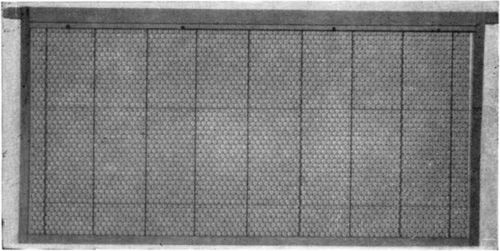
A frame with wired foundation. The wooden portion on the outside is the frame, the center portion the wax foundation. Notice the crimped wire in the foundation which adds strength to the finished bee comb.
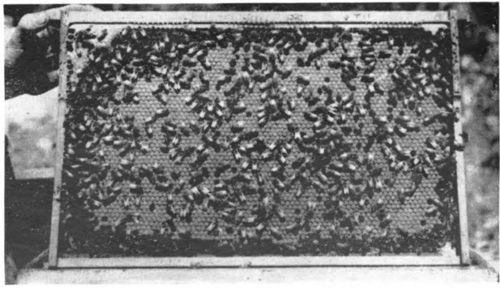
A beautiful comb of brood-result of foundation well built
This hive, then, with its top, bottom and hive body with frames and combs of bees, brood, pollen and honey constitutes the bee colony.
Additional equipment consists of supers with frames and foundation to be placed on the hive as is needed in which the bees may store the nectar from the flowers and evaporate or thicken it into the honey which will be removed.
Here the beginner has a decision to make. He may decide to produce honey in the little pound boxes called sections and consume or dispose of it in section or comb honey form. In such case, he will order comb honey supers with comb honey sections and foundation to fit.
Or he may wish to produce for his own use in shallow frames (5-3/8 or 6 1/4 inches deep), comb honey which he can cut out of the frames for home consumption, to give to friends, or to sell wrapped in cellophane. In such case, he uses shallow supers with frames and thin foundation. Thus, the combs may be cut out when filled, new foundation inserted, and the frames returned to their supers for the balance of the crop.
The beginner may ultimately wish to produce liquid or extracted honey. In such case, the same shallow supers may be equipped with medium brood foundation, which is heavier; or added hive bodies with full depth brood frames may act as storage space for surplus honey. This extracted honey production, however, will require additional removal equipment such as an uncapping knife and honey extractor.
Perhaps the first season, in any case, the beginner would be better off as his colony builds up, to order his surplus honey storage space for either comb honey or for bulk honey in shallow frames. The latter has the added advantage that such storage equipment may be used for extracted honey production if a change to that type of production is made later.
Equipment for handling the colony of bees is a necessity. A bee veil should be worn protecting the face from the attack by any occasional angry bees. Bee gloves, while not necessary, do give a feeling of security until the amateur has become acquainted with the manipulation of the colony.

Wire Veil
The bee veil protects the face and neck from stings. While some beekeepers actually work with bees without any protection for the face, this is not advised for the beginner.
There are several types of veils, but the wire veil which stands out from the face offers the best protection. The wire is stiff enough to keep the wind from blowing the veil and to keep branches of trees from brushing it against the face. Any type of hat may be worn with this type of veil; it is recommended however, that a lightweight, well - ventilated summer or straw hat be worn.
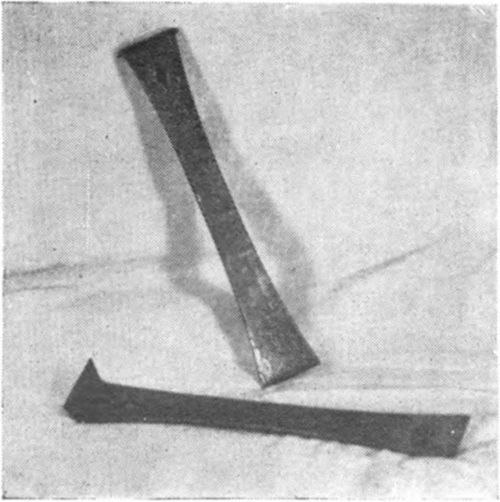
Hive Tool
The all-purpose hive tool. Used for pulling nails, scraping beeswax and propolis, prying frames apart, taking off the cover, inner cover, and super, and other utility purposes. Notice the hole used as a nail puller and the angle end which is used for scraping wax and propolis. Beekeepers sometimes use such things as screw drivers and car springs in place of the hive tool, but such substitutions are never so desirable a tool.
The bees use beeswax and propolis to stick the frames together which makes it necessary to have some kind of an allpurpose tool to use in working the hive. The modern hive tool is the answer to this necessity. In addition to having a cleaning and scraping edge, it also has a nail puller as a built-in feature.
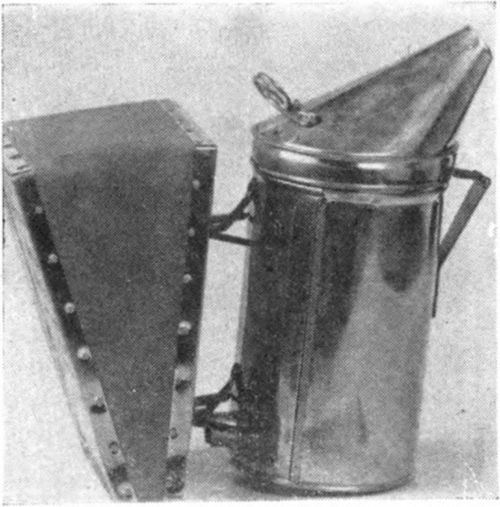
The bee smoker is one of the most important tools that the beekeeper uses. It helps to subdue and quiet the bees and they sting very little when the smoker is used properly. On the other hand, excessive use of the smoker may tend to irritate and anger the bees to the point where they will sting readily.

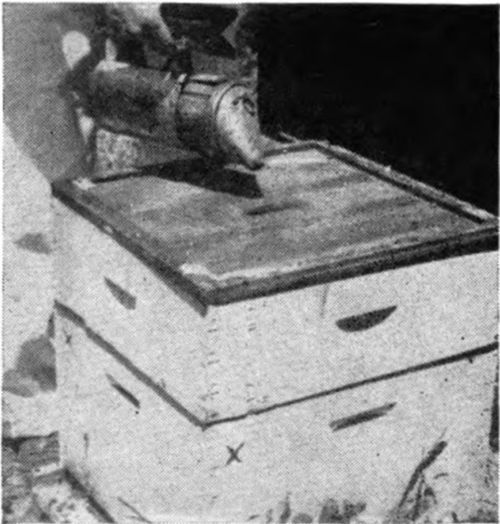
Before starting to work a colony of bees puff a little smoke in the entrance to the hive. This smoke at the entrance disrupts the guard bees and causes the bees within the lower parts of the hive to gorge themselves on honey.
Continue to:


My Books

