


Chapter XII. Rearing Queens - Queen Introduction
Description
This section is from the book "Beekeeping for Beginners", by G. H. Cale, Jr.. Also available from Amazon: Beekeeping for Beginners.
Chapter XII. Rearing Queens - Queen Introduction
IN successful beekeeping and for maximum honey production it is desirable, naturally, to have the colony at maximum strength at the time of the opening of the major honey-flow. Inasmuch as every emerging worker bee owes its existence to the queen, it is logical that the condition of the colony will depend upon the quality of the queen which heads that colony and the vigor with which she proceeds to furnish the eggs from which evolve the potential honey and pollen gatherers for the honeyflow to come. In fact, "the queen is the soul of the colony. "
Owing to various causes: poor mating, chilling, accidental damage, heavy demand through long protracted flows, or winter chilling, the queen is apt to show signs of failing, even though she has not reached the age at which queens ordinarily deteriorate. Such a queen should be replaced as soon as the beekeeper becomes aware that her best days are over.
In a state of nature, the bees will take care of this themselves by making provisions within the hive and raising queen cells for a new queen. This is called Supersedure. These "Supersedure cells" are usually few in number. When the new queen has emerged, she is subsequently mated and takes her place as the new egg-laying fountain of the hive. The old queen either is destroyed by the new one or she disappears, probably disposed of by the bees of the colony, although the old and new queens (mother and daughter) may remain in the hive from several days to a few weeks.
Some beekeepers leave it to the bees to take care of requeening by these Supersedure methods. The difficulty is that many times the bees do not become aware, in time, of the failure of their queen and the colony dwindles in strength, taking considerable time to bring it back to nectar gathering strength, during which time the major honeyflow could have waned and passed with insufficient bees in the hive to make a satisfactory crop.
So, more and more, the beekeeper lends a hand in seeing that the apiary is headed by queens, young and vigorous, for egg laying. Such requeening is ordinarily done every two years, but should be done in each colony as needed.
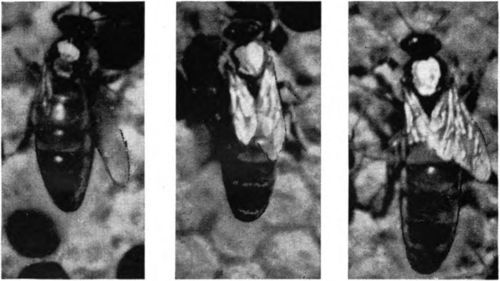
The queen at right is a large, long and well proportioned, good queen. The queen in the middle is satisfactory but of medium size. The queen at the left is a a stubby-type and a very poor layer. Medium-size and stubby-type queens seldom have the egg-laying capacity of a queen of the type illustrated at the right.
When bees are transported from one honeyflow to the other during the season so that a full harvesting force is needed over a long period, the queen's laying powers, even though she may have proved to be a superior queen, may be taxed to the point where she may last only a season, while in other seasons with lighter flows, the call on the queen may not be so great. In any case, it is up to the beekeeper to judge whether or not a new queen is needed to head the colony for maximum efficiency.
Ordinarily most queens are secured from commercial queen breeders in the South who are situated where they can rear good queens in quantity and at a reasonable price. These breeders have the added advantage that, being in the business, they have an opportunity of choosing queens which will be the best breeders. There is the added advantage that they may surround their queen rearing yards with drone producing colonies headed by superior mothers, for the virgin queen is mated only in flight and the beekeeper has little choice of the drones selected except by providing maximum possibilities of desirable drones. This practice of supplying proper drone flight is particularly practiced by those queen breeders offering instrumentally developed hybrid bees. Indeed, future improved strains of bees will probably all be the result of scientific hybridization using controlled instrumental insemination.
However, home requeening is sometimes practiced by the beekeeper. He may either have a queen which has headed a colony of exceptional value, whose qualities he wishes to perpetuate in his apiary, or he may, with innate interest and curiosity, want to do a little queen rearing "on his own. "
When a colony is suddenly made queenless, it immediately proceeds normally, to rear queen cells from the eggs still within the hive; sometimes only a few, sometimes a goodly number. Thus, all the beekeeper has to do to raise queens is to make his choice colony queenless. The bees build of the chosen larvae special queen cells, and give them special food called royal jelly during the first few days of their growth. This eventually leads to the sealing of the special cells, and their emergence as virgin queens fifteen or sixteen days after the laying of the egg.
The amateur queen breeder will want to have his colonies or nuclei (small two or three-frame colonies) prepared so they are ready to receive the sealed cells (when the cells are eight or nine days old). If a colony is to be requeened, a sealed queen cell is cut out of the comb of the breeder queen with an inch or so of comb around it so that the cell will not be damaged. This cell is now inserted into the colony to be requeened, preferably by cutting, in a comb near the brood, a space large enough so that the cell and its attached comb may be inserted. In due course of time, the young queen will emerge, take her wedding flight and return to head the colony. The colony to be requeened, of course, will have been deprived of its queen the day before the new cell is given.
Continue to:


My Books

