


The Honeyflow And Removal Of The Crop. Part 2
Description
This section is from the book "Beekeeping for Beginners", by G. H. Cale, Jr.. Also available from Amazon: Beekeeping for Beginners.
The Honeyflow And Removal Of The Crop. Part 2
Chunk Honey
When packing chunk honey, the bulk comb honey is cut into rectangles which fit into the mouth of a glass jar. The remaining space in the jar is then filled with liquid honey which has been previously heated to 150 degrees F. and allowed to cool quickly to 110 degrees F. before it is poured over the honey chunks in the jar. As soon as the jar is filled the lid should be placed on tightly and the jar laid on its side. This will prevent the comb from being crushed while the honey is hot. When the honey has cooled thoroughly the jar may be packed in a shipping case.
Chunk honey should not be stored for too long a time since it is apt to granulate. Jars of honey that have granulated may be liquefied by placing in a warm oven. (The temperature should be kept below 145 degrees F. which is the melting point of beeswax. )
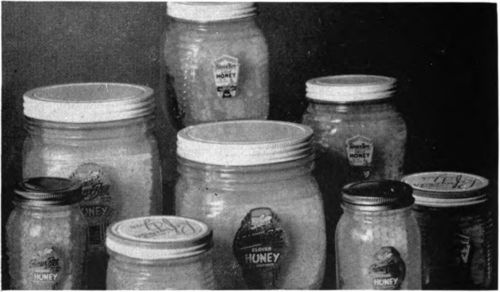
Chunk honey packed in a jar is a fancy honey. The beekeeper should always be sure that the finished product is neat, clean, and attractive. The comb should be white and free from pollen or stains and the liquid honey should be clean and clear.
Cut Comb Honey
Cut comb honey is bulk comb honey cut up into varying sizes or pieces. Cut comb usually varies in size from a small 2-ounce individual serving to larger ones weighing as much as a pound.
The pieces of cut comb honey are drained on a screen in a warm room for 24 hours. If an extractor is available they may be placed in a screen basket in the extractor and the liquid honey along the cut edges may be thrown off by centrifugal force. The pieces of cut comb honey are then wrapped in cellophane and placed in cartons of cardboard. The finished product resembles section comb honey.
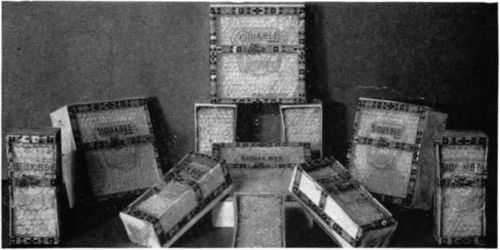
Packages of cut comb honey packed and ready for the market.
Management For Extracted Honey
Because of the initial expense involved, the beginner is not urged to produce extracted honey. Extra equipment required to produce extracted honey includes such items as an extractor and an uncapping knife. In a large apiary, or from the standpoint of commercial beekeeping, extracted honey is the cheapest to produce, since one man may care for more colonies in less time than with the two previously mentioned systems.
The early management of colonies to be used in extracted honey production is no different than that of section and bulk comb honey. No matter what type of honey is being produced, the colonies involved should be at the peak of their strength when the honeyflow begins.
The foundation used in the extracting super frames differs from section and bulk comb foundation in that it is made of a somewhat darker and heavier wax. It is also wired to prevent the comb from breaking in the centrifugal extractor. In producing extracted honey the same combs may be used year after year, while in bulk and section comb honey the supers are filled with new foundation each year.
Supers of drawn comb are added to the top of the hive in extracted honey production. As the top super is filled with honey and the bees have started to whiten the comb and seal the cells, another super is added on top of the one already on the hive. The beginner, starting out with all new equipment and supers of foundation instead of comb, should follow the same Supering procedure and manipulation as given for bulk comb honey production. Usually four supers per hive are enough. If the honey crop is larger, and more supers are needed, the full supers may be taken off and extracted and the supers with empty combs placed back on top of the colony.
In extracting the honey from the combs the first step is to remove the wax seal over the top of the cells. This is accomplished by means of an uncapping knife. The knife slices the wax seal from the cells so that the honey may be thrown out by centrifugal force in an extractor. For best results the honey should pass from the extractor, through strainers, and into a storage tank. After settling for 24 hours, the honey may be drawn from the storage tank into cans or bottles to be used by the producer or sold on the market.
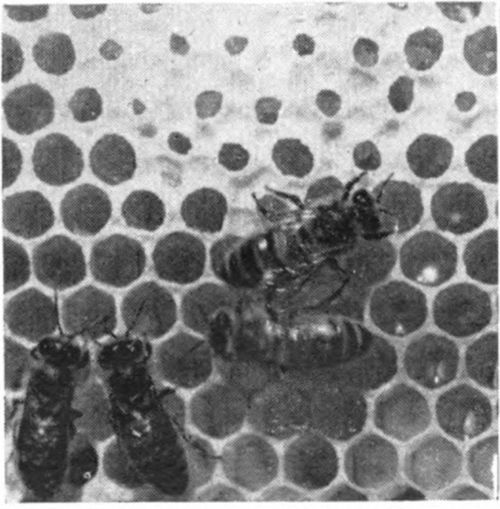
Notice how the cells at the top of the picture are white with new wax and how the bees are sealing the full cells of ripe honey.
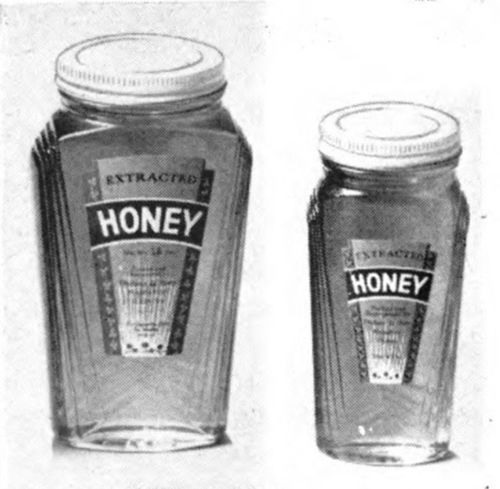
Jars of extracted honey after drawing from the storage tank. With the addition of a colorful label, these jars will make an attractive display.
Continue to:


My Books

