


Beekeeping for Beginners. Part 2
Description
This section is from the collection of "Booklets on Bee Managements", by Various Authors. See also: Hive Management: A Seasonal Guide for Beekeepers.
Beekeeping for Beginners. Part 2
How to Build a Beehive
Factory-made beehives and frames are best. Their parts are of standard size and are interchangeable.
If you prefer to build your own beehive, use a factory-made hive as a model. Reproduce all parts exactly and keep all dimensions the same, so that the parts will fit together well and be interchangeable with corresponding parts in other hives.
Of special importance is the space you leave between frames in your hive. It should be about three-eighths inch. If the space is less, it will be too small for the bees to pass through, and they will seal it off with propolis. If the space between frames is more than three-eighths inch, it will be too wide and your bees will build honeycomb in it. Neither of these is desirable.
The diagram on page 6 gives plans and dimensions for constructing a 10-frame beehive-the most common hive size.

Plans and dimensions for a 10-frame beehive.
Where to Keep Beehives
When your hive is stocked with a bee colony, put it where the bees are unlikely to sting anyone.
If you live in a warm area, put the hive in the shade. If you live in an area that has extended periods of freezing temperatures, expose it to the sun and protect it from prevailing winds-particularly in winter.
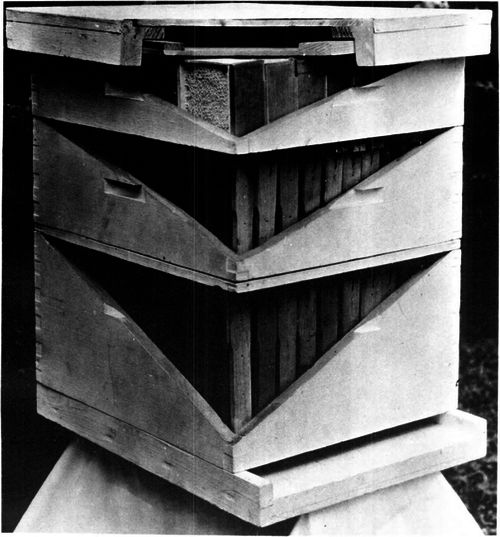
Beehive cutaway to show interior and placement of movable frames: Bottom, full-depth hive body; middle and top, shallow hive bodies.
Be sure there is a constant supply of fresh, cool water nearby.
For more information, write for Leaflet No. 530, "Shade and Water for the Honey Bee Colony, " available free from the Office of Governmental and Public Affairs, U. S. Department of Agriculture, Washington, D. C. 20250.
What Bees Need
Bees need four basic materials: Nectar, pollen, propolis, and water. They make honey out of nectar. They make pollen into beebread (food for young bees). They use propolis to seal cracks and waterproof their hive. They dilute honey with water before eating it, and they use water in their hive "air conditioning system. "
Nectar
Bees can't make honey without nectar, a liquid sugary substance produced by flowers. It is the raw material of honey and the bees' main source of food.
Several hundred kinds of plants produce nectar, but only a few kinds are common enough, or produce enough nectar, to be considered major sources.
The best sources of nectar for producing surplus honey vary from place to place. As a beekeeper you will want to learn what plants in your area are best for honey production. Here are some of the plants that are major nectar sources in the United Statesalfalfa locust aster mesquite buckwheat palmetto catclaw tuliptree citrus fruit tupelo clover sage cotton sourwood fireweed star thistle goldenrod sweetclover holly sumac horsemint willow
The color and flavor of honey depend on the kinds of plants that bees collect nectar from. Honey may be colorless, amber, or even reddish; its flavor can range from mild to strong.
Pollen
As worker bees gather nectar from flowers, tiny particles of pollen stick to their bodies and are accumulated in pellets on their hind legs. This pollen is carried back to the hive where the bees store it as "beebread" in cells of the honeycomb.
Later, worker bees in the hive consume the "beebread" and the nutrients in it are converted into larval food by special glands in the heads of the "nursemaids. " (The few young larvae selected by the workers to become new queens are fed a greater amount of an enriched larval food commonly called royal jelly. ) Pollen, therefore, is necessary for producing new bees.
An average-size colony of bees uses about 100 pounds of pollen each year. That is why you need to locate your colonies near good sources of pollen. Many wild flowers, ornamentals, weeds, shrubs, and trees will provide pollen. Some especially good sources are: aster maple clover wild mustard dandelion poplar fruit blossoms ragweed goldenrod willow
How Bees Make Honey and Wax
The nectar that bees collect is generally half to three-fourths water. After nectar is carried into the hive, the bees evaporate most of the water from it. While evaporating the water, enzymes change the nectar into honey. Then the bees seal the honey into cells of the honeycomb.
Beeswax begins as a liquid made by glands on the underside of the worker bee's abdomen. As it is produced, it hardens into tiny wax scales. Worker bees then use this wax to build honeycomb.
Beekeepers often provide their bees with honeycomb foundation made of sheets of beeswax. This foundation fits into hive frames and becomes the base of the honeycomb. It enables bees to speed up comb construction, and it provides a pattern for building a straight and easy-to-remove honeycomb.
How to Move a Colony
If you need to move your bee colony, get the bees oriented to the new location. Unless you move at least several miles, the bees will find their way back to their old location.
If you want to move your bees only a few hundred yards, first take them several miles away and leave them for a week or more. After they get used to the distant location, move them to the nearby site you originally desired, and let them get oriented there.
Or, move the colony a few feet each day, until you have moved it to the location you want.
It is not advisable to move bees during the period of honey production. The honey already stored will add extra weight; new honeycomb may break loose; and you will disturb your bees and cause a slowdown in honey storage.
Night is the best time to move a colony. All the bees are inside then. If the weather is cold, you can completely close the hive entrance.
If the weather is unseasonably warm and the colony strong, do not seal the hive entrance. You might suffocate your bees, even if you seal them in for only an hour. Instead, cover the entrance and replace the cover of the hive with a fine screen.
Staple, crate, or tie the hive in advance so that parts cannot shift during the move.
Continue to:


My Books

