


Invention Of The Honey Extractor. Continued
Description
This section is from the book "History Of American Beekeeping", by Frank Chapman Pellett. Also available from Amazon: History Of American Beekeeping.
Invention Of The Honey Extractor. Continued
The machine consists of a tin case, in shape somewhat resembling a common wash boiler, adapted to receive frames of any size, across either end, and is made to revolve upon a central stationary spindle, set in a cast iron base.

H. O. Peabody manufactured the first honey extractors offered for sale in America.
The bottom of the can is made sloping toward the center, and has a metal casting of peculiar form soldered into the center of the same, through the center of which passes the spindle on which the case revolves, and in which are also formed outlet passages, through which the honey is discharged.
While this machine remained on the market for some years, it appears never to have had a large sale.
Soon machines began to appear under the name of numerous men who had some minor difference to offer. There was "Gray's Honey Slinger, " a Muth extractor, and a dozen others, all presenting some supposed advantage but really differing but little from each other.
Herrod-Hempsall in his Beekeeping New and Old states that the first practical cylindrical extractors, called
"Honey Slingers, " to be sold in England were manufactured by R. R. Murphy, of Fulton, Illinois, and cost delivered in England a total of eight pounds sterling. Because of the high price, only three were sold in England. This was about 1873, the year when T. W. Cowan began his experiments which led to the Cowan extractor. Cowan appears to have originated the reversible basket, which enabled the beekeeper to change sides of the comb to be extracted without lifting them from the machine. This was a very important step forward, and was later adopted by most of the machines in common use.

The Peabody extractor differed in that the can with contents rotated on a pivot.
While many individuals offered minor changes in these machines, but few men seem to have made any definite contribution. The first machine built in this country by Langstroth and Samuel Wagner was quite different in design from the Hruschka extractor, although, of course, utilizing the same principle of centrifugal motion. It provided for rotation of the combs within a container by means of a gear driven shaft, and this improvement is retained until now. Quinby appears from the record to have gone a step farther, although just how much he contributed to the machine later known as the "Novice, " developed by A. I. Root, is not clear from the record. Root made a very definite improvement in the container by using a can which was taller than wide, and by means of improved driving machinery. To this, the reversible baskets contributed by Cowan were added later. Little further improvement was apparent for many years.
Automatic reversing extractors had a short vogue. Cowan's baskets were hung from hinges fastened at one side and. by swinging first one way and then the other, both sides of the comb were emptied. The next step was to set the baskets on a pivot in the center of the bottom, and to reverse by simply turning the basket while the machine was in motion.
Who is entitled to prior credit in originating this form of reversing frames, is not entirely clear. In the spring of 1917, the writer visited T. W. Livingstone at Leslie, Georgia, and was much interested in a machine which Livingstone had built for his own use on this plan. It was illustrated in the American Bee Journal, December, 1919. Livingstone previously had described it in the same magazine in 1909, and the machine had been in use in his apiaries since that time. Whether or not he was the first, he never received either recognition or reward for the invention.
About 1919 a man named Markle demonstrated an extractor which he called the "New Idea" at the annual meeting of the Ontario Beekeepers' Association. This machine was manufactured and offered for sale in 1921 by Ham Brothers, of Brant ford, after it had been given two years of tests in the apiaries of Foster and Holterman. In 1922, it was offered in the United States by the name of Lewis-Markle extractor, by the G. B. Lewis Company of Wisconsin. It was built as a power machine only, with eight baskets. A considerable number of them were sold for a few years.
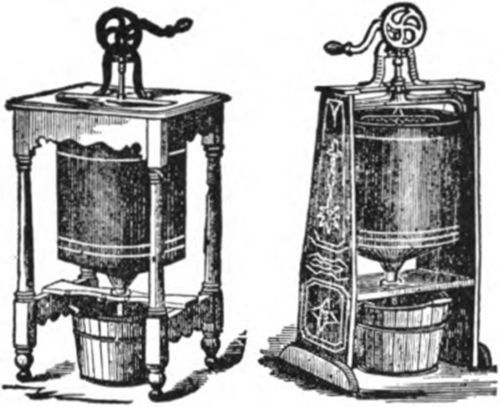
These models of the Gray machine, known as honey slinger, were typical of early extractors.
In 1919, the Root Company also built a machine of this type which they called the Buckeye. It was tried in a Michigan apiary that year and again in 1920. A model for trial was first built at Medina in 1918. In 1921, they offered it in the catalog and continued its sale for several years. Others have since appeared.
The perfection of the radial extractor by several individuals at about the same time brought a new kind of power extractor into the market, and definitely retired the Buckeye and the Markle.
Radial extraction appears to have been suggested by several soon after Hruschka discovered that honey could be thrown out by centrifugal motion, but much difficulty appeared in the making of a practical machine. It was mentioned by Hamet in L'Apiculteur in 1867. Cowan's first extractor, which was exhibited at the Crystal Palace in 1874, appears to have been built on this principle, as will be seen from the following description by the editor, C. N. Abbot, in the October 1 issue of the British Bee Journal:

Late model two-frame extractor was modeled after the Novice made by Root.
Instead of the combs of honey standing at right angles with the radii of the circle as with others and forming two sides of a square within the circle in which they revolve, and which necessitates the reversal of their positions, as each side of the comb is operated upon, they stand perpendicular as radii from the center of the machine in the same plane with its spindle; and the argument appears to be, that inasmuch as the cells point slightly upwards toward the top bar of the frame of comb, if the frame is placed on end with its top bar outermost, the cells will have their inclination outward, and at the angle which most facilitates the escape of the honey from them.

T. W. Cowan of England was responsible for reversible baskets and these were promptly adopted in America.
In the same magazine (August 16, 1888), Mr. Cowan tells of his success with this first outfit, but explains that it was safe to extract only old combs because of damage to new combs through breakage. He then described a similar machine invented by M. Buhne-Lauben, of Schleisen. When Cowan invented reversible baskets the radial principle was dormant for many a long year.
In 1893, "Rambler" described, in Gleanings, the Bohn's honey extractor invented by a German living in California. Bohn placed the combs in a wheel so constructed that fourteen combs could be extracted at once. It was provided with gearing and is described as "so simple and easy that the eleven-year-old boy, Claude Henderson, extracted with it twelve tons of honey during the past season. "
About 1922, interest was revived in this method of extraction and experiments looking toward a practical machine were undertaken. In 1924 S. P. Hodgson & Sons, of British Columbia, patented such a machine in Canada and, in the following year, the A. I. Root Company announced their Simplicity machine which held forty-five combs, whereas the Hodgson machine took twenty-eight. Herrod-Hempsall patented a similar machine in England shortly before, and it appears that Hodgson based his machine on that.
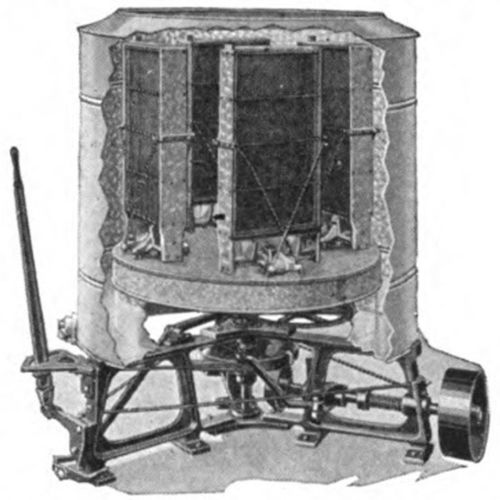
The Lewis-Markle was the first of the pivotal type reversible extractors to attract much notice in this country. It had a short period of favor.
Arthur Hodgson, of Jarvis, Ontario, built a machine in 1923 on the general plan of the Bohn extractor which would carry forty-eight combs at one time. Root credits Arthur Hodgson with building the first practical machine which would throw out the honey in a commercial way without reversing the combs, and at the same time reduce the time necessary for the operation. Although it took longer to extract a comb completely, the fact that the machine could accommodate so many more combs at one time made the final result more efficient.
There were other patents both in this country and abroad, but since the machines did not come into common use, they contributed little to the development of the industry.
Continue to:


My Books

