


Shipment Of Queens
Description
This section is from the book "History Of American Beekeeping", by Frank Chapman Pellett. Also available from Amazon: History Of American Beekeeping.
Shipment Of Queens
No sooner did beekeepers begin rearing queens than they began looking for some cheap and safe way of transporting them to their customers. The first queens to be sent by mail probably were sent in 1863, by C. J. Robinson, of Richfield, to Langs-troth. Mr. Robinson had received Italian queens from P. J. Mahan, of Philadelphia, by express and was bothered about getting them as he lived twenty miles from an express office. In that day of horse and buggy movement, twenty miles was a considerable distance. He thought that queens might be sent by mail and wrote to Langstroth to get his opinion of the matter. Langstroth replied that he thought it was impractical. To prove his point, Robinson caught a black queen and confined her in a cage with several workers and dispatched them by mail carried in a stage coach to Langstroth's address. The bees reached Langstroth in good condition and, in return, he sent a fine Italian queen to Robinson. This mailing was not so fortunate, as the bees were daubed with honey and the queen soon died. A second attempt resulted in a safe journey.
In 1868, Moses Quinby advertised to ship queens short distances by mail. Such shipments did not become common, however, since they were soon excluded from the mails by postal officials. The matter was frequently agitated by the beekeepers from time to time, as told in the chapter on beekeepers' societies, and committees were appointed and petitions sent to Washington.
The matter was finally settled in section 372 of the postal laws, approved March 3, 1886, in which it was provided:
"Queenbees and their attendant bees may be sent in the mails, when properly put up so as not to injure the persons of those handling the mails, nor soil the mail bags or their contents. "
Shipping Cages
The first queen cages were very crude in comparison to those now in use. A block of wood two inches square and an inch and a half in thickness was used. A hole bored to within one-fourth inch of the bottom left a good-sized cavity for bees and food. A piece of capped comb honey was cut to fit the hole and this was placed on the alighting board of a hive to be cleaned by the bees. This was to prevent the occupants of the cage from getting daubed by the honey. The small piece of comb was fastened in place by means of a wooden pin passed through small holes which previously had been bored in the box. The open top was covered with wire cloth to prevent the escape of the queen and her attendants. Such cages were difficult to stock, and it was not easy to remove the queen for introduction to her new colony.
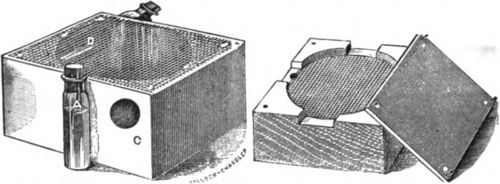
Early queen cages made no provision for stores in compartment separate from that occupied by the bees.
Many types of cages appeared, resulting from efforts of bee-men to find something really satisfactory. A. I. Root offered a cage made in a square block of wood thinner than the above, provided with a slide cover for an opening in the side, and stocked with candy, which was a step in advance.
For a time A. I. Root shipped queens in cages made by placing a wire screen cover over both sides of a comb honey section filled with comb and containing a small amount of sealed honey. This permitted sending a considerable number of bees along with the queen.
The cage problem was finally solved by Frank Benton who used a small block of wood with most of its interior cut away. This left only a hollow shell open on one side. Part of this space was filled with candy for food. The open side was covered with wire cloth.
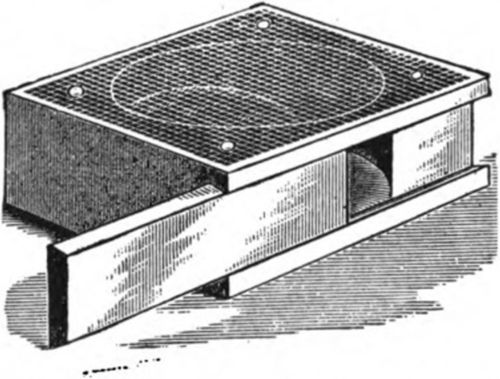
Novice's queen cage which was described as about one inch high and two inches square. 1878.
A small hole, large enough to permit the passage of a single bee, was bored in each end. One of these holes was entirely filled with candy to permit the liberation of the queen when all the candy had been eaten away by the bees in the hive in which it was placed for introduction. The other hole permitted the beekeeper to put in the queen and her attendants, after which it was closed by a bit of metal nailed over it. This Benton cage, with slight changes, has remained in common use until now.
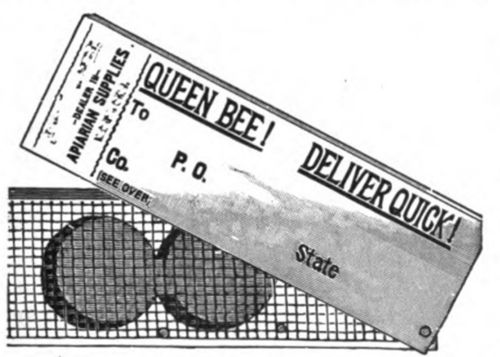
The Benton cage is still the one most commonly used.
A great many variations in the candy used for stocking the cages appeared from time to time. Much space was given to this subject in the bee magazines. P. L. Vial-lon appears to have been the first to succeed with candy with the formula described in Chapter XX (The Trade In Live Bees). Of course, others offered what they thought to be improvements by using a different mixture. The Scholtz candy was made by mixing fine sugar and honey together to make a stiff dough. I. R. Good came forward with a mixture of granulated sugar and extracted honey and, for many years, much was heard about the "Good" candy for queen cages.
The pioneers in the business of rearing and shipping queens suffered many embarrassments and much vexation. So many things could happen to the queens after they had left their hands that they were charged with losses entirely beyond their power to prevent. Too often the new queen would be lost in introduction, and the bees, finding themselves queenless, would rear another from their own brood. The buyer, unaware of what had happened and finding a black queen in the hive in which he had placed the newcomer, at once charged that he had been defrauded. The old bee magazines contain hundreds of letters from disappointed beekeepers who probably were unaware of their own shortcomings.
Continue to:


My Books

