


The Canada Jay
Description
This section is from the magazine "Birds Illustrated by Color Photograph". Also available from Amazon: The Wisdom of Birds: An Illustrated History of Ornithology.
The Canada Jay
I don't believe I shall let this bird talk to you, boys and girls, for I'm afraid he will not tell you what a funny fellow he is. Isn't he a queer looking bird? See how ruffled up his feathers are. He looks as though he forgot to fix up, just as some little boys forget to comb their hair before going to school.
Well, to tell the truth, he is a very careless bird and does very funny things sometimes. He can't be trusted.
Just listen to some of the names that people give him - "Meat Bird," "Camp Robber." I think you can guess why he is called those names.
Hunters say that he is the boldest of birds, and I think they are right, for what bird would dare to go right into a tent and carry off things to eat.
A hunter thought he would play a joke on one of these birds. He had a small paper sack of crackers in the bottom of his boat. The Jay flew down, helped himself to a cracker and flew away with it to his nest. While he was gone the hunter tied up the mouth of the bag.
In a few moments the Jay was back for more. When he saw he could not get into the bag, he just picked it up and carried it off. The joke was on the hunter after all. Look at him. Doesn't he look bold enough to do such a trick?
Look back at your February number of "Birds" and see if he is anything like the Blue Jay.
He is not afraid of the snow and often times he and his mate have built their nest, and the eggs are laid while there is still snow on the ground. Do you know of any other birds who build their nests so early?
There is one thing about this bird which we all admire - he is always busy, never idle; so we will forgive him for his funny tricks.
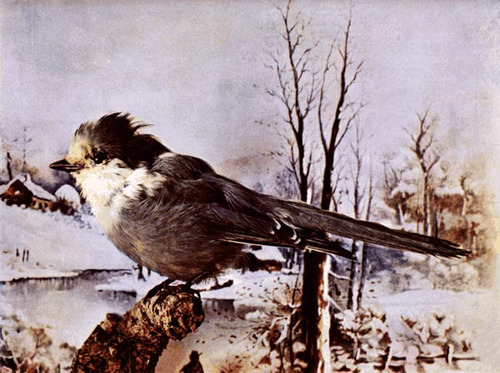
Canada Jay.
From col. Chi. Acad. Sciences.
ANY will recognize the Canada Jay by his local names, of which he has a large assortment. He is called by the guides and lumbermen of the Adirondack wilderness, "Whisky Jack" or "Whisky John," a corruption of the Indian name, "Wis-ka-tjon," "Moose Bird," "Camp Robber," "Hudson Bay Bird," "Caribou Bird," "Meat Bird," "Grease Bird," and "Venison Heron." To each of these names his characteristics have well entitled him.
The Canada Jay is found only in the more northern parts of the United States, where it is a resident and breeds. In northern Maine and northern Minnesota it is most common; and it ranges northward through the Dominion of Canada to the western shores of Hudson Bay, and to the limit of timber within the Arctic Circle east of the Rocky Mountains.
Mr. Manly Hardy, in a special bulletin of the Smithsonian Institution, says, "They are the boldest of our birds, except the Chickadee, and in cool impudence far surpass all others. They will enter the tents, and often alight on the bow of a canoe, where the paddle at every stroke comes within eighteen inches of them. I know nothing which can be eaten that they will not take, and I had one steal all my candles, pulling them out endwise, one by one, from a piece of birch bark in which they were rolled, and another pecked a large hole in a keg of castile soap. A duck which I had picked and laid down for a few minutes had the entire breast eaten out by one or more of these birds. I have seen one alight in the middle of my canoe and peck away at the carcass of a beaver I had skinned. They often spoil deer saddles by pecking into them near the kidneys. They do great damage to the trappers by stealing the bait from traps set for martens and minks, and by eating trapped game. They will sit quietly and see you build a log trap and bait it, and then, almost before your back is turned, you hear their hateful "Ca-ca-ca," as they glide down and peer into it. They will work steadily, carrying off meat and hiding it. I have thrown out pieces, and watched one to see how much he would carry off.
He flew across a wide stream and in a short time looked as bloody as a butcher from carrying large pieces; but his patience held out longer than mine. I think one would work as long as Mark Twain's California Jay did trying to fill a miner's cabin with acorns through a knot hole in the roof. They are fond of the berries of the mountain ash, and, in fact, few things come amiss; I believe they do not possess a single good quality except industry."
Its flight is slow and laborious, while it moves on the ground and in trees with a quickness and freedom equal to that of our better known Bluejay.
The nesting season begins early, before the snow has disappeared, and therefore comparatively little is known about its breeding habits. It is then silent and retiring and is seldom seen or heard. The nest is quite large, made of twigs, fibres, willow bark, and the down of the cottonwood tree, and lined with finer material. The eggs, so far as is known, number three or four. They are of a pale gray color, flecked and spotted over the surface with brown, slate gray, and lavender.
Continue to:


My Books

