


The Prothonotary, Or Golden Swamp Warbler
Description
This section is from the magazine "Birds Illustrated by Color Photograph". Also available from Amazon: The Wisdom of Birds: An Illustrated History of Ornithology.
The Prothonotary, Or Golden Swamp Warbler
Quite a long name for such small birds - don't you think so? You will have to get your teacher to repeat it several times, I fear, before you learn it.
These little yellow warblers are just as happy as the pair of wrens I showed you in April "Birds." In fact, I suspect they are even happier, for their nest has been made and the eggs laid. What do you think of their house? Sometimes they find an old hole in a stump, one that a woodpecker has left, perhaps, and there build a nest. This year they have found a very pretty place to begin their housekeeping. What kind of tree is it? I thought I would show only the part of the tree that makes their home. I just believe some boy or girl who loves birds made those holes for them. Don't you think so? They have an upstairs and a down stairs, it seems.
Like the Wrens I wrote about last month, they prefer to live in swampy land and along rivers. They nearly always find a hole in a decayed willow tree for their nest - low down. This isn't a willow tree, though.
Whenever I show you a pair of birds, always pick out the father and the mother bird. You will usually find that one has more color than the other. Which one is it? Maybe you know why this is. If you don't I am sure your teacher can tell you. Don't you remember in the Bobolink family how differently Mr. and Mrs. Bobolink were dressed?
I think most of you will agree with me when I say this is one of the prettiest pictures you ever saw.
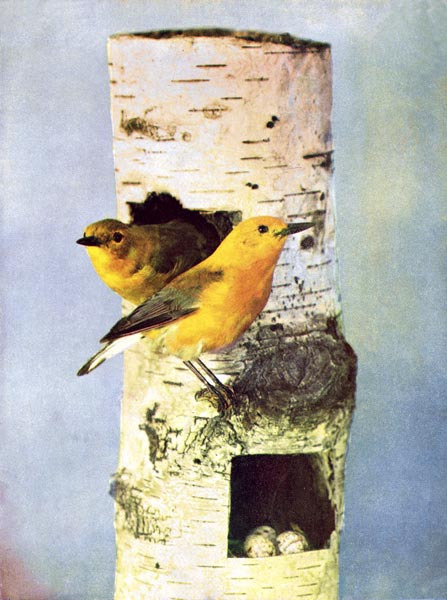
prothonotary warbler.
From col. Chi. Acad. Sciences.

THE Golden Swamp Warbler is one of the very handsomest of American birds, being noted for the pureness and mellowness of its plumage. Baird notes that the habits of this beautiful and interesting warbler were formerly little known, its geographical distribution being somewhat irregular and over a narrow range. It is found in the West Indies and Central America as a migrant, and in the southern region of the United States. Further west the range widens, and it appears as far north as Kansas, Central Illinois, and Missouri.
Its favorite resorts are creeks and lagoons overshadowed by large trees, as well as the borders of sheets of water and the interiors of forests. It returns early in March to the Southern states, but to Kentucky not before the last of April, leaving in October. A single brood only is raised in a season.
A very pretty nest is sometimes built within a Woodpecker's hole in a stump of a tree, not more than three feet high. Where this occurs the nest is not shaped round, but is made to conform to the irregular cavity of the stump. This cavity is deepest at one end, and the nest is closely packed with dried leaves, broken bits of grasses, stems, mosses, decayed wood, and other material, the upper part interwoven with fine roots, varying in size, but all strong, wiry, and slender, and lined with hair.
Other nests have been discovered which were circular in shape. In one instance the nest was built in a brace hole in a mill, where the birds could be watched closely as they carried in the materials. They were not alarmed by the presence of the observer but seemed quite tame.
So far from being noisy and vociferous, Mr. Ridgway describes it as one of the most silent of all the warblers, while Mr. W. Brewster maintains that in restlessness few birds equal this species. Not a nook or corner of his domain but is repeatedly visited during the day. "Now he sings a few times from the top of some tall willow that leans out over the stream, sitting motionless among the marsh foliage, fully aware, perhaps, of the protection afforded by his harmonizing tints. The next moment he descends to the cool shadows beneath, where dark, coffee-colored waters, the overflow of a pond or river, stretch back among the trees. Here he loves to hop about the floating drift-wood, wet by the lapping of pulsating wavelets, now following up some long, inclining, half submerged log, peeping into every crevice and occasionally dragging forth from its concealment a spider or small beetle, turning alternately its bright yellow breast and olive back towards the light; now jetting his beautiful tail, or quivering his wings tremulously, he darts off into some thicket in response to a call from his mate; or, flying to a neighboring tree trunk, clings for a moment against the mossy hole to pipe his little strain, or look up the exact whereabouts of some suspected insect prize."
Continue to:


My Books

