


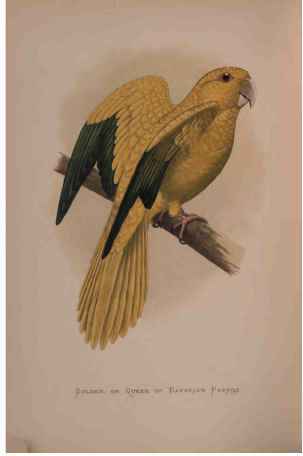
Golden, Or Queen Of Bavaria's Parrot. Psittacus luteus. Psittacus gouaruba, Gml.; Aratinga Carolinae Augustae, Spx.; Sittace lutea, Wgl.; Conurus luteus, Gr.; Psittacara gouaruba, Br.; Heliospitta guarouba; Bp.; Psittaca lutea, BRss
Description
This section is from the book "Parrots In Captivity", by William Thomas Greene. Also available from Amazon: Parrots in Captivity.
Golden, Or Queen Of Bavaria's Parrot. Psittacus luteus. Psittacus gouaruba, Gml.; Aratinga Carolinae Augustae, Spx.; Sittace lutea, Wgl.; Conurus luteus, Gr.; Psittacara gouaruba, Br.; Heliospitta guarouba; Bp.; Psittaca lutea, BRss
Psittacus luteus. Synonyms: Psittacus gouaruba, Gml.; Aratinga Carolinae Augustae, Spx.; Sittace lutea, Wgl.; Conurus luteus, Gr.; Psittacara gouaruba, Br.; Heliospitta guarouba; Bp.; Psittaca lutea, BRss.
French: La Perruche dorée, ou guarouba jaune, BFfn. GERMAN: Der Goldsittich, Rss.; Gelber Keilschwanzsittich, Fnsch.
FOR wealth of colour and elegance of shape, as well as for general intelligence and docility, the Parrots are scarcely to be surpassed by any of the feathered tribes. From pure white to the deepest shade of black, from scarlet and vermilion to the richest golden yellow, from purple to sky-blue, and from dark grass green to the palest of emerald tints; these and every combination of them are the hues that decorate the plumage of the Psittacidae, among which there is perhaps no more striking looking creature than the subject of the present notice; a native of Northern Brazil, where amidst the rich tropical vegetation, decked with myriads of blooms of the brightest and most varied hues, it seems more like an animated blossom than a bird, as it darts on strong unerring pinion through "Some sylvan scene, Where the long drooping boughs between, Shadows dark and sunlight sheen Alternate come and go," and impart fresh beauties to its form, by revealing each instant new gradations of colour, that would have been lost to the spectator, who had merely seen the Golden Parrot sitting motionless upon a tree, whether in sun or shade.
But after all "handsome is that handsome does," the Golden Conure, or Parrot, is not gifted with a melodious voice, but is, on the contrary, master of one of the most piercing shrieks that can distress a sensitive ear, and, worst fault of all, it will not learn to imitate the human voice, let its fair owner charm it never so wisely with sweet sounds; but on the other hand it becomes very tame in captivity, and is possessed of the most endearing ways; it will climb on to the shoulder of its owner with winning confidence, and coo pleasantly in her ear, which it will gently kiss with its pinky white and rather large bill; nor unless excessively provoked, will it dream of using the latter upon even its most aggravating tormentor or relentless foe.
Bright citron yellow is the general colour of the adult bird, but as in the case of the Hawk-headed Parrot and some others, the plumage appears to assume different shades according to the relative position of the spectator and the Parrot with regard to the light, as well as to the brilliancy or deficiency of the latter. In our gloomy English climate, for instance, the Golden Conure does not show to the same advantage as in its own country, where the sunlight has a warmth and intensity of which the dweller in these islands can form no adequate conception; but still in spite of all our climatic drawbacks, it is a bird to be remembered when seen, and when possessed "a thing of beauty and a joy," therefore "for ever."
Rich golden yellow, citron yellow, orange even, according to the light that plays upon it, and the position of the beholder, is, as we have said, the general colour of this remarkable and very rare bird, but the flight feathers of the wings are dark grass green, forming a curious and by no means unpleasing contrast to the rest of the plumage. The eyes are orange yellow with a shade of brown, and the legs and feet a pinky flesh colour.
Known to naturalists for a long time, it was accurately described by Buffon, with whom it does not appear to have been a favourite, for he says: "It does not learn to speak (which is correct,) it is melancholy and misanthropical," which is surely a libel upon an attractive and most engaging bird, and must have been the result of his observations upon an ailing specimen of the race. "At the same time," he admits, "its beautiful plumage is a recommendation in its favour, and it is very easily tamed," a gracious admission which we can entirely endorse.
The Golden Parrot is not of very common occurrence in its native country. Wallace met with it but seldom, and then only when the rice crops were about to be harvested, and on one occasion only did he encounter a small party of five, which were probably the parents and their young ones of the year. Burmester never saw it, and Natterer and Spix but once or twice.
There is no appreciable difference in outward appearance between the sexes, but the young are said to be more or less spotted with green, especially on the back and wing coverts.
That these beautiful birds are eminently hardy may be gathered from the fact, that one of them has survived since 1871 in the Parrot House of the Zoological Gardens in Regent's Park, where it is fed on maize, hemp, and boiled rice, and appears to be in as good health as it certainly is in condition, and attracts the notice of visitors, not only by its handsome appearance, but by its. grotesque movements and loud and shrill outcries.
Notwithstanding this latter decided drawback we are of opinion that the Golden Parrot is as worthy as any other member of the family, of occupying a prominent position in the collection of every amateur, who may be fortunate enough to secure a specimen; and should the opportunity present itself in our case we should not for a moment consider the bird's notes as a reason for rejecting it, but gladly put up with its voice for the sake of the beautiful creature from whose throat it proceeds. Suppose it does not learn to speak: what then? Many people keep peacocks, which are not a whit more clever, and have a decidedly more disagreeable note.
This bird is classed with the Conures, but erroneously so we think, for it differs from them not only in size, but in the formation of the beak and tail, in which it approaches more nearly to the Hawk-heads, which it further resembles by the elongated nuchal feathers, which it also has the power of ruffling up to a certain extent, though not in such a remarkable manner as the latter birds, but more after the fashion of the Grey-breasted Parrakeet.
These birds are, as we have said, rare, but in addition to the London Zoological Gardens, those of Berlin and Antwerp possess examples, and others are to be met with in the aviaries of a few fortunate amateurs, among whom Dr. Buss mentions the Prince Ferdinand of Saxe Coburg Gotha.
Considering its extremely rare occurrence in European countries, no price can be fixed for the Golden Parrot, which will fetch whatever a fortunate importer may be able to obtain from an admiring connoisseur, but one of these birds would certainly not be dear at, say, five-and-twenty pounds sterling, and would probably bring more.
To sum up, giving the non-attractive qualities first: the Golden Parrot does not learn to speak, and screams shrilly at times. On the other hand, it is very hardy, as are most Brazilian birds, very handsome, very gentle, very tame, very droll in its movements, and very affectionate with those it is well acquainted with, while even with complete strangers it maintains rather a watchful than a defiant attitude, and if treated kindly very soon becomes familiar.
It is fond of wood cutting, and feeds on maize, rice, hemp seed, fruit, and biscuits.
Considering the scarcity of these birds in their native country, the infrequency of their importation into Europe, and their consequent high price; it is not surprising that no attempt at breeding them has been made, much less that no successful rearing of a brood of Golden Parrots has been recorded, either in the Transactions of Zoological Societies, or in the volumes of those journals which devote the whole or a portion of their space to bird matters; and yet it should not be difficult to induce a bird that is hardy and docile to perpetuate its species in captivity, which so many of the Psittacidae are anxious to do, and accomplish successfully when in harmony with their surroundings, which, unfortunately, is not very often the case.
The bird from which the plate was taken, and which we have had under observation for some time, shows every inclination to pair, if only it could find a mate. Should we succeed in getting it one, and a brood be the result, we shall take care to let the interesting fact be known.
The Hon. And Rev. F. G. Dutton's Account Of Conurus Luteus
I have not much to say about this bird, because it is one that I have not yet had, but am always trying to get; but I have seen enough of it to wish to make me get one. Here let me make a digression to complain of the perverse fate which causes all the most unlikely people in the world to have Parrots sent or given to them, but which always turns that particular stream of benevolence away from me, who have loved Parrots from the time I was a boy.
However, to return to our Conure. The first Golden Conure I ever saw was at the Zoological Gardens. I was struck with the beauty of the bird, and its charming tameness. You might do anything with it; swing it by the beak or one leg, or it would lie on its back in your hand. They are said to be excellent talkers. Later on, I saw two more at the Gardens. These were young birds, and as far as I recollect entirely green, instead of, as in the old birds, a bright canary yellow. Even in the old birds the flight feathers are green.
Of course as they are not brought over very often, they command a good price, and one would have to pay some £5 for a bird. They are natives of Brazil.
Continue to:


My Books

