


Grey Parrot. Psittacus Erithacus, Linn., Lthm., Bchst.. Psittacus cum cauda rubra, Fnsch.; Psittacus Ghuneensis cinereus, Brss.; Psittacus ruber, Sep
Description
This section is from the book "Parrots In Captivity", by William Thomas Greene. Also available from Amazon: Parrots in Captivity.
Grey Parrot. Psittacus Erithacus, Linn., Lthm., Bchst.. Psittacus cum cauda rubra, Fnsch.; Psittacus Ghuneensis cinereus, Brss.; Psittacus ruber, Sep
Psittacus erithacus, Linn., Lthm., Bchst., etc. Synonyms: Psittacus cum cauda rubra, Fnsch.; Psittacus Ghuneensis cinereus, Brss.; Psittacus ruber, Sep.
German: Der graue Papagei, Russ.
French: Le Perroquet gris, ou cendre, ou le Jaco, Bffn.
IT is almost superfluous to describe so well known a bird, however not to do so would be contre les regles, so we shall proceed, briefly, to remark that the general colour of the plumage is a fine pearl grey, the feathers of the head, neck, and belly are margined with whitish grey, and the tail, which is short, is of a bright vermilion colour; the beak is strong and black, the membrane at its base and the circle of the eyes have a powdered appearance, and on touching the bird an abundant chalky substance adheres to the hand; the feet are ash-coloured, and the iris yellowish; black in very young subjects.
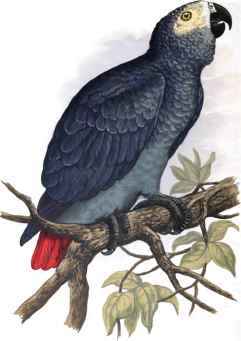
GREY PARROT.
Varieties of the Grey Parrot are not uncommon, and are generally supposed to come from the interior of the "black continent": two are mentioned by Brisson, one of which, according to that naturalist's account, has the wings marked with red, while the other has many red feathers mixed throughout the grey.
One of the latter sort was shown to Latham, and stated to him to have been brought from South America, an account of its origin which that writer very sensibly rejected; remarking, that if it had been brought to England from America, it had certainly been first imported from Africa, as no Grey Parrots were to be found in the dual continent, at least without some admixture of green in their feathers.
We have also seen a very dark, almost black Parrot of this species, which we were assured was from Ceylon; but, like Latham, we rejected this account of its origin, and, while admitting that it may have been actually brought from that island of spices, we feel sure that it was not indigenous to it.
The male and female are exactly alike, and learn to talk with almost equal facility; the male, however, is usually the more fluent speaker of the two, but what few words the female learns she generally pronounces with great distinctness.
It has been said that a Parrot can only speak in one tone of voice, but this is not universally correct, for we once lived next door to a retired tradesman who was possessed of one of these birds, and of a white Pomeranian dog, which the bird would call "Carlo, Carlo", in such an exact imitation of his mistress's voice as to deceive the dog himself. The old gentleman was very fond of sitting and smoking in an arbour at the bottom of the garden, where his meditations were very frequently disturbed by his wife calling to him from the house, in order to consult him upon some domestic matter, on which occasions he used to call out, in the gruffest of gruff tones: "Well, what do you waant?" which the bird used to repeat so correctly as to leave the hearer in doubt as to whether it was the man or the Parrot that had spoken.
To Mrs. Cassirer we are indebted for the following account of a Grey Parrot, communicated to Dr. Brehm by a lady of high rank: - "The bird of which I am about to relate some particulars, was presented to us by a man who had lived in the East Indies for a long time. The bird could already speak well, but only Dutch. In a short time, however, he learnt both German and French. These three languages he spoke as distinctly as a human being, and was so attentive that he often caught up expressions which had never been used before him; introducing them appropriately to the great astonishment of every one.
"He spoke single words and sentences in the Dutch language, and also introduced Dutch words with judgment between German ones, when he did not know, or had forgotten, the German equivalent. He asked questions and returned answers, made requests and returned thanks; and used words correctly in relation to time, place, and persons.
"'Polly wants to kluk kluk (drink)': 'Polly wants something to eat.' If he did not receive what he wished for at once, he exclaimed: 'Bat Polly must and will have something to eat!' If he still received nothing, he flung everything about to show his anger!
"His morning greeting was 'Bon jour', the evening one 'Bon soir': he expressed a desire to rest, and took leave: 'Polly wants to go to sleep': as he was being carried away, he took leave, repeatedly saying: 'Bon soir, Bon soir.' Towards his mistress, who usually fed him, he displayed the greatest affection. When he received food from her, he kissed her hand with his beak, and said: 'I kiss the lady's hand.' He took great interest in everything his mistress did, and often, when he saw her busy about anything, would inquire, with extremely comical earnestness: 'Well, what is the lady doing there?' and when she was removed by death, and he no longer saw her, he also felt the loss and sorrowed. It was difficult to persuade him to take food, and to keep him alive. Often too he would re-waken the grief of the mourners, by asking them: 'But where is the lady then?'
"He whistled wonderfully, especially the tune Ich dank dir durch dienen Sohn; he also sang beautifully. 'Polly must sing a song', he would remind himself, and then begin:
'Perroquet mignon, dis-moi sans facon, Qu'a-t-on fait dans ma maison, Pendant mon absence? or the following couplet:
'Ohne Lieb und ohne Wein, Konnen wir doch leben.
Occasionally he would alter this to, 'Ohne Lieb und ohne maison, Konnen wir doch leben,' or he would substitute 'Ein Kuss - sans facon,' which amused him so much that he laughed loudly. 'Polly, what does Lotty say?' he would ask himself sometimes, and answer at once, as if some one else had asked him the question: 'O my lovely, lovely Polly, come and kiss me.' This was spoken with the correct accent of tenderness, as only Lotty could say it. His self-approbation he expressed by the words: 'Ah! ha! how lovely Polly is!' stroking his beak at the same time with his claw.
"He was, however, by no means beautiful, as he had the bad habit of plucking out his own feathers. Wine baths were ordered for him as a remedy, which were administered by means of a small syringe. These baths were extremely disagreeable to him; as soon as he noticed the preparations being made, he began to plead coaxingly: 'Don't make Polly wet - oh! poor Polly - don't - make - him - wet!' He was not fond of strangers; those who came to see him, and hear him speak, generally were only able to gratify their curiosity by hiding themselves from him. In their presence he remained as quiet as a mouse; but began to talk faster than ever as soon as they had taken leave, or concealed themselves, as if to indemnify himself for his self-imposed restraint. His affection, however, could be won, and he spoke willingly with such persons as were in the habit of visiting us, sometimes, indeed, making a clever joke at their expense.
"A stont Major, whom he knew very well, attempted one day to teach ,him tricks: 'Jump on the stick, Polly, on the stick!' commanded the warrior. Polly was extremely annoyed: then suddenly he burst out laughing loudly, and said: ' Major, jump on the stick, Major !'
"Another of his friends had not visited the house for some considerable time, this was spoken of, and it was expected that Both, which was the name of the wished-for visitor, would come that day. 'Here comes Roth', suddenly exclaimed the Parrot, who had been looking out of the window, and had recognised the expected visitor at a distance.
"A son of the family, George, was expected home after a lengthened absence, and this was naturally talked about among the members of the household: George arrived late one evening, when Polly was already sleeping in the darkness of her covered cage. After the first greetings were over, George turned to the general favourite, and lifted the corner of the cage: 'Ah, George, art thou there? that is nice, very nice', said the bird.
"He had noticed that when his master went to the window, he often called to the steward, or to the bailiff, to come upstairs from the courtyard. When, after this, the Parrot saw his master go quickly towards the window, he called every time both the men by name, as he was unable to tell which of the two his master intended to summon.
"It is impossible for me to relate all that the bird did and said, he seemed almost a human being. Polly had a mournful ending. He was bestowed upon an aged relative of the family, who had become childish, and had taken a childish fancy to the bird. All wept as the wonderful creature was carried away: Polly alone shed no tears, but could not endure the parting from his beloved ones: a few days later he was dead." - Probably starved, poor thing, by his "childish" owner.
In the Feathered World for August 16th., 1883, a Mr. Diettrich relates the following anecdote of his Grey Parrot: - "It is very amusing to see Polly call the hens together, in imitation of my wife, and she then gave us no peace till she received a piece of bread, with which she took her seat on the window ledge, or on the paling, breaking it up and throwing down the crumbs. The running of the hens after the crumbs seemed to afford her the greatest amusement."
In the face of anecdotes like those related above, and others which are to follow, it would really appear as if these birds were gifted with a certain modicum of human intelligence; but a little reflection, and careful observation, will show that while the Parrot is certainly capable of attaching ideas to certain sounds, it is incapable of generalization; and that many of its most apposite answers, and remarks, are no more than mere coincidences.
A Parrot of this species belonging to a chemist in Bermondsey, where it is kept in the shop, calls out "Wanted", as soon as a customer comes in; and if the latter approaches the bird, and looks at it, it will put its head on one side and inquire, in quite a confidential tone of voice: "Well, who are you?" or "Well, what do you want?"
Another that belongs to a medical man of our acquaintance has learned, when a patient knocks, to say, "Open the door, and call the doctor", but occasionally it reverses this order, and shouts out, "Open the doctor, and call the door"; apparently quite unconscious of the mistake it has made; thus showing that although it may attach, and doubtless does, a certain meaning to the sentence it uses, the several words of which it is composed convey no ideas to its mind; and that this is really the case has been proved, in more than one instance, by actual experiment.
The majority of these birds that are sold in this country, are brought from the Gold Coast, but they appear to be pretty generally distributed throughout the western and central parts of Africa.
Buffon relates that in his time a pair of these birds bred for several years consecutively in Paris, and reared their young; this statement, however, has been questioned by some more recent writers, but is nevertheless probably quite correct, for a pair belonging to the late Mr. Charles Buxton, M.P., made a nest in a hollow branch, and "brought up two young Grey Parrots, which were afflicted with most awful tempers. The party of four fly about almost always together, and are a great ornament to the place" (Northrepps Hall).
The same gentleman continues: "A cat made her lodgings in one of the nest-boxes, and brought up her kittens in it, and two of the Grey Parrots, who had not been industrious enough to lay eggs and have a family of their own, were seized with the idea that these kittens were their children; they kept up a constant warfare with the old cat, and whenever she left the box one of them used to get in and sit with the kittens, and they were constantly in close attendance, even when the mother cat was at home."
"I had at one time", continues the same writer, "a flock of eleven Grey Parrots at my house in Surrey, but ten of them having got shot, the survivor associated himself with some Cockatoos, and for the last few years has invariably flown about in their company."
"The Grey Parrots have the sense to get into a house that was built for shelter for them, bat none of the others can ever be persuaded to enter it: the gardener declares that the Grey Parrots foresee a storm, and often take refuge in their glass-house before it comes."
The foregoing extracts are from a paper read before the British Association in 1868, by the late Mr. C. Buxton, and nearly all the birds to which he there alludes, some fifty in number, fell a prey to "those vile guns"; one gamekeeper "bagged" no less than eleven, and, as Mr. Buxton good-naturedly put it, "naturally thought he had secured a wonderful prize."
"The Grey Parrot is a very good imitator of sounds and voices", wrote Mr. Sydney C. Buxton in The Animal World for 1878. "We had for many years an old retriever named 'Tory' - now, alas! dead of old age and merciful prussic acid. The Parrot could imitate our tone and call of 'Tory, Tory!' and when he happened to be in a merry mood (Parrots are fond of fun), and saw Tory half asleep, and comfortably curled up on the mat, he would call out 'Tory! To-ry!' The dog would rouse himself, anxious for a walk, look high and low, before and behind, and seeing no one, would begin to lay himself down again to rest, his temper slightly ruffled. Cries the Parrot, louder than before, 'Tory! To-ry!' Tory, now thoroughly roused, would glance about, and at last espying the Parrot, with a look of intense disgust and indignation, proceed to curl himself up again: the bird meanwhile chuckling to himself on the success of his practical joke."
Although the following anecdote from the same pen refers to a different species, we cannot refrain from quoting it: - "I spoke of the love of fun just now. We used to have a Grey Red-breasted Cockatoo, 'Minniehaha' by name, who would deliberately lay herself down on her back in the middle of the gravel-path, seize a pebble with one foot, fling it into the air, and catch it in her mouth if she could as it fell. All the while she would scream with pleasure and excitement, and evidently thought she was having the jolliest game possible."
The Grey Parrots in their native country feed on fruit and grain, principally maize, and many thousands of them die within a few weeks or months of their importation here. The causes of this mortality are various; fever contracted on ship-board, regret for the loss of their liberty, or their companions, sheer fright in some cases, and disgust at their surroundings in others, improper food in some instances, deprivation of water in some, and too much of it in others: but the chief cause of death is the inability of the young birds to feed themselves sufficiently to support life. On board-ship and at the dealers, when a number of these birds are caged together, the old ones feed the young ones, which require this attention for a good many months, for the Grey Parrot is a long-lived bird, and slowly reaches maturity. When removed from his companions, the poor young creature dies of slow starvation, and the disconsolate owner wonders, and buys another to meet, probably, with a similar fate.
The only way to preserve these young Parrots is to boil their corn until soft, chew a mouthful, and placing the beak of the bird in the mouth, let it feed itself there as it has been used to do from the mouths of its father and mother, or its kind companions in the dealer's shop.
There is a vile prejudice still existing in this country against giving water to Parrots; but we have already so fully descanted upon its absurdity, not to say wickedness, that we need merely here remark, that all animals drink, and can be kept without water only to their detriment and manifold discomfort: but the water must be fresh and clean, that is a sine qua non: foul water means diarrhaea, inflammation of the bowels, fever, and death.
The Grey Parrot, as we have remarked, grows slowly, and attains to a green old age: some specimens are reported to have lived for sixty, eighty, and even one hundred years, but for the truth of this statement we are unable to vouch.
Apropos of the bird under consideration, a writer in a recent number of the Daily Telegraph, under the heading On the Congo with Stanley, says: "Flocks of Grey Parrots flew across the sky, alternately screeching and whistling melodiously. I have seen it stated erroneously that the Grey Parrot never whistles in a wild state. On the contrary, it does so very sweetly, and with a great variety of note."
Well, one certainly lives and learns: it is comprehensible nevertheless that the sibilant utterances of Erithacus in a state of freedom may be devoid of the concentrated bitterness that usually marks his attempts at vocalization in captivity, when his temper has been spoiled, and his digestion ruined, by alternate teasing and stuffing with inappropriate tit bits; or the writer of the above quotation may, by the sight of the wild birds, have been pleasantly reminded of some familiar "Polly" of his acquaintance, and the associate ideas connected therewith, have lent a melody to the Parrot's notes they might not otherwise have possessed: we never saw any wild Parrots (we do not include Parrakeets) that did anything else but scream horribly; but then, of course, it does not follow that others may not have been more fortunate, and we certainly have not been on the Congo, wandered on the shores of Stanley Pool, or gazed on the luxuriant vegetation that adorns the islands dotted on the surface of its limped waves: "palms beautiful and symmetrical, with hanging clusters of bright orangecoloured fruit, masses of yellow flowers, lilac-coloured papilionaceoe, and mauve convolvuluses, beautiful scarlet seed-vessels of a certain bean that form blazing clusters of gorgeous effect amid the tender green foliage"; nor have we been happy enough to behold the "immense numbers of Grey Parrots, small flocks of them going together that flutter and play about the tops of the tall trees, whistling and screaming joyously all the time", or been privileged to see "the many snags that rear their withered branches over the rushing stream, where numerous little birds have for safety's sake hung their pendant nests of grass, so that there is a constant twittering and fluttering of pretty and brilliant forms round the gnarled old trunks and whitened twigs" - a lovely scene surely, and a description that inspires the reader with a desire to start off forthwith and feast his eyes upon its unparalleled beauty.
The following interesting particulars from the pen of Mr. J. G. Keulemans will be read with interest: - "Of all the foreign cage-birds that decorate and enliven our dwellings, few are more common or better known than the Grey Parrot. Large numbers are being continually brought to Europe from their native wilds, and at some places - Lisbon, for instance - they may be seen in large numbers at the bird-shops, but nowhere is the Grey Parrot more frequently found as a cage-bird than in London.
"The range of the Grey Parrot is limited to the Western Coast of Africa, and extends for some distance into the interior. It is common on the Gold Coast and adjacent islands; but is curiously distributed among these latter. On Prince's Island we find these birds in great abundance, while on the neighbouring island of St. Thomas not a Grey Parrot is to be seen - a fact to be accounted for by the large numbers of the Kite (Milvus parasiticus) inhabiting the latter island.
"Although a familiar cage-bird very little is known about its habits when in the wild state. It is therefore with much satisfaction that I find myself able, from personal observation, to communicate many new and interesting particulars concerning it, which I hope may prove acceptable to my readers, and at the same time enable them to form some idea of the vie privee of this favourite.
"At Prince's Island, which may not inappropriately be termed the Paradise of the Grey Parrots, I resided for more than a year, and during that time I daily carefully observed their habits and mode of life in the natural state. Nowhere on the continent of Africa are these birds so plentiful, nowhere so free and undisturbed. On Prince's Island they are supreme among the birds; they stand in no dread of the other feathered inhabitants, but are feared and respected by them.
From their own immediate domain the Parrots drive away all other birds, both great and small, - if necessary combining for that purpose.
"The only enemy they meet with are the Kites (Milvus parasiticus) of the neighbouring island of St. Thomas; it sometimes happens that a Kite does, either by design or accident, find its way to Prince's Island, but no sooner is the intruder observed than the alarm is raised, the Parrots hasten up from all parts, and in a very short time the luckless bird is either killed or driven away.
"During the day, when flying about in flocks, the Parrots never settle on a tree, unless satisfied that it is a safe resting-place. They are very suspicious, and always on the alert, taking notice of everything that occurs in their vicinity. They are more prudent and sharp than the native, quicker than the monkey; they require no tools to crack the hard nuts, and are consequently the most independent of the living creatures on that island.
"On Prince's Island there is a very lofty mountain, reaching some 1200 feet above the level of the sea, and called by the natives 'Pico de Papagaio', or Peak of the Parrot. On the slope of this mountain, and extending far up its side, is a magnificent forest. The trees are of great size and height, and their trunks and branches give support to the lianos and other climbing plants, which hang about them in rich luxuriant folds. The density of the forest is so great that it is only with the utmost difficulty and toil the explorer can force a passage through it, while to the Parrots, who come up there every night, it presents no obstacle, but gives them, under the shelter of its thick foliage, a secure and pleasant resting-place.
"As sunset draws on, the Parrots may be seen in parties winging their way for the mountain from all sides of the island, and on reaching it take their places on the trees. Approaching troops acquaint their fellows of their coming by a loud whistling. Those of them who have found an approved resting-place warble and whistle as long as daylight continues, but as darkness closes in the noise gradually subsides, and all becomes hushed. Occasionally, however, a few sounds may be heard at intervals after dark, which most probably proceed from some belated bird seeking a place or a quarrel: sometimes in the dead of the night the whole colony is thrown into an uproar, occasioned, I believe, by the visit of bats or of some predacious animal.
"There was one flock in particular, consisting of about forty individuals, that attracted my special attention; every evening at nearly the same time, namely, half-past five, they would pass over my house on their way to the mountain. I used to follow them with the eye, and always found that they settled on the same tree.
"My house and plantation were situated at an elevation of some 1200 feet above the sea-level and opposite to the Pico de Papagaio, a valley being between. From here I had an extensive view across to the Pico; and observing a trail in the direction of the tree which this particular flock of Parrots had taken for their resting-place, I determined to pay them a visit. As the distance did not seem to be very great, I thought that by following the path visible from my house I should have little difficulty in reaching the wished-for spot without either guide or assistance.
"Accordingly, on the 16th. of January, 1865, I set out unaccompanied, at daybreak, for the place in question, and soon reached the edge of the forest, but before I had penetrated very far it became evident that my plan was not so easy of execution as I had imagined, for that which from my window looked like a path, turned out to be merely a rough track or trail overrun with rank vegetation, which only served me for a short distance, and then became obliterated; this loss of track brought me to a standstill. I was alone and had no knowledge of the way, but being unwilling to return, having got thus far, I looked about in hopes of discovering in this dense tangle some place through which I might force a passage, but in vain; on all sides the lianos and other climbing plants grew so thickly, and presented such a high impenetrable barrier, that I felt to attempt to proceed further without a guide would be unsafe, and at once decided to retrace my steps and obtain the assistance of a native. From surrounding appearances I was convinced that many Parrots were breeding there already, and the idea of giving up a trip that promised such interesting results was not to be thought of. I hastened back and soon reached my house again. Having secured the aid of a native, who assured me that he was able to make his way to the place and find his way back, I set out again the same morning with the hope that this time my wish to reach the abode of the Parrots would be realized.
"At nine o'clock we started, and after a very fatiguing journey, during which we had in many places literally to cut our way through the dense undergrowth, reached one of the places frequented by the Grey Parrots. My gratification at this moment was extreme. What should be done? Shoot as many of the old birds as presented themselves, or seek out their nests and take the young ones home? We decided to take the young birds. From the noise we knew that many Parrots were in our vicinity: on all sides their joyful whistling resounded, and the falling of pits, or husks, and the stones of fruits, sufficiently proved that many were concealed in the trees about us. Up to this time we had not seen any; they kept themselves so well hidden among the leaves that we could not get sight of them. Thus they remained for some little time, when at last one came down, and I could not restrain the temptation to shoot it. At the discharge of the gun a multitude suddenly burst from their concealment and dispersed with deafening screams. Picking up my prize we walked cautiously forwards until we observed at a distance in front of us another troop - or it might have been the one we had disturbed - on the highest branches of an exceedingly large tree. In half an hour we reached the spot,- where we found numbers of large trees with foliage so thick that we could not see any Parrots. While waiting and eagerly watching we again heard the falling of empty husks, and at the same time observed a movement among the leaves of a palm tree. On closer inspection we could see our birds, and as we had no desire to cause another Parrot revolution we left them to eat their palm nuts in peace. It being now about five o'clock in the afternoon, and the sun setting at six, we had only an hour left at our disposal to seek after the nests. My companion being more likely, from his experience, to spy out the nests quicker than myself, I set him to inspect the trees within a short circuit, while I remained at that spot, and arranged that he should inform me of the discovery of a nest by imitating the call of the Wood Kingfisher (Halcyon dryas). Soon after the sudden signal of my black man informed me that he had been successful in finding nests: repeating the call alternately, I at last got up to the place where he was, and the position of the nest was pointed out to me. A hole in the trunk of one of the trees was, according to my man, the home of a pair of Parrots. Knowing from experience how sharp-eyed these fellows are, I was quite sure that something Parrot-like would be found inside the hole. Darkness was now coming on fast, and it being too late to do anything that night, we marked the tree by fastening some palm-leaves on the trunk, and left the breeding pair inside the hole undisturbed till next morning. While thus occupied, troops of Parrots approached from different sides and settled among the trees. As for ourselves we found a capital shelter under a clump of bushes, where we concealed ourselves, and from there observed unperceived the doings of the Parrots around us. Some were climbing and hanging on the branches, others flying and scampering through the foliage; we saw them perching close to each other, and afterwards five or six settled just above our shelter. Numbers came from all sides, and the chattering which we had previously heard at the distance was by this time close to us. There was a noise of whistling, screaming, quarrelling, and the breaking of dead branches. We saw them pass before us and settle on the trees: at this time we must have been surrounded by hundreds of Parrots. Being now almost dark, and having to pass the night in the open air, it was time to take steps to make our sojourn in the forest as comfortable as possible. A fire being the first necessity, we left our shelter in order to gather some of the dead palm-leaves that lay about; as we emerged from our coverts the Parrots perceived us, and in a moment the whole place was ringing with their deafening screams. The fire was soon made, and, burning up quickly, it cast a cheerful light and warmth around the spot, rendering our bivouac more agreeable; and the Parrots, attracted by the unusual sight, kept flying over and around the place thus illuminated. An hour afterwards, quiet been restored, we proceeded to get our supper, consisting of roasted bananas; this being finished, we dried some moss to serve for a bed and retired; but the night was so cold, and the mosquitos kept stinging my face so pertinaciously, that it was impossible to sleep; so I got up and roasted some more bananas, smoked a pipe, and then felt quite ready to go in pursuit of the birds. My companion was sleeping soundly, apparently undisturbed by those causes that deprived me of my sleep. As it wanted some three hours of daylight I occupied myself in preparing limed sticks and making snares. On the appearance of the first streak of dawn we proceeded to the tree where a nest was suspected to be; my black man, being a capital climber, went up to the hole, and looking in found two young Parrots, which he carefully tied up in a pocket-handkerchief and lowered down to me: the little things seemed to be about a fortnight old, and readily took some banana I offered them. The old birds were absent, probably seeking food; at least we did not see them. The two young ones we fastened with string to the trunk of the tree, and placed some limed sticks round about them. In this way we caught one of the parent birds, the securing of which was a matter of some difficulty, owing to the resistance it made. We put the freshly caught old bird in a linen bag, and fastened it beside the young ones. In a few minutes our captive began to turn round and round, at the same time screaming vociferously: this quickly attracted the attention of the Parrots in the neighbourhood, which came near, gazing with astonishment at the bag which contained their mysteriously hidden comrade. One more bold than the rest flew down and settled on a lime stick, but its struggles were so violent that it succeeded in getting away. I then took my gun and shot two individuals, the others immediately taking flight.
"On the same morning we discovered two more nests: one of them contained three very young birds; the other had only one egg. My man had previously laid some snares, but no birds had been caught. We then searched about among the trees in this part of the Pico de Papagaio, and discovered several holes, many of which probably contained nests, but we were not able to climb up to see, the trunks being so smooth and thick.
"We set out on our return for my plantation at noon, and arrived there safely at 4 p.m. Although my excursion had furnished me with the small result of six living Parrots, three dead ones, and one egg, yet the exertion this had entailed brought on a severe fever, which developed itself as soon as I got home and confined me to my house for several days.
" While on the Pico I availed myself of such a favourable opportunity, and took particular notice of the habits of this bird. The first thing I observed was that it is always found in flocks, which flocks go about over the island during the day, returning to their own appointed place on the mountain in the evening to roost. Their food consists of fruits, such as the palm nut, the avocat (Laurus persea), the banana (Musa paradisea), goyave, mango, and many other fruits of a smaller kind, but they always give the preference to palm nuts.
"They drink but little, and as no water is found on the Pico they must obtain what they require during the day on the lowland. They make no nest, but deposit their eggs (which are from two to four in number) on the bottom of the hole. The eggs are in size, shape, and colour similar to those of the Wood Pigeon (Columba palumbus): when unblown they are of a pinkish hue, which may be owing to the thinness of the shell.. Both birds take it by turns to sit, and while one is sitting the other often comes and feeds it out of its crop. The young ones are fed in the same way. In time of danger the old birds defend their progeny vigorously, and should the enemy prove too strong to be successfully resisted by one pair, other Parrots come up to their assistance, and joining forces either kill or put the aggressor to flight.
"The Grey Parrot delights to dwell in companies: many nests are found within a few feet of each other, and often in one tree two or more holes may be seen occupied by hatching pairs.
"The young birds are covered with a long and fluffy down, which afterwards, when moulting, falls off. Their first plumage is darker, and the iris dark grey, instead of pale yellow. They leave the nest when about four weeks old, but may be seen looking outside the hole some time before they are able to fly. They grow quickly, and the feathers get gradually paler; when two months old the first moulting begins, which lasts about five weeks, after which the plumage is similar to that of the old birds, although the edges of the feathers are not so pale and the cheeks and forehead not so white as in old individuals.
The iris changes gradually and slowly; the eyes are dark for more than seven months. The feathers when wet appear of a dark bluish grey, with a purple gloss.
"As to the method of treatment, I have always found hemp seed to be a very good kind of food, and one that is relished by the bird; boiled rice is also very suitable, and a lump of sugar is a source of great amusement. They will eat canary and other small-grained seeds, but these I think are objectionable, as they keep the bird too much occupied with eating, so that they lose a good deal of their capacity for imitating words. The best food is Indian corn boiled or ground and mixed with hemp seed, and bread softened in sugar water. Almonds are not easily digested, and bitter almonds make them ill. Parsley is poison for a Parrot. Fresh fruit, such as figs, pears, cherries, etc., always give great satisfaction to the bird, but they must not have too much of it."
The Hon. And Rev. F. G. Dutton's Account Of The Grey Parrot
Of all Parrots there is none so well known as the Grey. If a man has ever seen a Parrot, it is probably a Grey that he has seen. If a person wants a Parrot, he wants a bird that will talk, and the Grey Parrot is, on the whole, the surest of talkers. Other Parrots may become more wonderful talkers, but they probably will require careful teaching, the Grey Parrot can be trusted to pick up words without much trouble.
But in spite of this, a great deal of misapprehension exists as to the talking powers of the Grey Parrot. One hears stories of Grey Parrots that had been in the possession of different people, and would suddenly pass from a childish treble to a gruff man's voice. Such birds may have existed, but I can only say that though I have possessed several Grey Parrots, and known more, I never yet came across one that had this power. The Macaws unquestionably possess it; Amazons have an unrivalled power of imitating the general tenour of a conversation without pronouncing one distinct word, but Grey Parrots, according to my experience, though they learn to pronounce their words distinctly, always do so in their own rather throaty voice: nor are they by any means all gifted with the same power of speech.
I have had a Grey Parrot which, though very tame, could never learn a word; and I had another which only required a week or two to learn long sentences, and began to reproduce them after a day or two. Books tell one that the two sexes talk equally well. I doubt this about any species of Parrot, or bird. Just as in song-birds, the male is the songster, so in talking-birds, I believe the male to be the talker. The female may learn to speak, but not nearly so well, as a rule. That there are exceptions is as probable as that there are hen Canaries with a considerable power of song.
But how to distinguish the sex of the Grey Parrot, I know not. Some people say that the hen has the flatter and broader skull. I cannot say: but I can say this, which gives colour to the assertion, that all the good talkers I have had, had small neat heads, with the skull nicely arched and a small beak; while the flatter headed birds with large beaks have been the bad talkers.
Certainly if I were going to buy a young one, I should take care to pick out one with a small arched skull, and with a small beak.
This brings me to the subject of the purchase of a young Parrot. Many of those imported, perhaps it would not be too much to say most of those imported, die soon after their arrival, or soon after their purchase. Many of them probably have already the seeds of disease in them, and the journey from the dealer to the purchaser's house takes away what little chance they might have had of recovering. The chief symptom is an unquenchable thirst, and diarrhaea. To give the bird cold water will add to the mischief. I should try milk - skim milk - with a little brandy in it - a teaspoonful to four tablespoonful. If it could not digest that, then I should try warm water and brandy. By this means, if the bird will do nothing but drink, you are keeping up its strength all the time.
I should occasionally vary this diet with warm chicken broth, till I could get the bird to eat boiled maize or rice. It must be kept in an even warmth, about 70°; for Grey Parrots, heat alone is almost a cure for many of their illnesses.
In old days, the books always used to give bread and milk as the proper food for Parrots. I believe very few adult Parrots will be found to eat it, and it is not very good for them, if they will. But young Parrots require it, and it may be continued till they show a distaste for it, when it can be changed for bread and water, or for plain water. As to the seed for them, hemp, canary, and millet, are all good. The three best and plumpest Grey Parrots I have ever seen were fed, one on nothing but hemp, and the other two on nothing but maize unboiled.
Sometimes one meets with Grey Parrots with the red feathers ap-pearing amongst the grey. These used to be thought accidental examples, and were said by their owners to be unrivalled talkers: a recent traveller, however, reports that there is a district in Africa where the variegated bird replaces the ordinary type of grey. If that be so, it is to be hoped that some may be brought to England.
In conclusion, I cannot too strongly impress npon the reader the necessity of giving the birds plenty of employment, - sticks to bite, or reels to play with, if they are to be kept from feather plucking, which generally arises from want of something to do.
P.S. - Since writing the above, I have seen a Parrot which, according to its owner's testimony, can perfectly imitate two distinct voices. I have not heard it do so myself, but I have not the least reason to doubt that it does.
As we have already stated, we have known a Parrot that could imitate exactly the voices of both its master and its mistress so accurately as to deceive every one that heard it.
Continue to:


My Books

