


Brown Tabby Persians. Part 2
Description
This section is from the book "The Book Of The Cat", by Frances Simpson. Also available from Amazon: The Book Of The Cat.
Brown Tabby Persians. Part 2
These sable-marked cats are rare, but still more beautiful would be a cat entirely of the one tawny colour - a self sable, without markings. "The most suitable factors to obtain this colour," so writes Mrs. Balding, "would probably be tortoiseshell - and - sable tabby, as free from marking and as red in ground colour as possible. A cross of orange, bright coloured and as nearly as obtainable from unmarked ancestors, would be useful. Some nine years ago I purchased a dimly marked bright sable coloured cat,' Molly,' shown by Mrs. Davies at the Crystal Palace, with a view to producing a self-coloured sable cat; but 'Molly' unfortunately died, and I abandoned the idea." The nearest approach to a self-sable I have ever come across was a cat I obtained for the Viscountess Esher, which had, alas ! been neutered. He was almost unmarked, and of the colour of Canadian sable, with golden eyes - a most uncommon specimen.
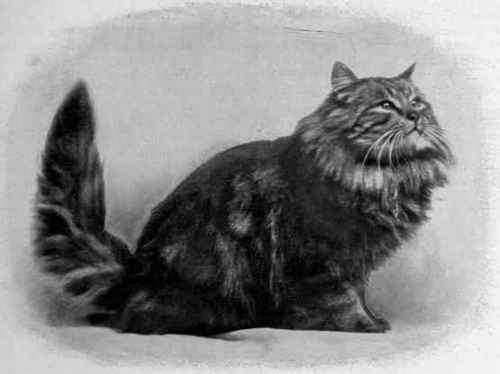
" Champion Crystal." Owned by C H. Jones, Palmyra, N.Y.
Another species is the spotted tabby, but I have never seen a true specimen in Persians.
Some brown tabbies are ticked or spotted on the sides, but they have the spine line and ings on neck, head, and tail.
Very few and far between have been good brown tabbies in the history of the fancy. Amongst the males two names may be said to stand out conspicuously - Miss Southam's "Birkdale Ruffie" and my own "Persimmon." Both these cats, of quite different types, have gone to their rest.
As regards the famous Birkdale strain, the following account, kindly supplied to me by Miss Southam, will be of interest : "There is no doubt that, until quite recently, pur old friend the tabby has been deliberately placed in the background, and regarded in the show world with an indifference which has proved an unmistakable stumbling block to the improvement of this particular breed.
"Nor is this very much to be wondered at, when we take into consideration the hideous combination of the drab, colourless browns, dowdy greys, and indistinct markings which had hitherto constituted the chief charms of the typical tabby. Instead, it would appear that the commonplace and unattractive grey was openly encouraged, rather than otherwise ; for, although the silver tabby was provided with a classification of his own, only one class was relegated to " brown and grey tabbies," either colour being considered equally worthy of carrying off premier honours !
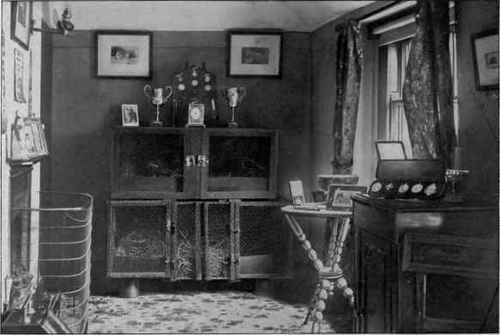
A Room In Brayfrot Cattery (Photo : W. Lawrence, Dublin.)
"It was at this period, when the nondescript tabby was reigning supreme, that Champion 'Birkdale Ruffie' made his debut in the show world, my sister, Miss Emily Southam, being the first to bring the sable tabby into prominence. Whether, however, it was that the public was not sufficiently up-to-date to appreciate the sudden departure from the usual sombre colours with which it had hitherto been satisfied to a brilliant sable, or whether he was particularly unfortunate in his choice of judges, it is difficult to say ; at any rate, it was not until four years after his first appearance in the show pen that he met with the justice that his many beautiful points so richly deserved. In fact, after exhibiting him at several shows, where he was deliberately passed over for other and most inferior cats, he being in the pink of condition, my sister was so annoyed at the treatment he received that she simply burnt the schedules which poured in upon her and kept him at home, determined he should not be further insulted by such flagrant injustice !
" It was at the West of England Cat Show in 1894 that'Birkdale Ruffie' scored his first real success - I believe under Mr. Gresham - winning two first prizes in the open and novice classes and two specials. Here at last his beautiful sable colouring, his dense black markings, and wonderfully expressive face were appreciated.
"The year 1896 was the occasion of his sensational win at the Crystal Palace show. He simply swept the board, carrying everything before him - first prize, championship, several specials, and the special given by the King (then Prince of Wales) - for the best rough-coated cat in the show, the prize being a handsomely framed portrait of the King with his autograph attached. Mrs. Vallance was judge. Again, in 1897, he was shown with great success at the Crystal Palace, winning first prize, championship, and special.
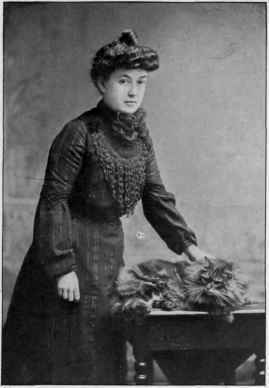
Miss Whitney And Her Neuter Brown Tabby (Photo : W. Lawrence, Dublin.)
"This was the occasion of'Birkdale Ruffle's' last appearance before the public, as it was during the following month my sister was taken dangerously ill, and for this reason his pen at the Brighton show was empty. After her death we determined to subject him no more to the trials and discomforts of the show pen, so 'Ruffie,' who was now seven years old and a great pet, both for his own sake and that of his mistress, only too gladly retired into the privacy of home life, spending the cold winters by the fireside in his own little snug retreat, and in the long summer days lying under his bower of shady hops, lazily watching his facsimile, his little son 'Master Ruffie,' growing up more beautiful each day and ready to take up the thread of his father's famous career in the exhibition world.
"Into the latter 'Master Ruffie' made his debut without any of the numerous anxieties encountered by his celebrated parent. The way was paved for him, and when he appeared at the Crystal Palace show in 1899, in all the full glory of his youth and beauty, it was difficult for the judges to realise that it was not their old favourite who was now confronting them through the wires !
"'Master Ruffie' has only been shown on two occasions - in 1897 as a kitten, and in 1899 at the Crystal Palace, when he returned home with his box literally filled with cards, his winnings including three first prizes, four specials, and a championship.
Continue to:


My Books

