


Brown Tabby Persians. Part 6
Description
This section is from the book "The Book Of The Cat", by Frances Simpson. Also available from Amazon: The Book Of The Cat.
Brown Tabby Persians. Part 6
She is a most successful breeding cat, her produce being usually winners. Her sister, 'Brayfort Princess,' is also a sable tabby, and carries an immense coat, ruff, and frill; it is denser than'Fina's,' and I.fancy but for the latter 'Princess' would have been more heard of as a winner, as, except on one or two occasions, she has been usually beaten by'Fina.' "'Brayfort Persimmon Laddie' is by 'Champion Persimmon' ex' Brayfort Fina.' He made his public appearance at Bristol when he was four months old, taking first and special in a tabby kitten class and third in novice, against an entry of twenty-five adults ; then he won first and special in kittens, and second in open to his mother's first at Belfast in 1900; also he took first and special for best long-haired neuter at Manchester in 1901; first, Liverpool; and first and two specials at the Crystal Palace, 1902. He is too well known to comment on. He is a wonderful sable colour, and is superb in coat. 'Brayfort Sable Boy' is also by the late 'Champion Persimmon' ex'Fina.' He won first and special at the kitten show in October, 1902, and first and two specials at the Crystal Palace show, 1902 ; his wins speak to his merit.
"I find all my cats very strong and healthy, and even in the coldest winter they never have artificial heat. I attribute having never lost a pet after a show to taking them away at night. Unless something very unforeseen occurred, nothing would induce me to leave a cat of mine in a show.
I have found mating to a good brown tabby much the most successful. I tried mating to an orange, but did not like the results. I always mated to the late' Champion Persimmon,' and had never fewer than six kittens in a litter - sometimes eight - all strong and healthy. Twice only have I lost any, and on these occasions the fault lay with the foster mothers.
"In the spring and summer my cats get a run out in the garden every day; the two neuters go on leads, but the females have their liberty; indeed, unless I were present 'Fina' would not leave the house. Their rooms look out on the grass terrace, so they can come in or out as they please till their breakfast time, which is at about ten o'clock. They are groomed every morning between 8 and 8.30 o'clock, winter and summer, and always fed regularly. Their sleeping houses, as in photo, are about four feet long, lined round with oilcloth, so they can be washed when necessary. In the winter the bedding is hay, and in summer, shavings. The houses are sufficiently long to allow for sanitary boxes during the breeding time. I find Hall's washable distemper very nice for the cattery walls, and it looks so bright and fresh. The floor-covering is linoleum."
In America brown tabbies are beginning to find favour, and several good specimens have been exported. "Arlington Hercules," who took first at Westminster in 1901, was shipped to Mrs. Sarmiento and Mrs. Cutler, and I sent a "Persimmon" kitten out by Mrs. Robert Locke to Mrs. Clinton Locke, the president of the Beresford Club. He was passed on to her honorary secretary, and in Field and Fancy of December, 1902, the following notice appears: "Miss Lucy Johnstone is the fortunate owner of' Persimmon Squirrel,' a son of the noted brown tabby' Persimmon,' who lately died. Good brown tabbies are very scarce, and she should congratulate herself on this possession, as, according to all accounts, he is destined to make a good hit."
Another American lady, Mrs. Gotwalts, of Pittsburg, wrote to me for a brownie, and I sent her one bred by Mrs. Bignell, and the cat has, I believe, had some good litters. The most famous brown tabby, however, over the herring pond was Mr. E. N. Barker's wonderful "King Humbert." This cat arrived in America in 1885, and made a considerable stir in catty circles. Mr. Barker is said to have refused a thousand dollars for him from a New York millionaire. I remember when Mr. Barker was over, acting as judge at the Westminster Cat show, he sought, but did not find anything to beat his noted brown tabby now gone to its last home. Mr. Barker, writing of this breed, says:"If I were asked suddenly why I admire brown tabby Persians, the liking must be partly attributed to face markings and colour, and to one who grows accustomed to these they are fascinating and add to the general beauty of the cat, and seem natural and as though they ought to be there, and one is not so overweighted with a sense of continual sameness as may be apparent in a whole colour. I must confess, personally speaking, I have become used to bars and stripes.
I miss them when I contemplate a self-coloured Persian.
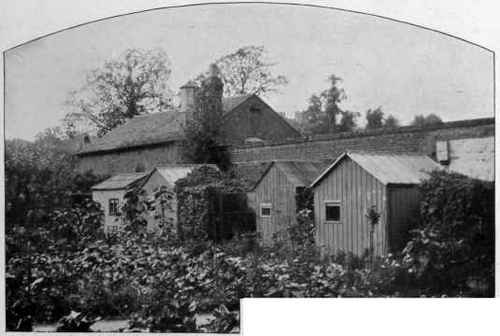
"Birkdale Ruffie's " Cattery
"I once had a good many brown tabby Persians, and people did not fancy them, as they said,'They are so like ordinary cats' - a great mistake ; but by gentle persuasion I managed to get one or two adopted. One lady some time afterwards candidly confessed,' I could not now be satisfied with any other kind, I should miss the stripes so much on the face.' That is just it; in a tabby you have a little more than your neighbours, who go in for self-coloured cats, and, though for the time being they are not quite so fashionable, you can chuckle to yourself if you own one, and feel quietly superior to fashion and the common herd, and hold your tabby still closer to your heart, and purr softly to yourself with satisfaction at its possession; for I think one may say that for good all-round, everyday, reliable qualities, the brown tabby stands pre-eminent.
"His constitut'on being good, he is not peevish ; he stands cold and heat, change of climate and surroundings, better on an average than any. Brown tabbies should have the under-coat a good golden hue, the markings black, clear, and distinct, rather too many than too few. A good-shaped body, lots of bone, a bold head, red nose, golden eyes, well marked on the chest, and no light colour on the lips and chin. These cats may with advantage be a good size. With care, the under colour may be bred to a grand copper colour; a grey hue in brown tabbies is most undesirable."
Continue to:


My Books

