


Cat Appliances. Continued
Description
This section is from the book "The Book Of The Cat", by Frances Simpson. Also available from Amazon: The Book Of The Cat.
Cat Appliances. Continued
A 4 inch deep tray is quite deep enough, and this should not be filled more than two thirds full, or the cat rakes so much earth out on the floor. Neither do they require to be very large, as their weight when filled with soil makes them very cumbersome to move, and they get the more quickly knocked out of shape. The best size is about 17 inches by 14 inches and 4 inches deep, made in stout galvanised iron, with a rim round the edge, and these might be painted some light colour with Aspinall's enamel paint. (I advocate "light paint." as any dirt stains are seen at once.) They will then last free from rust, and can be washed out every morning. Two or three tins of smaller size - say, 12 inches by 8 inches by 2 V inches - are suggested for kittens, or for placing in small pens in an emergency. Baking tins answer this purpose.
After washing, it is well to stand these trays in the air to sweeten, as if they smell disagreeable the cats will not use them.
Messrs
Whiteley supply these zinc tins, or they can be made by any local ironmonger to dimensions given.
Hot - Water Appliances
These are very necessary in the cattery, and should by no means be forgotten.
Many a sick cat's life has been saved, and the critical corner in an illness turned, by the timely comfort and strength bestowed by the hot-water bottle or bag, or even a brick made hot in the oven and wrapped up. In the event of winter litters, too, a hot-water bag should be always in readiness, in case it is advisable to remove the first-born kittens from the mother for a few hours. Heat will restore a seemingly dead kitten, as I have said before. The outside dwellers also, how they appreciate on a bitter winter's night the hot bottle or wrapped up hot brick to keep them cosy!
I know a luxurious stud cat who has a hot-water tin made to fit his sleeping box, which is filled by the maid every cold night and slid beneath his hay bed. Assuredly, there is no greater safeguard against winter's chills and changes of temperature than to provide for your pets sleeping warmly and comfortably at night. The hot-bottle plan has many advantages over the heating of the sleeping houses by stove or lamp during the night. It is better for the animals themselves, as the air is not exhausted, and they are not so prone to take a chill going from heated air to the outside rawness of a w i n t e. r's morning. It is much safer, and it is also much more economical. Personally I prefer the indiarubber bag to the old-fashioned stone bottle, and in the smaller sizes (which are quite large enough) are not much more expensive than the latter. If not filled too full, and wrapped in a washable cover - flannelette is very good - it can be laid flat under the hay, and the cat will remain upon it all night.
In the case of a sick cat the cover should always be of flannel, to avoid any chill as the bag grows colder.

Lethal Chamber, Royal London Institution And Home For Lost And Starving Cats (Photo: Cassell & Company, Limited. )
Then, in our list of appliances, proper travelling baskets must come under consideration. I say "proper" advisedly, for how heterogeneous is the collection of hampers, boxes, baskets - I had almost added bundles - one sees brought in by the officials during the receiving hours before a big show ! Every variety of package, very many of which are exactly what they ought not to be. Some unnecessarily elaborate, polished wooden cases with brass fittings - handsome and durable no doubt, but far too cumbersome, and by their very weight inflicting much jar on the occupant when moved about; while others are a disgrace to anyone pretending to care about a cat or even to know what a cat is, many deserving to be straightway brought under the notice of the Society for the Prevention of Cruelty to Animals.

Spratt's Travelling Basket
I have seen big heavy cats jammed into margarine hampers, a thin wicker receptacle whose sides slope inwards like a flower-pot, where the animal must have suffered agonies of cramp in a veritable chamber of "little ease." Others are sent weary distances in shallow, rough grocery boxes with a few holes bored for ventilation, subject to be thrown about in transit, first on one side then on the other, the lid perchance nailed on, giving thereby much extra trouble to the penning officials. Little wonder if the cat arrives bruised, shaken, frightened nearly to death, and very probably wild and savage.
Now, as evil is wrought by want of thought (and common sense) as well as want of heart, I have thought it well to comment on these very wrong and stupid ways of sending our cats on their journeys before advising better arrangements.
Here are two illustrations of excellent travelling baskets, which fulfil pretty nearly all requirements for cats travelling singly.
The first is made by Messrs. Spratt, and has an inner skeleton lid, which is much to be recommended when sending a vicious or very timid cat that is likely to make a bolt on the basket being opened.
The second, beehive shaped, is designed by Mrs. Paul Hardy, of Chobham. It is of strong white wicker, the lid fastening with a rim of about two inches deep over the body of the basket, apertures in the rim allowing the wicker loops of the fastenings to project; when the cane stick is thrust through these the basket is absolutely secure - not a paw can get out.
This beehive shape has several advantages. The cat can stand up and stretch itself at ease, when tired of lying down. The handle being at the apex, it is carried - even by porters - without the cat being tilted off its legs; whilst the dome top prevents any other package being piled upon it - a disadvantage the flat-typed hamper always has. I line my baskets outside with brown paper or oil baize up to the rim, and inside with curtain serge, leaving the lid free for ventilation. Then, with plenty of hay at the bottom of the basket, the cat will travel from one end of England to the other in comfort and safety, with no danger of taking cold even if left about draughty platforms or in parcel offices. This basket is made by Messrs. Bull, of Guildford, at a very moderate cost, and lasts for years.
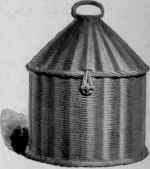
A Useful Cat Basket,
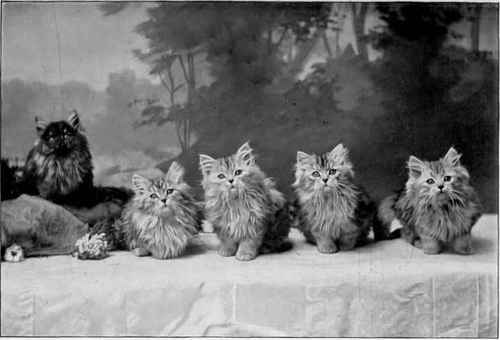
"A Gang Of Poachers" - Kittens Belonging To Miss Alice Dell (Photo: E. Landor, Ealing. )
These baskets are, of course, intended for one cat only, or a pair of kittens. A really safe and capable travelling arrangement for a litter with the mother has yet, I think, to be devised. I have seen none I think good. The double compartment hamper I much dislike. The handles are perforce at each end, necessitating two carriers - who never do it - so the hamper is dragged by the porter or official with one end tilted (the other cat being nearly upside down), is leant up against other luggage, or dropped flat with a bang. With young kittens inside this leads to fatalities.
A label for the travelling basket seems an insignificant item to mention, but an efficient one is as important as that proverbial nail for whose absence the horse and the kingdom were lost.
I have just made the acquaintance of a first-rate label, devised and sent out by a Mr. Foalstone. at sixpence per dozen, from the Aerefair Engineering Works, near Ruabon. It is a stout linen label, printed "Valuable Live Cat" in big block letters; below is "Urgent" in red - a good idea, red being more likely to attract the casual eye of the railway official. Spaces are left below for line of travel, via, etc., and date and time of despatch. It is reversible, so the sender can fill up with the return address if necessary. I always prefer to fasten the label down at both ends, flat to the basket: it is less likely to be torn away than when left hanging loose from one eyelet.
It is by due attention to the details that cat fanciers can to some extent mitigate the dangers and risks that must necessarily attend the transit of live stock by rail.
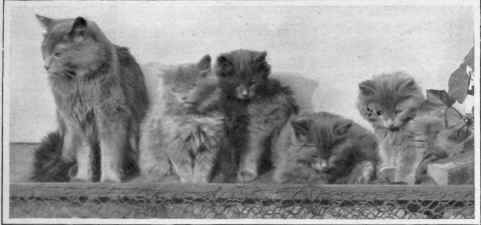
Waking Beauties (Photo: Mrs. S. F. Clarke. );
Continue to:


My Books

