


Cat Club Judging. Continued
Description
This section is from the book "The Book Of The Cat", by Frances Simpson. Also available from Amazon: The Book Of The Cat.
Cat Club Judging. Continued
It is quite legitimate for a judge to ask permission of the show authorities to award an extra prize in a large class with several fine specimens; and if he has withheld others in a poor and badly filled class then there is no extra burden put on to the funds of the club. A great deal should be left to the discretion of the judge, and in the matter of special prizes, if one is offered for, say, the best longhaired white cat, and only one or two specimens are on show, and these are neither of them good types of this breed, then the judge should be empowered to withhold the prize. Such a course may be an unpopular one, but I am sure it is the correct and fairest one, for it is a farce to award first prize and specials to an inferior animal just because he happens to be without other competitors. Anyone who has judged the large classes of blues and silvers which now appear at our principal shows will bear me out in my suggestion that such classes, numbering perhaps thirty and more exhibits, should be subdivided according to age. Such an arrangement would be welcomed by judge and exhibitor alike. At the Crystal Palace Show in 1901 the blue kittens numbered thirty-nine in the class, male and female, the age limit being three to eight months.
How could a judge be expected to satisfactorily award three prizes in such a huge class? And I know that many superb specimens on this occasion had to be content with a V. H. C. card, which it would have gone to my heart as a judge to place on their pen.

Type Of Cage At The Richmond Cat Show (Photo: Cassell & Company, Limited. )

Mr. C. A House, Editor of " Fur and Feather. " (Photo: A. & G. Taylor. )
If there is a prize offered for the best cat in the show, the judge or judges have not to consider which is their favourite breed or which is the most fashionable colour, but just which cat is the best possible type, which specimen is the nearest perfection, and which is exhibited in the best all-round show condition. In longhaired classes the length and quality of coat and fulness of ruff go a long way towards a high place in the awards, and, as I have before remarked, condition is a most important factor in the judges' estimation. In the self-coloured classes of blues and blacks a judge should make diligent search for white spots on throat or stomach. Formerly cats thus blemished were relegated to the "any other" class, but it has been wisely decided by both clubs that cats with white spots should be judged in their own classes, and that this defect should count as a point or points against them. This is as it should be, for to place self-coloured cats in an "any other colour" class seems absurd. They are black and blue cats in spite of a few white hairs, and should be judged as such.
They may never aspire to a first prize, at any rate at a large show; but surely a really fine black or blue cat, with correct eyes, grand head, and good shape, even with the unfortunate spot, should and ought to score over a poor specimen with green eyes and long nose. In the tabby classes a judge will first consider the groundwork and markings, and to these premier points special attention should be given, as there is a tendency to breed tabby cats which are barred only on heads and legs, the body markings being blurred and indistinct. It is not unlikely that indue time the "any other colour" class will no longer form part of the classification at our large shows. Formerly this used to be the largest class of any, but nowadays the entries are becoming small and beautifully less. It is not worth while for a fancier to keep these specimens - they do not fetch any price, they are not valuable as breeders, and it is quite a toss up whether they can win in such a mixed company. I remember the time when blues were entered in the "any other colour" class, and when blue tabbies were more numerous than silvers or blues. It is really a most difficult task for a judge to give his awards at a local show where all sorts and conditions of cats are placed in the one class.
Such an arrangement is good for neither man nor beast.
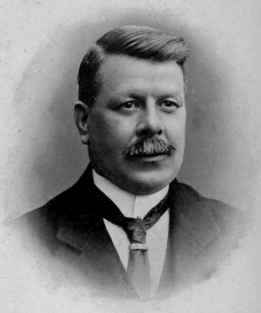
Mr. T. B. Mason (Photo: C. L. Easllake, Leeds. )
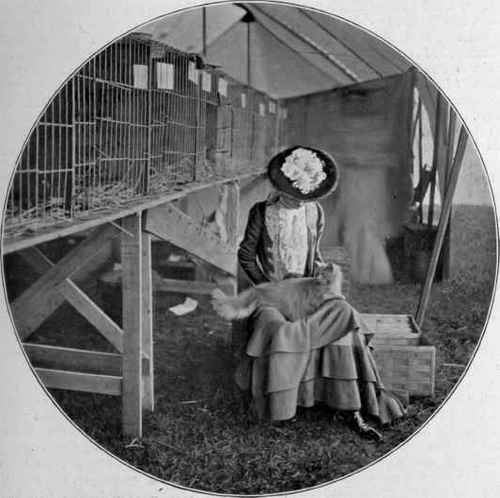
The Toilet - Mrs. Peter Brown and her Prize Cat. (Photo: Cassell & Company, Limited. )
And then, again, at our large shows it behoves a judge to be very level-headed to cope with the numerous brace, team, and novice classes, for one cat may be entered in all these, besides being in the open cat and kitten class; and woe betide the unfortunate judge who makes a slip, for the wrath of the exhibitor and the sarcasm of the reporter will be poured out upon him. No doubt it is a grave mistake to reverse one's own awards, and yet judges are but mortal, and "to err is human. It is hard when cat fanciers take to judging the judges and their judgments. A judge may be absolutely ignorant of the owners of the cats, and thus utterly unbiased; yet there will not be wanting those who will pick holes in their characters, and see in their awards clear proof of personal spite and party favour. The intense suspiciousness of some fanciers and the readiness with which they impute low motives to others is greatly to be deplored.
I will here quote from an article by Mr. C. A. House, the well-known editor and judge of live stock. Under the heading of "The Judging of Cats," Mr. House says: - "All my awards are based on the idea that each breed possesses a distinctive feature, and that distinctive feature must be the one to which most consideration is given. After the chief features come others, such as shape, coat, colour, etc., and the premier awards should be given to cats possessing the best all-round properties.... Selfs, above all things, should be pure in colour. For instance, a blue should be blue, and a black, black. Yet a little rustiness of colour should not be allowed to outweigh a host of other good properties. Colour, however, is hard to breed rich and pure, and should at all times be more highly valued than size, or even coat. The same with markings. Only those who have tried to breed markings know how difficult it is to get them anything approaching perfection. Nothing is more fleeting than marking, and nothing more tantalising to the breeder.
Summing up the matter, my own opinion is, and has been for years, that the cat fancy has been hindered and hampered by judges judging the exhibits because they belong to so-and-so, or had won so-and-so under so-and-so.... I was much amused at one incident at Westminster where a big champion had suffered defeat. The fair owner was heckling the judge, and he in reply to her remarks made this answer: 'It makes no difference to me had the cat belonged to the Queen herself; I should then have done the same. I don't judge cats on what they have previously won or because they belong to any particular person. I judge them on their form at the time, and it makes no difference to me if a cat has won fifty firsts or none at all. ' This reply was more than the exhibitor had bargained for, but all honest-minded fanciers must acknowledge the judge was right. What is sadly needed in the cat fancy to-day is more of this sturdy, unflinching determination to judge cats and not their owners. Cat exhibitors have much to learn yet, and the sooner the morale of the judging arena is raised the more healthy will the fancy become and the more quickly will it advance."
Another of our well-known judges, Mr. T. B. Mason, writing on the same subject, says: - "In my judging engagements I have very often come across exhibits with good coloured eyes, but not the correct shape. A small eye, however good the colour may be, will give the cat a disagreeable, sour expression. With this shape of eye we generally see a narrow, long face, which should keep any exhibit out of the prize list in good competitions. Let it, however, be clearly understood, I do not want eyes to have undue weight in the general conditions of cat judging; but they are important, and as such ought to have due and careful attention at the hands of breeders and judges alike. Two things in the judging of short-hairs weigh heavily with me, namely, pale colours and light-marked heads and white lips. These defects, in my opinion, ought to put out of the money those that possess them in good competition. I perfectly agree with Mr. House about the standards. They are useful both to the breeder and judge; but for the judge to take the standards and try to judge by them at any show would be foolish indeed.
All judges are expected to know the varieties they are called upon to judge, and to have the faculty to weigh up the good points and defects of the specimens before them, and place them accordingly."
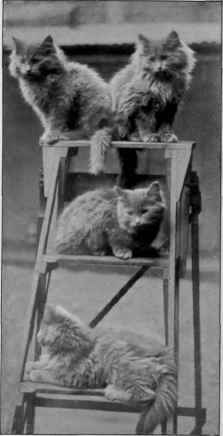
Blue' Persian Kittens (Photo: Mrs. S. F. Clarke. )
Continue to:


My Books

