


Cat Judging In America
Description
This section is from the book "The Book Of The Cat", by Frances Simpson. Also available from Amazon: The Book Of The Cat.
Cat Judging In America
In 1900, I am not afraid to say, we had not more than two judges capable of judging a small show correctly all the way through. To-day we have a great many breeders who could do very fair work, and would not make many mistakes if the classes were not too big for them. Of course, the fact must be recognised here, as elsewhere, that a judge improves with experience, and I hazard the opinion that the fewer cats he owns the better he may judge, though I personally prefer for my own stock a judge who has at some time bred the variety. I cannot say that I have found the judging of cats in America a very difficult matter, up to now, for classes have been, as a rule, small, and in most cases the winners stood out well; and though, no doubt, there have been differences of opinion upon what I have done, I have not had many qualms of conscience, over past doings. The weakest spot in the American cat shows has been the tendency of owners to over-estimate the value of their cats in many cases, and the disappointment of defeat comes sometimes severely upon very enthusiastic people; but there is no hope for a fancier who cannot suffer defeat and come again for some more, so I think we need not waste our tears upon these, for they were never destined to succeed.
Want of quality is another weak spot we have to contend with, and this often comes from the eye not having been trained to the best. Size as a factor of beauty is another fetish we have to destroy with a rude hand, but our people are apt pupils, and those who stay in the game are very anxious to be on the right track, though it will take some a few years longer to learn the give and take, to withdraw gracefully, and to admit that there may be another side to a question. My own position to-day is that I am as much interested in the fancy as ever, but I do not find the necessity for doing the work in so severe a manner now, for there are so many capable of carrying on what has been done, and the future is pretty well assured ; so that for the health of the fancy at large it is better that too much should not be monopolised by two or three pairs of hands, and some of us old-timers who began in 1893 and 1894, and before that, are allowing the younger blood to take its share of the tasks.
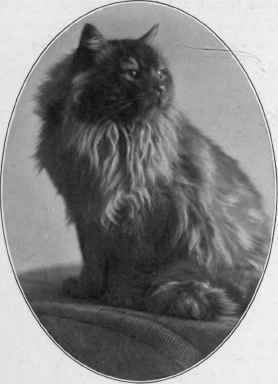
An American Beauty (Photo: A. Lloyd, Amsterdam, New York.)
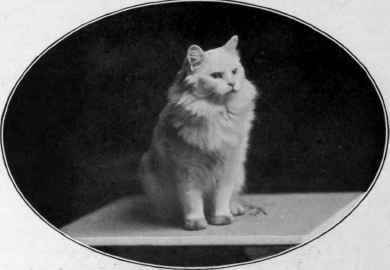
"Champion Miss Detroit." Owned by Mrs. Grose and Mrs. Owen. (Photo: D. D. Spellman, Detroit.)
In judging cats, as in other stock, it seems to me that one of the greatest criterions as to the success of our efforts as judges is the success in many cases of cats or kittens bred from those we have put in the front rank. And only time can tell the force of what we have done. If in the future I see cats doing as well as they are this season, bred from those I have put in the prize list, and judged by other judges, then shall I feel repaid for work done in the past, and not until then can I be sure I have been right. It would be impossible to go back through the last eight years and their troubles and experiences, and though in many cases I know I may have been called a " beast," I hope posterity will say I was a " just beast."
It might be as well to refer to the score card to show where in cases such as we have had to contend with it has done a great deal of good. One hundred points make perfection, and the question arose in one's mind before using the score card as to whether the budding exhibitor would be for ever crushed by finding that the cherished one came out of the score card ordeal with about 75 points instead of the possible 100 ; so that when it has been selected by a club for a show I have warned the owners of the danger; but to the everlasting credit of our fanciers I may say that I have not had to register a kick because of a low score, and many - even novices - were more than pleased with a score of eighty. If I may point out a failing in English judging - and we see the same thing here in the dog fancy - the criticism is left to the reporter, who has not the time or the opportunity for finding the real faults nor the space at command to do justice to the exhibits.
The task of explaining to exhibitors why their animals have lost is not an agreeable one ; but in a land like this, where nearly all have been beginners, this has been an absolute necessity, and the dose must be swallowed or no progress is made, and, as in the case of the score card, no doubt the having to give a reason is likely to keep us from giving prizes to one point at the expense of all the rest. Two great factors we have had to consider here are type and quality, the two weakest points in our cats; and if we had run to extremes in eye colour we should have made no progress in type or perhaps quality. Great stress has been laid upon markings in tabby cats, with very good results, and we are rapidly accumulating a good lot of tabbies - especially in the Detroit district, where tabbies are popular, which is a thing to be grateful for. We have never thought it well here to discourage the orange tabbies for the sake of unmarked orange, and we have some very good orange tabbies whose number is on the increase; and if the plain orange can range up beside the orange tabbies, all well and good.
But I shall be an advocate, if there is a danger of one hurting the other, of making separate classes, for we do not want to drive out the good orange tabbies, which are very popular, and the average American who loves an orange cat at the present moment does not care whether it is marked or unmarked. Cats with white hair are much in favour, as is the case with Madame Ronner and the Continental fanciers ; and, if so, there seems to be no reason for discouraging them, and we may as well first make up our minds to the fact that, in trying to force English ideas down the throats of the people of another country with too violent a hand, we may do a lasting injury to the fancy at large.
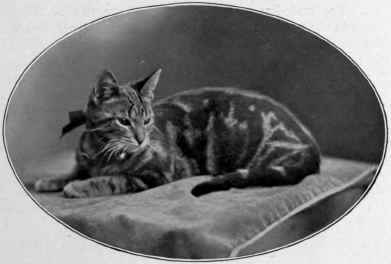
"the commissioner." (Photo: Arthur, Detroit.)
Another thing I might refer to, and that is that the average American exhibitor does not favour giving prizes to long-haired cats when out of coat, and the strength of the fancy and its future popularity lies in presenting to the public the cats in their best dress, and this mostly is the only logical way we can give out the principal prizes and appeal to the good sense of those who come to see them ; for the general public, when not experts, can only judge from appearance. The strength in England lies in the fanciers themselves, who have the opportunity of seeing so much more and of learning. Our future here lies in being able to gather recruits by presenting the cats to them in as perfect a form as possible, and therefore we have to depend upon the public. Our shows have to be in the winter, when the cats are in coat, and the dangers of exposure to the weather are very great, all of which is a good deal to the disadvantage of the fancier.
Continue to:


My Books

