


Chapter I. Cats Of The Past
Description
This section is from the book "The Book Of The Cat", by Frances Simpson. Also available from Amazon: The Book Of The Cat.
Chapter I. Cats Of The Past
THE origin of the cat has puzzled the learned, and the stock from whence it sprang is still, in the opinion of some, a mystery for the zoologist to solve.
Historians tell us that the feline race came into existence about the same time as the horse. Reference is made to the cat in Sanskrit writings over 2, 000 years old, and still earlier records are found in the monumental figures, inscriptions, and cat mummies of ancient Egypt. These carefully-preserved relics of the past assist us in answering the question as to how this least tameable of animals became domesticated. There are many legends concerning Puss and the manner in which she first sprang into existence. A surprising account of the cat's creation is found in the works of an Arabian naturalist. It is as follows: "When Noah made a couple of each kind of animal enter the Ark, his companions, as well as the members of his family, said to him, 'What security can there be for us and for the animals so long as the lion shall dwell with us in the same vessel?' The patriarch betook himself to prayer and entreated the Lord God. Immediately fever came down from Heaven and seized upon the king of beasts, so that tranquility of mind was restored to the inhabitants of the Ark. But there was in the vessel an enemy no less harmful - this was the mouse.
The companions of Noah called his attention to the fact that it would be impossible for them to preserve their provisions and their clothes intact. After the patriarch had addressed renewed supplications to the Most High, the lion sneezed, and a cat ran out of his nostrils. From that time forth the mouse became so timid that it contracted the habit of hiding itself in holes."
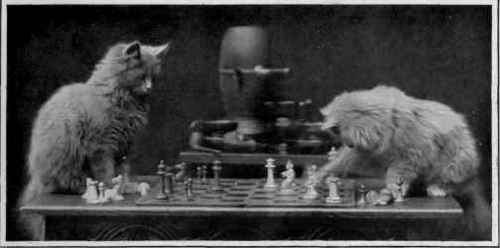
"White To Move. " Photo: Mrs. S. F. Clarke
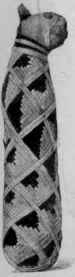
Mummy Of A Cat (At the British Museum. )
So runs the legend, and in an old Italian picture representing the departure from the Ark we may observe a big brindled cat leading the procession of animals with an air of dignity and self-satisfaction. According to the Arabic scholar Damirei, there was no cat in the Garden of Eden. It is a singular fact that nowhere in the canonical books of the Old Testament nor in the New Testament is the cat mentioned, and if we take into consideration the number of books connected with the life, manners, customs, and religions of the Egyptians, this omission is the more striking. The only Biblical reference to cats occurs in the Book of Baruch, chap. vi., v. 22. This is a letter by Jeremy to the Children of Israel, who were taken captive by Nebuchadnezzar to Babylon. Some Hebrew scholars have asserted that the animals that prowled and cried among the ruins of Babylon were jackals, and not cats.
But however much the origin of the feline tribe is wrapped in mystery, we are certain that more than 3, 000 years ago the cat lived and was loved along the banks of the Nile. The ancient city of the Pharaohs paid her homage; she was admitted into the ranks of sacred animals, she was worshipped in the temples. Jewels were placed in her ears and necklaces about her neck. Figures of cats were kept in the home and buried in the tomb. Trinkets representing both the goddess and the cat were worn upon the person, to indicate special devotion on the part of the wearer. There seems but little doubt that the ancient and well-beloved cat of the Egyptians was a barred or marked animal, answering to some extent to our homely tabby. Paintings and statuettes of this type frequently occur, and therefore we may it take for granted that the Egyptians, who were so realistic and true to Nature when dealing with the animal world, would have presented cats of other species had they existed.
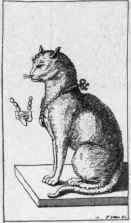
The God Cat (From an old Wood-cut. )
According to the historian, animal worship was first introduced into Egypt by Chores, the second king of the Second Dynasty.
The Egyptians made gods of many living creatures of all kinds, amongst others the bull, the crocodile, the ibis, the hawk, the beetle, and the asp; but the cat appears to have held the highest place in their hearts. Not only was it preserved from injury, beloved and venerated during life, but at its death it was buried with all respect, and everyone mourned for it with outward and visible signs of grief, even to the extent of shaving off their eyebrows. The Egyptian's idea of a correct burial involved mummification, so that all the parts might be preserved and thus kept from annihilation against the day of resurrection. A rich man's cat was very elaborately mummified. Different coloured stuffs were twisted round and round the body, forming curious patterns in two colours. The head would be carefully encased and sometimes gilded; the ears were always standing upright. These curious mummies look something like bottles of rare wine done up in plaited straw. Sometimes the mummy would be enclosed in a bronze box with a statue of a cat Seated on the top. Mummies of cats with painted faces have been found in wooden coffins at Bubastes, Speos, Artemidos, Thebes, and elsewhere.
Here is an illustration of a kitten brought to me from the Boulak Museum. The picture gives but little idea of the care and neatness which must have been employed in wrapping up the dear little dead bodies. The linen used is of the finest. The ears of the tiny kitten are each separate and distinct, and the muzzle of the creature shows distinctly through the delicate wrappings. Scarcely a good museum in the country now that has not some specimens of cat mummies. In some of these we notice that eyes have been added after the mummy has been encased and the embalmment completed. Most of the cats that died in the far-away time were thus embalmed and sent for burial to the holy city of Bubastes, near Thebes, on the banks of the Nile.
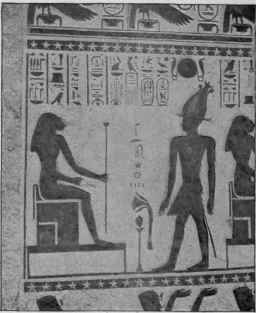
An Egyptian Wall-Painting: The Adoration Of The Goddess Pasht (British Museum. )
Continue to:


My Books

