


Chapter II. Cats Of Today
Description
This section is from the book "The Book Of The Cat", by Frances Simpson. Also available from Amazon: The Book Of The Cat.
Chapter II. Cats Of Today
THE term "Cat" is applied in its widest sense to all feline animals. The following are the various names by which the cat is known in different countries, and it is curious to note that, with two exceptions, they all begin with a "C" or a "K," and differ very little in pronunciation: Irish and Scotch, Cat; French, Chat; Dutch, Kat; Danish, Kat; Swedish, Katt; German, Katti or Katze-; Italian, Gatto; Portuguese and Spanish, Gato; Polish, Kot; Russian, Kots; Turkish, Keti; Welsh, Cetti; Cornish, Katt; American, Katz. In the English house and home we call her "puss," and it is the name which appeals most to our hearts. No woman likes to be called a "cat," but to be likened to a puss or pussy is suggestive of something or someone soft and pretty, with gentle, winning ways. Archbishop Whately has said that only one English noun had a true vocative case, "Nominative, cat; vocative, puss." I do not think that in any other country there is a pet name for the cat, just as there is no word in any foreign language that breathes the same tender truth to the hearts as "home." Puss and home! The terms seem so closely connected with each other, and suggest peaceful happiness and restful repose.
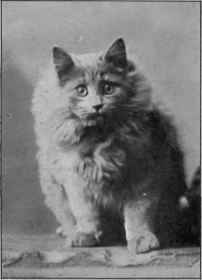
Miss F. Simpson's "Bonnie Boy. " (Photo: Gunn & Stuart, Richmond. )
Truly, the history of the cat has been a strangely chequered one. Perhaps, because she is such a secret, complex, and independent creature she has remained somewhat of a puzzle to humankind, and is therefore to a great extent misunderstood; but those who will take the trouble to consider the cat and try to understand her, will find that puss is none of those things she has been accused of being. It is only those who are in constant contact with cats who understand how intelligent they really are; although their intelligence is quite in a different mould from that of the dog. I may mention that the household cat outnumbers, it is said, the household dog in London by the proportion of four to one. This fact may be accounted for by the non-taxation of cats. The question of the taxation of cats has very often been raised, and I do not think that anyone who really values his cat would object to pay a yearly tax; but the proposal is as unpractical as it is ridiculous, and it is certain that taxation would not help in exterminating the poor, disreputable, half-starved members of the feline tribe, who have no fixed abode and whose only means of existence is by plunder.
The figure and number nine seems to be an important one in connection with cats. There is a popular saying that a cat has nine lives. The expostulating tabby in Gay's Fables says to the old beldame:"'Tis infamy to serve a hag, Cats are thought imps, her broom a nag; And boys against our lives combine, Because, 'tis said, your cats have nine. "
Cats probably owe this reputation to their extraordinary powers of endurance, and certain it is that they have a greater tenacity to life than any other animal. At the Battersea Home a dog and a cat have been placed in the lethal chamber, and it was observed that the dog died in five minutes, whereas the cat breathed for forty minutes longer. A short time ago I received the following letter from a cat fancier:"At 11 p. m. two kittens, a few hours old, were placed in a pail of water, and left there for rather over ten minutes. Seeing them at the bottom with their mouths open, it was taken for granted they were dead; the bodies were then transferred to the ashpit, and early next morning they were discovered to be alive and quite chirpy. Restoring them to the mother, they have grown nice, strong, healthy little kits, and have just left for comfortable homes. "
In Thistleton Dyer's interesting book on "English Folk-lore," reference is made to-this subject. "Cats," he says, "from their great suppleness and aptitude to fall on their feet, are commonly said to have nine lives; hence Ben Johnson, in 'Every Man in his Humour,' says,' 'Tis a pity you had not ten lives - a cat's and your own.'"
"In the Middle Ages a witch was empowered to take cat's body nine times," so writes an eminent old zoologist.
The "cat-o'-mne-tails" is a dreaded object to some light-fingered and heavy-handed miscreants. I have heard a magistrate remark that he considers this form of punishment the best way in which to give hints to the wicked. Garrotting was virtually stamped out by its use. Wife-beating would be less common if the brute-husband were treated to a taste of the cat-o'-nine-tails. This implement of torture consists of nine pieces of cord put together, and in each cord are nine knots. Consequently every stroke inflicts a large number of long and severe marks not unlike the clawing and scratching of a savage cat, producing crossing and re-crossing wounds.

Kitten At Work And Play (Photo: C. Reid, Wishaw. )
In my long and varied experience of cats, I have noticed that more of these creatures succumb to the common enemy at about nine years of age than at any other period. We have heard of cats attaining the age of twenty years, but the following account surpasses all previous records of longevity in the feline world: - To the Editor of the Stock-Keeper,
Sir, - Seeing you have a column in your paper devoted to cats, I thought it might interest your readers to hear that in our village there is a cat thirty-one years old. She is quite lively, and looks like living a few more years. It belongs to a poor widow, who told me she had it as a kitten when she married. (Her husband lived twenty-seven years, and has been dead four. )
Newbury, Bucks. W. B. Herman.
It is strange that the poor dead bodies of cats have often been used as objects of foolish and vulgar so-called sport. Dead cats and rotten eggs were, and are sometimes still, considered legitimate missiles to make use of at borough and county elections.
Continue to:


My Books

