


Chapter XVII. Tortoiseshell Persians
Description
This section is from the book "The Book Of The Cat", by Frances Simpson. Also available from Amazon: The Book Of The Cat.
Chapter XVII. Tortoiseshell Persians
MANY years ago, when I first took up the cat fancy, I used to think tor-toiseshells ugly and commonplace, and I am afraid even now I have not that admiration for the breed which I feel a really good specimen of this variety ought to inspire. To begin with, it is seldom that a true type of long-haired tortoiseshell is seen or exhibited, and perhaps this may account for the breed being so much neglected. They are not taking-looking cats, and make a poor show in the pen. I have often remarked, however, that this is a favourite breed with the sterner sex, and that our professional men judges will almost invariably pick out a tortoiseshell when judging an " any other colour" class, and give it some mark of distinction. This may be accounted for by the fact that, of all varieties, a really good tortoiseshell is most difficult to breed, and therefore any specimen approaching perfection should be encouraged. There are splashed and sable tortoiseshells and tortoiseshell tabbies, all handsome cats of their kind, but not the genuine article.
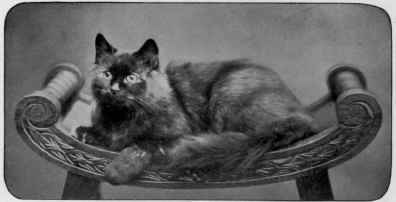
"Topsy Of Merevale." The Property of Mrs. Bignell. (Photo: O. Hardee, Chislehurst.)
Real tortoiseshells may be called tricolour cats, for they should bear three colours, like a tortoiseshell comb, on their bodies, namely black, red, and yellow, in distinct patches or blotches, solid in colour and well broken up, with no trace of stripes, bars, or tabby markings. A brindling effect is to be avoided, and a white spot on chin is a great blemish. It is most undesirable that the black should predominate, in which case the specimen will lack brilliancy. The three colours should, if possible, be pretty evenly distributed over the body, legs, and tail, and should not run into each other. The red and yellow may preponderate over the black with good effect. A blaze, so called, up the face is considered correct, and this should be of the red or yellow, and in a straight line from the nose upwards. This is a very distinctive feature in the breed, and one that judges will look for in a good show specimen. It is incorrect for the tail to be in any way ringed with the colours. The texture of the coat is often coarser and more hairy in this breed, and it is not usually so long and flowing as in other varieties of Persian cats. There is no difference of opinion as to the correct colour for the eyes of tortoiseshells.
They should be a bright golden or orange, and these seem in perfect harmony with the colouring of the coat. Tortoiseshells never attain any great size, and may be called a small breed of Persian cats. I give the list of points as drawn up by the specialist society
Continue to:


My Books

