


Cream Or Fawn Cats
Description
This section is from the book "The Book Of The Cat", by Frances Simpson. Also available from Amazon: The Book Of The Cat.
Cream Or Fawn Cats
Colour
To be as pure as possible without marking or shading, either paler or darker, dulness and white to be particularly avoided. All shades from the palest fawn to be allowable. 25.
Coat
To be very long and fluffy. 25.
Size And Shape
To be large - not coarse, but massive, with plenty of bone and substance ; short legs. 20.
Head
To be round and broad, with short nose, ears small and well opened. 15.
Eyes
To be large and full, and bright orange or hazel in colour. 5.
Condition
10.
Much has been done by this energetic specialist society to get a better classifica-t i o n for creams at our shows; and per-haps,astime goes on and a larger number of fanciers take up these breeds, a distinct classification will be given for creams and fawns. It may always be a little difficult to draw the line between the two; but such a division of colours would, I think, give satisfaction to the breeders of both creams and fawns, for at present judges are more inclined to give a preference to the palest - coloured cats, perhaps because more beautiful and more difficult to breed.
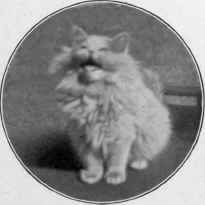
A Creamy Smile
In the former breeds, more especially blues and silvers, that I have described in this work it would have been impossible to name all those cats that were noted in the fancy, for the simple reason that their name is legion ; but it is different in a breed like creams, for, as I mentioned in the beginning of this chapter, in times past it was a case of only here and there a cream Persian appearing on the scene, then vanishing perhaps to America, or else being purchased for a pet and retiring from public life. These " sports " in the fancy were not seriously taken up, and no one thought of trying to establish a strain; so that one can, as it were, put one's finger on the cats of this variety, if not so easily in the present day, certainly in the past.
The first recorded cream Persian in catalogues or stud books is "Cupid Bassanio," born in 1890, bred by Mrs. Kinchant ; no pedigree is given. He was a big, broad-headed, heavily coated cat, with a good many marks and shadings, and was sold to Mrs. Preston Whyte, and passed on to Miss Norman. In the same year Mrs. Kinchant exhibited cream kittens at Brighton. "Ripon" was another well-known cream of imported parents (a blue and an orange). This cat was purchased from Mrs. Foote by Lady Marcus Beresford, and eventually disappeared when in the possession of Miss Cockburn Dickinson. Mr. McLaren Morrison in 1893 owned a pale cat called "Devonshire Cream." In the following year Miss Taylor bred a splendid specimen from "Tawny," her noted tortoise-shell. This cat, called "Fawn," was an absolutely self - coloured fawn with brown eyes, and would do some winning if alive now to compete in our up-to-date classes for cream or fawn. It was in 1895 that Miss Beal first exhibited some of her creams, upon which at that time she did not set much store, more interested as she was in blues ; but of her now celebrated strain more anon.
One of the best-known creams of late years is "Zoroaster," bred by Mrs. Bagster from her tortoiseshell "Pixie." This was a remarkably large pale cat with glorious eyes, but he was a good deal patched in colour when I saw him at Mrs. Mackenzie Stewart's cattery. Mrs. Cartwright bred a well-shaped light cream, "Upwood Junket," by "Timkins," a blue, and a daughter of "Cyrus the Elamite." Mrs. Davies, of Caterham, has often had creams in her possession, notably "Lord Cremorne," quite one of the palest seen in the show pen. Two noted creams now placed at stud are Mrs. Norris's "Kew Ronald" and Mrs. Western's "Matthew of the Durhams." Both these cats are bred from Miss Beal's famous "Heavenly Twins." Regarding "Matthew," a reporter in Our Cats thus writes after the Botanic show of 1901 : - "Creams are, we prophesy, the coming cats. There seems to us great possibilities in this variety.' Matthew of the Durhams is one of the cats we would bring forward in support of this view. Eminently aristocratic, breathing an air of refinement, this cat might be the petted darling of a princess whose cats are all selected by a connoisseur." Mr. Western is justly proud of his purchase, for he claimed this fine cat at the Sandy show, 1901, when he was exhibited by Mrs. D'Arcy Hildyard. "Matthew" has on four separate occasions taken second to his father "Admiral's" first.
He has sired some lovely creams, notably "Wynnstay Myrtle," also owned by Mrs. F. Western. This female is one of the best of her breed, and is sure to have some influence over the creams of the future. At the Crystal Palace show of 1902, where she was awarded first and many specials, she was the admired of all admirers. As a rule, cream females have been very much behind the males in quantity and quality. Almost the first two were bred by Miss Hester Cochrane from "Cyrus the Elamite" and "Brunette." "Cremed'Or" is quite one of the best, and was owned by Mrs. Wellbye, who sold her to Mrs. Norris. This cat declined to enter into any matrimonial alliance for some time, but at last presented her owner with a family by "Darius," Mrs. Ransome's noted blue. Two of these cats, "Kew Laddie" and "Kew Ronald," are well known in their different spheres. "Kew Laddie" I purchased to send out to Mrs. Clinton Locke, in Chicago, and she presented him to the honorary secretary of the Beresford Club, Miss Johnstone. This lady exhibited "Laddie" at the big Chicago Cat Show, where he won high honours, and in a letter received from Miss Johnstone I learn he is growing a grand fellow and, in fact, is quite la crime de la creme in catty society over the water.
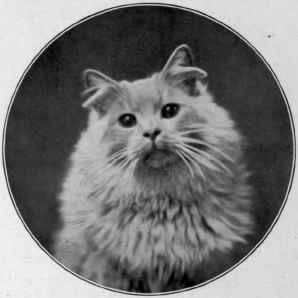
Mrs. F. Norris's Cream Kitten (Photo: E. Landor, Ealing.)
The picture of a perfect kitten on the opening page of this chapter represents a cream female, "Jessica Kew," bred by Mrs. Clinton Locke from "Lockhaven Daffodil," sired by Miss Johnstone's "Laddie Kew." Mrs. Clinton Locke is justly proud of this lovely kitten, and writes: "Jessica is the finest kitten I have ever seen ; all her points are perfect. She was five weeks old when this photo was taken. Her grandfather was my' Victor,' an orange, her great-grandmother a tortoiseshell-and-white."
I have mentioned Mr. F. Norris as a breeder of creams and the owner of the handsome pair of cats illustrated on this page. He has kindly supplied me with the following notes: "Cream cats are of a modern colour in Persians, but are now being more freely bred and finding numerous supporters. There are, however, very few good ones in the fancy, for size and colour are difficult to obtain. The great failing with them is that, although they are called cream cats, the best and soundest coloured ones are really of a fawn shade. So many show markings, patches, or shadings, whereas the colour should be one shade and sound throughout; better be a little dark in colour rather than shade from cream to white, as is the case with so many specimens exhibited.

"Kew Ronald" And "Kew Laddie." (Photo : E. Landor, Ealing.)

Miss Beal And Her Kittens
"For one grand-headed and good-eyed cat you see a dozen snipy, long-faced ones with curious slit eyes, instead of a short, snub head, with glorious big round golden eyes.
" In my opinion, to get the short head, good eye, fine body shape, and short legs, it is best to mate a cream with a good cobby blue. From my experience nothing beats a blue, although you can mate them with a red, tortoiseshell, or black. Mating two creams together I do not advocate, unless one of them has a distinct out-cross in the first generation to totally different blood.
"All the creams shown are descended from Miss Beal's two brothers' Romald-kirk Admiral' and'Romaldkirk Mid-shipmite,' and to keep the colour, breeders have bred in and into them again; and that is why they have lost so much in type and character, which would have been improved by using an out-cross.
"I have heard people say,' Cream females will not breed.' If they only studied the question a minute, they would know the reason well enough, which is that they have been too much in-bred. If breeders will only try the blue cross more, they will, I am sure, be pleased, and we shall see a better cat being shown. Breeding from blue you will get pure creams and some cream and blue mixed. Keep the blue and cream females, and when old enough mate them to a cream, and you will get some fine sound-coloured cream kits.
"It is very curious that there has been nothing yet bred in males to beat the twin cats 'Admiral' and' Mid-shipmite.'
"In females the best I have seen is 'Miriam of the Durhams,' who has a lovely body and coat, but is long in face and has those bad-shaped eyes.'Creme d'Or' runs her close, as she has such a good head, with perfect eye, but is a wee bit long in the leg." Miss Beal's females "Calliope" and "Mignonette" were both noted prize-winning cream females. Mrs. D'Arcy Hildyard has been most successful in her endeavours to breed creams from creams, and a letter from her in Our Cats of April, 1901, will be interesting to breeders of this variety
Continue to:


My Books

