


Female Cats And Kittens. Part 4
Description
This section is from the book "The Book Of The Cat", by Frances Simpson. Also available from Amazon: The Book Of The Cat.
Female Cats And Kittens. Part 4
At about five weeks old the kittens will begin to lap and possibly to eat. Many fanciers are delighted if they will eat and drink before a month old, and some make the serious mistake of trying to coax the little ones to eat solid food at this tender age. Such persons do not stop to think how weak are all the digestive organs of these tiny creatures. The milk of the mother supplies all that is needful for their growth and well-being until such time as Nature makes itself heard in her demands for further nourishment, and if substantial food is given to them too soon, or too strong, it merely goes through the stomach, passing out into the bowels undigested, decomposes, and forms slimy mucus which is the hotbed for worms, even if it does not set up inflammation of the bowels. More kittens die from worms and consumption of the bowels than from any other complaint, and much of this loss of life is directly traceable to strong food at too tender an age.
Lung disease, gastric catarrh, gastroenteritis, are all directly or indirectly set up by the non-assimilation of food; hence the supreme importance of giving nourishment which can be digested easily. After six weeks scraped raw beef may be given (if the kittens want to eat) three times daily in very small quantities, about half a teaspoonful to start with, and they may have warm milk and water with lime in it. This should be followed by Mellin's, or Benger's Frame Food, as directed for infants. It is advisable not to allow kittens to overload their stomachs, but to feed them about four times daily. If healthy they will eat eagerly, but not ravenously; a kitten who is greedy and precipitates itself into the saucer in its anxiety to get its dinner may be suspected of worms, and when about eight weeks old a course of Salvo's No. 1 powders may be given with safety.
As soon as the kittens are about a month old, a shallow tin of dry earth or ashes (I do not recommend sawdust) should be provided for them, and it will well repay their owners to spend some portion of the day with the little ones and lift them into the earth-pan when necessary. If this is done two or three times, the lesson is probably learnt for life. Kittens are naturally clean, and will get out of their beds, and run about crying loudly for some accommodation for their wants; and if this is neglected the seeds of dirty habits are sown, and the poor untaught little ones reap a sad harvest of cuffs and sometimes kicks from servants, who naturally dislike the trouble caused by dirty house pets. Even in catteries cleanly habits in cats are much to be desired. If a cat or kitten gets into dirty ways, it should never be beaten and put into the tin, but should be gently stroked and coaxed into good habits. Those who only keep one or two queens will find that if they spend a few minutes playing with the kittens before their meals, they will be well rewarded by the quicker growth and better digestion of the little ones; but, of course, this is out of the question in a large cattery.
In summer, kittens should be combed daily with a small tooth tomb, as the insects which inhabit their coats not only worry them and cause them to scratch out their fur, but they convey disease from one to another, to say nothing of sucking out so much blood that the poor little creatures become absolutely anaemic, and in this state they fall an easy prey to the first disease that attacks them. Fleas were formerly treated as irritating but otherwise harmless insects; but we are assured on the best authority that they are a dangerous medium of disease, and that tape-worms are generated in dogs and cats by their means. The poor animals, wildly resenting the annoyance of these pests, hunt for them with teeth and tongue, and, swallowing their enemy, may also swallow a number of undeveloped tapeworms, which in their larval or grub state are secreted in the abdomen of the flea. Tapeworms are said to undergo certain metamorphoses or transformations, and require to pass through the body of some other creature than the one they exist in in their mature state of being.
It is a great mistake to keep kittens in heated rooms, and worse still to allow them to be close to a fire by day and then to let the room get cold at night. An even temperature, cold and dry, is better than sudden changes; cats and kittens love warmth and comfort, but, at the same time, all extremes of heat and cold are bad. Never neglect the first symptoms of illness; note the signs, and if you are not able to dose the invalid yourself send off a wire to some competent cat doctor describing the form the indisposition has taken, and while waiting for medicine no harm can be done by giving as much carbonate of soda as will lie on a threepenny-bit in a little water two or three times daily. Salvo has lately advertised a medicine which is said to be very valuable for giving on the first signs of a cat or kitten being out of sorts, and which, he says, will take down fever, stop colds, and modify attacks of bronchitis, pneumonia, etc.; and for such fragile little beings as kittens fanciers would do well to keep this medicine by them.
People often say that their cats and kittens seem ill or out of sorts, and allow this sort of thing to go on quite calmly for a week or so, when one day they wake up to the fact that the poor creature is very seriously ill, and they then send off in a hurry for medicine which frequently arrives too late; and the sufferer may be beyond all human aid.
Double pneumonia, which is perhaps the quickest and most fatal of all diseases, is not so sudden but that it is ushered in by various symptoms, beginning often a week before the attack becomes acute. An animal will seem cold, will creep near the fire, or sit in the fender, mope about, refusing to play, sit in a hunch with its back up, or is very sleepy and stupid; the fur is rough; there may be sickness, and the evacuations are of a bright yellow colour; perhaps it has not quite finished its meals for a few days; and the nose is hot and dry, and, if taken up, the cat feels hot and dry all over. When there are several of these symptoms, no time should be lost in administering the remedies named above every hour or two until suitable remedies can be obtained; but do not rely upon them alone, or think if you give them persistently they will pull the" animal through the illness, for they will not, special remedies being needed for special symptoms and for various stages of disease. No two animals are exactly alike, and the experienced cat doctor will prescribe carefully for each individual cat in the same way as a physician will give different prescriptions to suit the needs of different patients.
One thing should never be neglected, and this is keeping up the strength from the first with beef-tea, eggs and milk, Brand's Essence, or animal Kreochyle - a teaspoonful every hour. As soon as an animal has refused two meals, begin feeding with spoon, as it will have so much more strength with which to battle against disease if fed up well from the first.
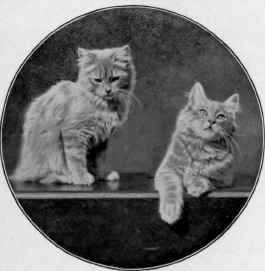
Kittens Belonging To Miss Bromley
People who desire to sell kittens for profit will do well to part with them at about two months old, before they start teething, for at this period of their little lives fresh troubles begin. Occasionally they suffer from fits, but though these are sometimes caused by cutting their teeth, they are oftener due to the presence of worms. If the gums are swollen and inflamed, a quarter of one of Steedman's teething powders will soothe them, or a few doses of bromide, as prescribed before for kittens desiring to mate too early, may be given, and excitable kittens should be kept quiet. If kittens are troubled with diarrhoea, all starchy food should be avoided, as it is never easily digested by animals. The reason of this is not far to seek, when we know that the saliva partly digests starch, while the juices of the stomach act directly on meat.
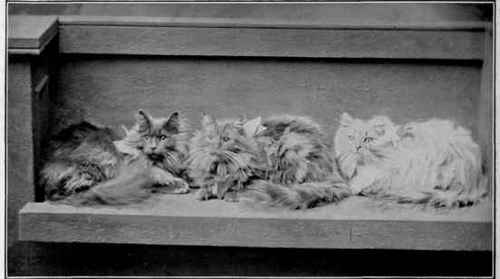
Neuter Pets Owned By Mrs. Hastings Lees (Photo: The Royal Central Photo Co., Bournemouth. )
Animals, instead of masticating their food, by which means the saliva acts upon it, often bolt it, and it goes into the stomach and is passed out into the large bowel practically undigested, where it decomposes, working off in noxious gases which escape through the skin, causing eczema, or in many cases producing inflammation of the bowels or enteritis. Nothing needs more careful attention than the diet of kittens, and nothing is so little studied. It would be no exaggeration to say that all disease, apart from outside or accidental causes, such as draughts, cold winds, contagion, etc., is in the first place set up by undigested food, and even what may be called external causes would often not be harmful to an animal if the digestive organs were in proper working order. Remember, it is not the quantity of food a kitten takes that benefits it. The secret of its health and well-being is in the quantity it digests. A kitten should only digest certain things in certain proportions, and whatever remains undigested produces irritation, and in this case the kitten cannot possibly develop, and is generally weakly and fretful.
Those who have never cared much for cats will be interested and amused if they bring up a family of kittens, and the love and trust of the little creatures will well repay them for all their care.
Continue to:


My Books

