


Standard Of Points For The "Royal" Siamese Cat. Part 2
Description
This section is from the book "The Book Of The Cat", by Frances Simpson. Also available from Amazon: The Book Of The Cat.
Standard Of Points For The "Royal" Siamese Cat. Part 2
" All Siamese kittens are white when born, but in a few days slight markings appear on tail, ears, and paws, and by four months old the markings are dark and complete, excepting those which connect the face and head ; these are seldom perfect before eight months old.
"The tails are sometimes straight, which is not a fault; but a knot or kink in the tail is a peculiarity of the breed, and therefore desirable. In England it has been asserted that this is a defect, but in Siam it is highly prized, and cats from the royal palace which have been given by the King as presents of value to important people have had this distinction. In the East a cat with a kinked tail fetches a higher price.
" The Siamese have a great affection for animals, and there is no doubt that the cats are much valued, those in the royal palace having been kept exceptionally pure. "There is a legend that the light-coloured cats, with blue eyes, represent silver; the dark cats, with yellow eyes, gold ; and that the possessor of both will always have plenty. This rather gives the idea that originally the eyes of the pure chocolate cat were yellow, and that the present variety has been crossed with the royal cat.
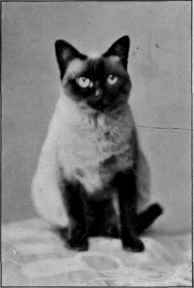
" Si." The Property of W. Margetson, Esq. (Photo: H.J. Comley, Stroud.)
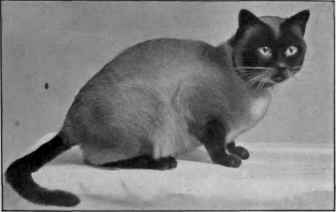
"Tiam-O-Shian I V." Owned by Mrs. Vyvyan. (Photo: Speight, Kettering.)
"Mr. Young, of Harrogate, had some years ago a chocolate cat with yellow eyes.
" Another belief is that they receive the souls of their owners at death, and it is well known that the King of Siam had one on board his yacht when visiting Europe a few years ago.
"It is a great mistake to mix the varieties, as the result after they become adult is a blurring of the markings and a patchy coat.
"The males are extremely powerful, and will kill strange cats and fight dogs. They are devoted to their wives and children, and to their owners. They are exceedingly intelligent. With the dogs of the house they will be on excellent terms.
"The litters vary in size, but four to five is the usual number. The kittens are difficult to rear, as they suffer from worms and teething, but after seven or eight months old there is little danger. Some people think a meat diet best, but I find it satisfactory to bring them up on lighter food, such as Ridge's food, milk, gravy, and fish, until they begin to cut their teeth, when meat is required.
"A pair from the Palace were given to Mrs. Vyvyan and myself in 1884-5, and we have been very careful in breeding, mating when possible with such good cats as Mrs. Lee's celebrated'Meo,' Miss Moore's'Siam,' Mrs. Harrington's'Mechi,' etc, and have bred in consequence the famous'Tiam-o-Shians' II., III., and IV.,'Polyphema,"Susa,"Kitya Kara," Goblin," Champion Eve,"Mafeking,'
'Vishuddha," Ah Choo," Suzanne,' and many others."
Among fanciers and importers of Siamese cats in the past, I may mention the Hon. Mrs. McLaren Morrison, Lady O'Malley, Lady Decies, Mrs. Brodie, Mr. Temple, Mr. Gambier Bolton, Miss Moore, Mrs. Elliott Hill, Mrs. Cunliffe Lee (owner of the celebrated "Meo"), and Mrs. Carew Cox, who later in this article will give some account of her "King Kesho" and the breed with which her name is still associated. Mrs. Herring has exhibited good specimens from time to time. Mrs. Chapman's "Wally Pug" used to cross the Irish Channel to visit English cat shows. Mr. Young and Mr. Inman, both of Harrogate, favoured this breed, and had some lovely cats. Mrs. Nield owned a charming little female named "Mintha-mee " ; and Miss Sutherland, who lives in the south of France, used to breed a lot of good Siamese from her imported " Prince of Siam." Several of her breeding have been sold in England, and have won at shows. Mrs. Patton Bethune has often exhibited, and is an ardent admirer of the breed. Mrs. Parker Brough, in whose care "Tiam-o-Shian IV." is placed by Mrs. Vyvyan, is well known as a Siamese breeder, as is also Mrs. Spencer, of Eye Vicarage, who exports quite a number of cats ; one of her breed - owned by Mr. E. Ratcliffe - is a beautiful animal.
Mrs. Vary Campbell, the president of the Siamese Club, is a generous supporter of the breed. Mr. and Mrs. W. R. Hawkins have always had some fine specimens ; and Mrs. Hankey, Miss H. Cochran, Miss Derby Hyde, and Miss Armitage are among others who owned some notable-Siamese cats. Mrs. Backhouse's " Champion Eve " was a distinguished prize-winner, and Mrs. Robinson's "Ah Choo" was chosen as a model for the medal of the Siamese Club. But it is chiefly as the owner of the celebrated " Champion Wankee " that Mrs. Robinson is known in the cat fancy in general, and among Siamese breeders in particular. "Wankee " was the first Siamese to win the title of " Champion." He was bred in Hong-Kong, his mother - "Nms " - being a stolen palace kitten. "Wankee" was six months old when he arrived in England: and was born in September, 1895. He has won over thirty prizes, but was never shown till June, 1898, therefore losing the time in which most Siamese cats gain their honours - namely, between six months and two years, when they are pale in colour of coat.
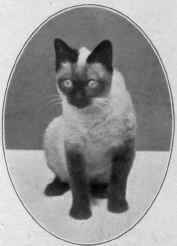
" It." Owned By Lady Marcus Beresford {Photo: Russell & Sons, Windsor.)
Many are the prize kittens he has sired, too numerous to mention. Mrs. Robinson, who is a member of the National Cat Club committee, has frequently acted as a judge of Siamese, and has kindly written the following account for this chapter : "One of the most beautiful of the short-haired cats is undoubtedly the royal cat of Siam, and the breed is greatly increasing in popularity ; but is never likely to be common, as the cats are delicate in this country. The best description is that drawn up by the Siamese Cat Club in their standard of points. The points of the chocolate Siamese are the same as the royal, with the exception of body colour, which is a dark rich brown all over, thus making the markings less noticeable. All Siamese cats darken with age, and when they get dark there is a tendency to call them chocolates. I know of only one real chocolate - Mr. C. Cooke's' Zetland Wanzies' - so consider them more likely to be a freak than a distinct variety.
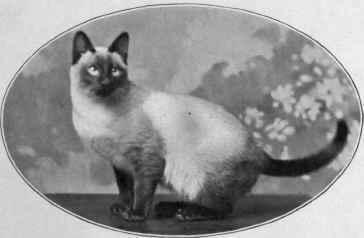
Mr. Ratcliffe's Siamese. (Photo: Hartley, Burnley.)
Continue to:


My Books

