


Chapter VIII. Chinchillas
Description
This section is from the book "Everybody's Cat Book", by Dorothy Bevill Champion. See also: Your Cat: Simple New Secrets to a Longer, Stronger Life.
Chapter VIII. Chinchillas
Probably many novices have no idea of the correct colour of a chinchilla cat; the name "chinchilla," as applied to the colour of a silver cat, is most misleading.
The little chinchilla animal is, as we all know, very dark grey at the roots of the fur, with very pale, almost white, tips to the hair. Now, has anyone seen a cat of this description? We venture to think not. Chinchillas, when first bred (now some twenty years ago) were just the opposite to their namesakes in colour, the coats at the roots were almost white, the tips a dark grey; therefore the name chinchilla is only a fancy name, and by no means descriptive. A chinchilla cat should be as pale silver as possible, with little or no tabby marking or dark shading; in fact, the ambition of everyone is to breed a silver as nearly self-coloured as possible, at the same time keeping the lavender shade, which gives brilliancy of colouring and prevents the cat looking "dirty white." Now, by "lavender" we do not mean a dark lavender; in fact, unless the cat were placed beside one of the "dirty white" chinchillas, you would not notice the lavender tint; but it adds brilliancy to the silver colouring.
The greatest point in the color of a chinchilla is freeness from any brown or cream tinge. Of course, a chinchilla can get its old coat rusty by lying in the sun, but if the cat is healthy, this should shed off before the show season, so does not matter; but should a cat you have bred, or may wish to purchase, have any cream on the frill, nose, ears, or shoulders, you may count this as permanent, as we have never found a cat go rusty in these parts through lying in the sun; unless, as I said before, it is out of health; then the coat loses its natural oil. Perhaps it would be a little difficult for a novice to discriminate between sunburn and a real creamy tinge, but to experienced breeders there is no difficulty. For instance, if a kitten is born with a yellow tinge, it generally grows up with it, so if at the age of six weeks you see your kitten has this fault, my advice is to dispose of it for a pet, and keep another one of the litter which although it may be darker, yet does not possess this defect. Of course, there have been instances of a pale chinchilla having a creamy tinge as a kitten, and when it is, say, two or three years old, this has entirely disappeared; but, in my opinion, this only happens when the cat is very pale and the cream tint is also pale; then, as the cat grows lighter in colour (as many chinchillas do with age), the cream becomes so light as to be imperceptible.
As a great many silvers of to-day possess this fault, perhaps it would be as well to give advice on how it is to be bred out. If your male cat has this failing, do not breed from him at all, if you can prevent it; if not, cross him with a blue, bred from silvers, a pale smoke (silver bred), or, if you wish to do so, a pure-coloured shaded silver or chinchilla queen; but if you possess the latter, you are only going backward, by crossing her with a male who is not pure in colour. I should strongly advise beginners in chinchilla-breeding to commence with a light smoke or shaded silver with good points, and send it to the best male of the day (chinchilla, of course), rather than to purchase a pale silver female with bad points and a creamy tinge. With the darker queens you may produce one or two nearly perfect kittens, which you can again cross with a good chinchilla male, whereas with a pale queen you may obtain three or four pale kittens which will have poor points or a creamy tinge, and this will take you a long time to breed out.
I have heard of, and, in fact, have had myself, many applications for a "perfect" chinchilla. Now, I may say, even after twenty years of breeding, good chinchillas are very scarce both in England and America, and we seldom hear of one of the best changing hands. If you inbreed silvers, there are a great many things to be considered. First, the parent cats must have good points as well as colour, for you must remember inbreeding fixes whatever points the two cats may possess more strongly; so to inbreed two cats that have really bad faults is to fix these faults. Strength is another, if not the most important, point.
Inbreeding tends to weaken a strain, so you must only use the strongest cats; if, after breeding several times from the same pair, you find any weakness in the kittens, you must at once stop, and take in a cross from a strong, unrelated strain. This, of course, will be, in the chinchillas, a difficulty (as nearly all silvers are bred from the same strains), but you had better take in a shaded silver as an outcross, to get size and strength, and perhaps lose a shade in colour, than to go on inbreeding and obtaining pale kittens which may be deformed or will be too delicate to live. On the other hand, if one out of the litter lives, it will probably grow up so undersized that it will take a low position in the show pen; and when you ask other fanciers to admire its beautiful colour, they may do so, but will add, "How very small. Is it full-grown?" If you wish to inbreed, it is best not to do so with very young stock. Wait until both your cats are two or three years old, as they are always much stronger at that age. About relationship for inbreeding, there is much diversity of opinion. Firstly, the stronger your stock is, the more closely you can inbreed; but I do not think, from personal experience, that too close inbreeding is any advantage.
Cousins are a good cross, and some people try half-brother and sister. This I knew in one case to be very successful, and the same mating was tried for several years with the same two cats; but as a rule, at the first sign of deformity you should discontinue and take in a fresh strain.
In breeding chinchillas, never forget that green is the correct colour for the eyes, the most desired being that deep blue-green tint so seldom seen in a cat's eyes; these, set in a silver ground colour, are most beautiful. The points of a chinchilla are the same as other Persians.
In purchasing a chinchilla for exhibition purposes, there are several very important points to consider.
First and foremost, paleness and purity of colour, freedom from markings or heavy shadings, good shape and green eyes. One seldom sees a cat of this description, and it is usually "not for sale" at any figure. Therefore, your best way is to breed one, and, as with other animals, this cannot be done all at once; it takes some time to obtain all these good points.
Therein lies the "sport" of breeding animals. If we were able to breed perfection at the start, there would be nothing else left for us to do; yet beginners almost invariably expect whole litters of future prize-winners, from, in many cases, quite ordinary parents.
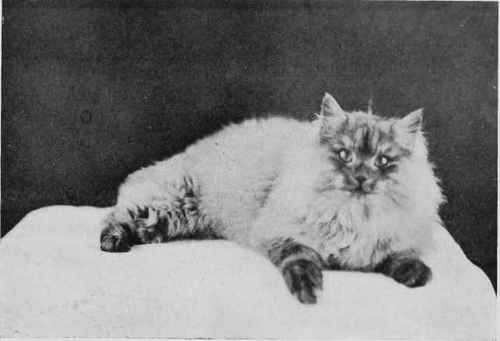
Champion Lord Sylvester.
Continue to:


My Books

