


Chapter XLV. Treatment Of The Ears In Cats
Description
This section is from the book "Everybody's Cat Book", by Dorothy Bevill Champion. See also: Your Cat: Simple New Secrets to a Longer, Stronger Life.
Chapter XLV. Treatment Of The Ears In Cats
Too little attention is paid to the ears, one of the most delicate organs of the cat, and, unless they are kept thoroughly clean, disease, and in many cases death, may be the result.
Properly speaking, the ears should be cleaned atleast once a month. Kittens' ears should first be attended to when they commence to run about; it will often be noticed that they begin to scratch them, even at that early age. The inside of the ear should be carefully wiped out with a small piece of absorbent cotton and a little pinch of dry boracic acid powder put in to dry up the soft wax, otherwise this collects the dust, and forms a hard black mass in which tiny parasites breed in millions; if neglected these cause inflammation of the ear drum and abscesses will form, sometimes affecting the brain and causing death.
These minute parasites of the ear, are greyish in colour, and can be seen with the naked eye in strong light, or with a microscope. Should these "mites" exist in the ear or even the hard black wax, the best treatment is the following:
First drop in the ear a few drops of almond oil, this should be slightly warmed; work the ear about gently from the outside so that the oil penetrates into the wax; then when it appears thoroughly softened, remove the wax with an ear cleaner or a hair pin, first winding a piece of absorbent cotton around, using the blunt end of the pin; always be very careful not to clean too deep down in the ear and treat always in a very gentle manner. If the patient becomes restless, place in a bag, tying with a string around the neck; this is far the most satisfactory method of treating a restive or frightened cat. After the ear has been thoroughly cleansed, use a good pinch of the following: One part iodoform and one part boracic acid powder and mix well. Apply by placing on a glossy card, such as a calling card, bend this up on either side to hold the powder, then tip it into the ear, which should be held firmly with the other hand, as the cat will try and shake as soon as the powder touches the ear.
The powder should be worked well down into the ear and any superfluous powder outside the ear wiped off, as iodoform is poisonous. One treatment is usually sufficient to kill these parasites, but careful examination should take place later to see that they have been entirely exterminated.
These pests not only cause gatherings inside the ear but cause abscesses which form right at the tip of the ear between the cartilage; if these do not break naturally and disperse, they should be lanced and the contents of the swelling (which is usually a blood clot) removed, then cleanse thoroughly with water and disinfectant. This should be done by a veterinary.
While the wound is healing, it should be constantly massaged or gently pulled every day to prevent the ear tip from becoming contracted, which it so often does, thus disfiguring the cat for life.
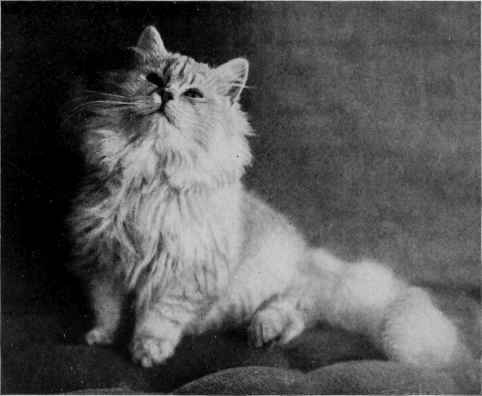
Silver Gleam (age 7 months).
The latter form of abscess is not often seen, as it is only through long neglect that it occurs.
Cold in the ears also causes serious trouble, usually resulting in an abscess at the base; these may also occur through weakness after an illness such as distemper.
Little can be done to the patient until the abscess breaks. When it is noticed that the ear is discharging, the opening of the ear should be bathed, first with a little warm water and disinfectant, using always absorbent cotton; then syringe out the inside with an ear syringe once or twice a day; clean out and dry well as before mentioned, then use the iodoform and boracic powder mixture. Should the ear seem very sore and tender, do not use so much iodoform, only enough to colour the boracic acid.
Protonuclein powder I have also found to be a great cure for these abscesses; it is very much more pleasant to use than iodoform, the later having a most objectionable odour.
Protonuclein powder can be dusted in freely, as it is non-poisonous.
The iodoform must be used for the parasites, and if the cats should taste any of it, they are apt to salivate, but a very small quantity is not poisonous, though care should always be taken to remove all that is possible from the fur around the ears.
In treating abscesses, they must by syringed and dressed every day after first discharging; later two or three times a week, until the discharge discontinues entirely. Sometimes if the cat is delicate this disease of the ear continues for weeks or even months, therefore the cat should be well fed and given a tonic.
Much ear trouble could be avoided by proper attention, never allowing them to become wet and sticky with wax; just wiping out with absorbent cotton and a pinch of boracic acid, every little while, will often prevent any serious trouble.
Continue to:


My Books

