


Chapter XX. The Siamese
Description
This section is from the book "Everybody's Cat Book", by Dorothy Bevill Champion. See also: Your Cat: Simple New Secrets to a Longer, Stronger Life.
Chapter XX. The Siamese
The Siamese cat is perhaps noted more for its very quaint and unique appearance than for its great beauty. These cats are very peculiar in colouring, to say nothing of their disposition. In the latter they are quite different from other cats, and for this reason they are liked by all those who have ever had them. They are faithful to their owners and show great attachment to each other - so much so that they have been known to die of grief when separated.
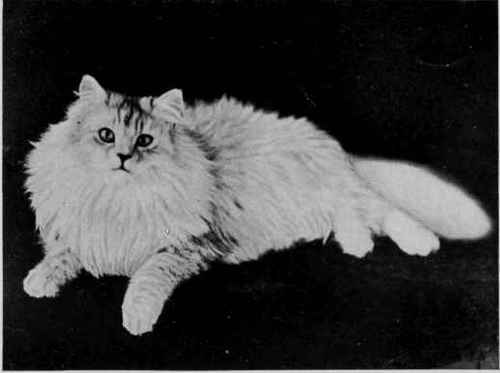
Argent Glorious.
The males are quite different from other male cats, as in many cases one is able to have them around the house, and the male may be allowed to live with the female and her youngsters, without any harm resulting to the little ones.
The cry of the Siamese cat is very mournful, being more of a wail than the ordinary cry of cats, and is very loud.
They do not, as a rule, make good show cats, as they are miserable when away from home.
The Siamese cat is often called the Royal Cat of Siam, as in its native country it is protected and under royal supervision. They are therefore difficult and expensive to obtain. In fact, at one time it was almost impossible to export a male from Siam, as they were made neuter before they left the Palace; but in process of years a few male kittens have evidently been smuggled out, as some very fine imported specimens have been exhibited in England and lately in this country.
In general appearance these cats differ from any other, more particularly in colour. This is of a cream or biscuit hue, while the extremities - namely, nose, ears, tail and paws - are of a deep seal brown, and the eyes are of deep blue. When the cat is two or three years old, or sometimes younger, it is almost certain to darken in body-colour, and become almost useless for showing, although when born they are pure white. As to the tail there is much diversity of opinion. Some say the tail should be kinked; others say they should not taper so much at the end like the ordinary short-haired cat. Personally I think the kinks in the tail have undoubtedly originated through inbreeding, which must have existed among the originators of the strain kept in the Royal Palace. If this is the case the kinked tail is only a deformity, the same as it is with other animals that are inbred, be they dogs or cats. This inbreeding is also the cause of the delicacy of the Siamese cat, and a cast in the eyes which may often be noticed.
The above is the description of the Royal Cat of Siam, but there is another variety, called the Chocolate Siamese.
Whether these are really a distinct variety, or are darker specimens of the royal cat, it is difficult to say. In shape, the Siamese is very graceful and of medium size. In type, and in almost every particular, it is the reverse of the domestic short-haired cat, especially in the head, which is longer and more angular than our present-day long-hairs and short-hairs. Though why fanciers should have bred these latter varieties to what they call perfection - namely, short and cobby, with a beautiful round face - and yet never attempted to improve the long face of the Siamese, I cannot understand, as the imported Persians and Angoras of long ago possessed a long, angular face similar to that of the Siamese; although to-day judges object to a long-faced Persian or short-haired cat, yet the Siamese is still being bred with the long, angular face.
If we alter, or, as we call it, improve some types, why should we not do the same with the Siamese? Surely what is an improvement in our eyes in one variety should be the same in the other. Why should we admire long, angular faces because the Siamese do?
Nothing is more beautiful than a Siamese cat with a round face. I have seen several of these, and yet their breeders will tell you it is incorrect. They did not say so in regard to the first long or short-haired cat they bred with round faces, but expected them to be admired, and they undoubtedly were, and always will be.
I feel sure, if breeders of this charming variety were to continue breeding from only their strongest specimens, and never inbreed for years to come, they would produce a variety of cat which would quickly become popular.
The following is the scale of points used by the Siamese Club of England:
Body colour to be as light and even as possible, cream being the most desirable, but fawn also admissible, without streaks, bars, blotches or other body markings.
Points (namely, mask, ears, legs, feet and tail) to be clearly defined, and of the shade known as seal brown.
Mask complete; namely, connected by tracings with the ears, neither separated by a pale ring as in kittens, nor blurred and indistinct, the desideratum being to preserve the "marten face," an impression greatly aided by a good mask.
Eyes bright, and decided blue.
Coat glossy and close-lying.
Shape, body rather long, legs proportionately slight.
Head rather long and pointed.
The points of Chocolate Siamese to be the same as above, except the colour of the body, which is seal brown.
Body colour ....... | 20 |
Shape ....... | 10 |
Coat ...... | 10 |
Head ....... | 10 |
Eyes ...... | 20 |
Mask ........ | 15 |
Density of Points ........ | 15 |
Total ......................... | 100 |
Continue to:


My Books

