


Chapter II. An Outline Of The Anatomy Of The Domestic Cat
Description
This section is from the book "The Cat", by Rush Shippen Huidekoper. Also available from Amazon: The Cat - A Guide To The Classification And Varieties Of Cats And A Short Treatise Upon Their Cares, Diseases, And Treatment.
Chapter II. An Outline Of The Anatomy Of The Domestic Cat
THE skeleton of the cat differs from that of man and those of the other domestic animals only in trivial details which allow such modification as is needed by the habits of the animal.
Figures 1 and 2 give the outlines of the external conformation of the cat, and the same animal in section, showing the proportionate relations of its skeleton to its exterior as a whole. To any one familiar with the skeletons of other animals it will be seen at once that the thorax or chest, as shown by the curves of the thirteen ribs in Figure 2, is very small in proportion to the body when compared with that of other animals. This means a small lung space, which leaves behind it, however, an immense area for the digestive tract and the organs of propagation. The head is rounded, and the jaws are rather short. The eyes are large, and separated by a considerable interval. The ears become narrow as they ascend, and each stands with its deep concavity directed forward and outward. The neck is a little shorter and less voluminous than the head. The front limbs are shorter than the hind limbs, and consist each of an upper arm, a forearm, and a paw with five short toes. Each hind limb has a thigh, a leg, and a foot with four toes. The proportions of the body are such that both the elbow and knee are placed close to the trunk. It will be seen that the shoulder-blade, the arm, and the forearm lie at very closed angles, as do also the thigh, leg, and foot of the hinder extremities.
This conformation indicates at once a character of action of the cat with which we are all familiar. The small lung area allows of quick, active movement, but not of prolonged work. The large space for digestive tract and propagation shows that the animal is capable of taking advantage of all the luxuries of food, with a space for storage, or is, again, able to resist the demands of a long famine. The angular joints of the legs show power and possibility of quick movement, without, however, great speed or extension of stride.
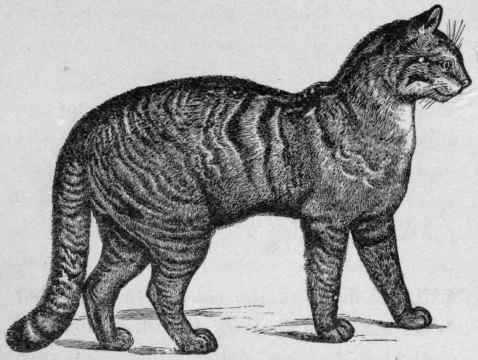
Fig. 1. - Exterior of a Cat.

Fig. 2. - Relative Proportion of Skeleton to the Exterior of the Cat.
It must be understood here that the enormous jumps which the cat is capable of taking are due to the great power and the closed angles of the joints of its legs; whereas the stride of the animal at a walk, trot, or run is very limited.
Figures 3 and 4 show the skull of the cat and its dentition. It will be seen that the cat's teeth are set at more or less of a hooklike angle, with the points turned toward the inside of the mouth, which gives it a very powerful hold of anything which it grasps. The cat has thirty teeth in all. It will be seen in Figure 4 - which represents the teeth of one side of the jaw - that there is first in front a row of incisors (three on either side - six in all), which are very small, and are practically rudimentary in this animal; then two enormous tush teeth, which enable it to grasp its prey in the shape of the mouse, bird, or a simple piece of meat, and hold it firmly; then posterior come the premolars - three in the upper jaw and two in the lower jaw of each side; and behind these the molars - one in each jaw. In the temporary or milk dentition of kittens the molars are absent, leaving but twenty-six teeth. These, it will be seen (Figure 4), have enormous strong roots set in the jaw-bone, while the points are sharp and cutting; which allows of the mangling of any solid food which may be taken, while it does not permit of grinding it, as is necessary in the herbivorous animals, or even, to a certain extent, in the omnivorous animals.
The cat, like the dog, after having once grasped its food, tears it to a certain degree, and then swallows it whole, when its powerful stomach and organs of digestion allow of the rapid disintegration of what it may have swallowed.
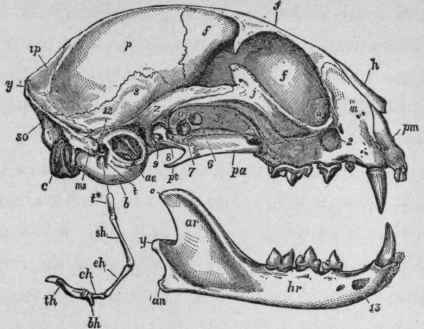
Fig. 3. - Skull of the Cat.
i, Incisors; c, Canines or tushes; pm, Premolars; m, Molars.

Fig. 4. - Permanent Dentition of the Cat.
The muzzle of the cat is soft, with long coarse hairs, ordinarily called the "whiskers" (vibrissa), which are really organs of touch. These, like the hairs on the end of a horse's muzzle, or those of most of the domestic animals, are deeply imbedded in the skin, touching at their roots sensory nerves, which indicate to the animal, when nosing over foreign objects or when feeling its way in the dark, that its head is coming in contact with foreign bodies; and they are really organs of self-protection. These are seen represented in Figure 5, which also represents the lips - the upper and lower lip the nostrils, and the point of the nose. And it will be understood in the description of the various cats in the latter part of this book that when the nose is spoken of as being black or pink, it is meant to indicate that this coloration applies to the mucous membrane surrounding the nostrils, as is seen in the figure, represented by the two dark orifices of the nostrils, surrounded by the grayish hook-lines turning in opposite directions.
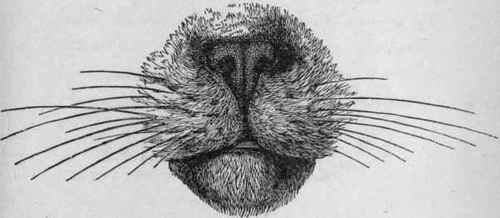
Fig. 5. - Muzzle of Cat, Showing above, Nose-point and Nostrils covered with Dense Mucous Membrane; at Sides, VibrissÆ; and below, the Lips and Chin.
The pads of the feet of the cat consist of bulbs of a fibro-elastic, fatty material, covered by an excessively thick and dense epithelial membrane, which is, however, nothing but a modification of the connective tissues and epithelial covering which form the skin of the rest of the body, but is condensed in order to meet the requirements of the extra friction which is demanded of those parts of the feet which come in contact with the ground and must bear the animal's weight. These pads in the forefeet are seven in number, as shown in Figure 6. In the hind feet there are only five. Each pad consists of a mass of fibrous tissue and fat, and a large triobed one is placed beneath the ends of those bones on which the animal rests in walking, as represented in the figure here given.
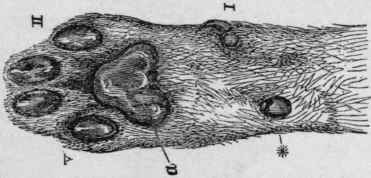
Fig. 6. - Right Forepaw of a Cat.
One essential character of the anatomy of the entire cat tribe consists in the arrangement of the claws at the end of each toe. While the nails of the fingers and toes of man and of the toes of the elephant, the hoofs on the extremity of the legs of the horse, cattle, and such animals, are fixed and practically immovable, and while these same appendages in the claws of the dog and many other animals are fixed, while slightly movable in the softer tissues which imbed them, in the feline species they are excessively movable. In the cat tribe there is in the soft tissue which covers the third phalanx, or the last joint of the toes, a pocket or socket which holds the claw. Under ordinary circumstances, and when the animal is at rest, the claw is drawn back into the socket, and held imbedded there by an elastic ligament, as will be seen in the upper illustration of Figure 7. When, however, an animal of the cat tribe wishes to grasp anything, and use its claws, it flexes the bones of its digital extremities, and tightening the tendon which is seen on the under-surface of both illustrations of

Fig. 7. - Upper Figure: Claw at Rest, Held back by Elastic Ligament. Lower Figure: Claw Drawn down by Contraction of Tendon below, Elastic Ligament Stretched, and Claw Protruding.
Figure 7, it draws the claw forward and downward, thereby stretching the elastic ligament. This can readily be verified by taking your own cat at perfect rest, and after patting it gently on the head, pass the hand down over the ends of the toes, when you will find that the claws can scarcely be felt; however, the instant the cat has been wakened and starts to play, or resists the handling it has been subjected to, the claws protrude as the paw and the foot are flexed.
It is not in place here to go into detailed anatomy of the cat. Reference has already been made to the slight development of the respiratory system. The digestive system of the cat is comparatively simple. The stomach is ample, and the intestines which follow it, while convoluted in order to be contained in a limited space, are not subject to the constrictions which are found in the horse and some of the larger domestic animals, and it is rare that we have in the cat troubles coming from obstruction of the digestive tract, unless the animal has by accident swallowed some enormous foreign body.
Continue to:


My Books

