


Mange (Sarcoptus Notocdres, Var. Cati) In Cats
Description
This section is from the book "The Cat", by Rush Shippen Huidekoper. Also available from Amazon: The Cat - A Guide To The Classification And Varieties Of Cats And A Short Treatise Upon Their Cares, Diseases, And Treatment.
Mange (Sarcoptus Notocdres, Var. Cati) In Cats
The ordinary mange, or sarcoptic mange, is due to a small parasite which burrows under the skin, where it deposits its eggs, which, upon hatching, become very irritating to the skin, as the young insects grow and tunnel out to the surface, where they breed, for the next generation again to burrow and deposit its eggs. The sarcoptic mange may appear first on the face and sides of the cheek, or upon the insides of the armpits and thighs; and it gradually extends over the softer skin of the inside of the thighs, the under surface of the belly, and even, in extreme cases, over almost the entire body. The itchiness produced by the mange causes the animal to scratch and rub itself, which further irritates the skin, producing abrasions which scab over; and as the scabs are in turn scratched off, they leave irritating, bleeding, and ugly ulcers. In severe cases the constant irritation and worry to the animal cause it to lose its appetite, and it may become excessively debilitated and emaciated. The cause and effect then become retroactive, as the mange will extend more rapidly on a debilitated animal, and the increase of the mange increases the debility.
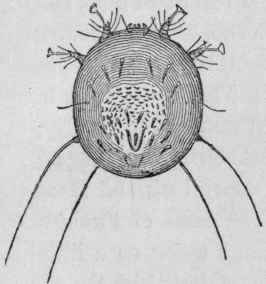
Back.
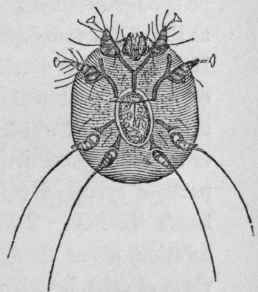
Betty.
Fig. 23. - Sarcoptus Cati (Female).
There are a great many remedies for the mange, and it is not so much the choice of the remedy to be used as the manner of its application which is efficacious. One of the simplest modes of treatment is sulphur ointment. One dram of flowers of sulphur to the ounce of pure lard should be well rubbed into the skin and all parts affected, and repeated for several days in succession. The skin should then be well sponged off with a little soap and tepid water, and allowed to remain clean for a day or two. The body should then be well brushed with a moderately stiff brush, which will remove any scabs on the skin, when the ointment is to be reapplied for several days. A mixture of one part of coal-tar, one part of oil of cade, and six or eight parts of benzine is an excellent remedy, although less cleanly. It should be applied with a moderately stiff brush daily for four days in succession, when the animal should be sponged off with tepid water and soap, and at the end of two days the application renewed. If the animal is much debilitated it can be put on a tonic treatment of one grain of quinine in thirty drops of whisky three times in the day, or upon teaspoonful doses of a mixture of equal parts of syrup of wild-cherry bark and Hux-ham's tincture.
Two-drop doses of Fowler's solution, given three times a day on a little piece of cake, bread, or anything which the cat will take from the hand, is an excellent tonic.
Continue to:


My Books

