


Tapeworm (Tania Crassicolis) In Cats
Description
This section is from the book "The Cat", by Rush Shippen Huidekoper. Also available from Amazon: The Cat - A Guide To The Classification And Varieties Of Cats And A Short Treatise Upon Their Cares, Diseases, And Treatment.
Tapeworm (Tania Crassicolis) In Cats
The whole of the feline tribe is a frequent host of the tapeworm, of which it has a variety of its own (Tænia crassicolis). The worm is from six to twenty-four inches in length. It has a large head, set on a narrow neck. The head is provided with a crown of from twenty-six to fifty-two hooks - frequently only thirty-four in number. The body is made up of a series of segments or rings, as can be seen in the illustration (Figure 27). The tapeworm inhabits the small intestine of the cat, the head remaining fastened to the mucous membrane of the intestine, while the body floats off in the soft contents. The end of the tail, or various portions of the body, break away from time to time, to be carried to the exterior to develop into fresh foci of infection. As the body breaks away from the tail, it keeps growing from the head. In its vesicular form the tapeworm is found in the livers of rats and mice, which, when they are eaten by the cat, again infect it. The tapeworm, unless existing in quantities, causes little irritation. What' symptoms do exist are those of intestinal irritation - occasional bloating or swelling up of the belly of the animal, and sometimes emaciation.
The diagnosis can only be accurately made by recognizing the segments of the worm which are carried away with the fæces, and which appear as small oblong whitish masses, sometimes single or sometimes connected together.
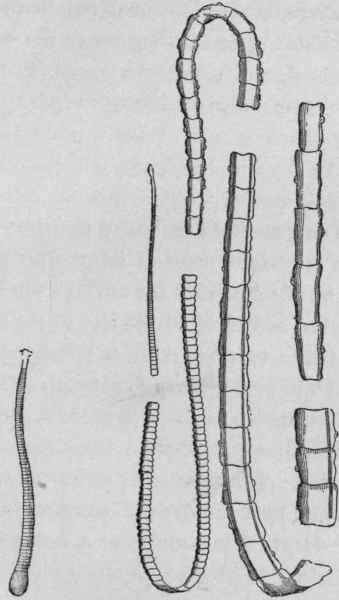
Fig. 27. - Tania Crassicolis.
The treatment consists of putting the cat upon an absolute diet for twenty-four hours; then give, according to the size of the animal, from ten to twenty grains of powdered areca and two to four grains of santonin. This can readily be given in a saucer of milk, which the animal willingly swallows, having been starved for a day. The powder is to be followed in two hours by a full dose of castor-oil, to which a few drops of turpentine or a few grains of jalap might be added.
Continue to:


My Books

